 Whatsable







TL;DR:
- Many business owners believe automation sacrifices personal connection, hindering growth, but speed and relevance drive results. Automated messaging responds instantly, builds consistency, and captures leads outside business hours, boosting sales and customer satisfaction. Strategic implementation and quality content turn automation into a powerful growth multiplier without replacing human touch.
Most business owners assume that automating customer messages means sacrificing the personal connection that builds loyalty. That assumption is costing them growth. The reality is that why messaging automation scales businesses comes down to one simple truth: customers don’t care whether a human or a system sent the message. They care whether it arrived fast, said something relevant, and solved their problem. Businesses that get this right are capturing more leads, closing more deals, and serving more customers without hiring proportionally more people. This guide breaks down exactly how.
Table of Contents
- Key takeaways
- Why messaging automation scales businesses
- The real business benefits of messaging automation
- How to implement messaging automation strategically
- Overcoming common objections to messaging automation
- Real-world use cases that show the scale advantage
- My take: automation is not a shortcut, it’s a multiplier
- How Whatsable powers scalable messaging for your business
- FAQ
Key takeaways
| Point | Details |
|---|---|
| Speed drives response rates | Automated first replies under one minute lift response rates by 88% compared to manual follow-up. |
| Scalability without headcount | Automation lets you handle far more message volume without adding staff proportionally. |
| After-hours lead capture | Automation captures 35% more leads outside business hours, converting interest that would otherwise go cold. |
| Personalization still wins | Customizing automated messages by behavior and segment preserves authenticity and improves conversion. |
| Human teams perform better | Removing repetitive messaging tasks frees your team for higher-value conversations that actually require judgment. |
Why messaging automation scales businesses
Messaging automation is the practice of sending pre-built or AI-generated messages to customers and leads based on triggers, schedules, or behavioral conditions. Instead of a rep manually typing a follow-up after every form submission, the system does it in seconds. The trigger fires, the message goes out, and the conversation starts before a human would have even opened the CRM tab.
The core channels where automation runs today include WhatsApp, SMS, Facebook Messenger, email, and AI-powered chat agents embedded on websites or in apps. Each channel operates differently, but the underlying logic is the same: something happens, a condition is met, and a message fires automatically.
Automation workflows typically involve three components. First, a trigger event such as a form fill, a purchase, an abandoned cart, or a specific time delay. Second, a set of conditions that determine which message to send to which contact. Third, the message itself, which can include text, images, links, buttons, or dynamic fields that personalize content.
The difference between manual and automated messaging isn’t just speed. It’s consistency. A human rep might follow up on 60% of leads when things are busy. An automated workflow follows up on 100% of leads, every time, in the right order.
- Trigger-based workflows fire messages the moment a user takes a defined action, with no delay
- Drip sequences send timed follow-up messages over days or weeks to nurture leads
- AI agents handle inbound conversations and qualify leads before routing to a human
- Broadcast messages reach large contact lists with personalized variables at scale
- Two-way automation captures replies and routes them based on keywords or intent
Pro Tip: Start by mapping your current manual messaging touchpoints on paper. You’ll likely find 5 to 10 moments where a trigger-based message could replace a task your team is doing inconsistently right now.
The real business benefits of messaging automation
The data on this is not subtle. Businesses using AI agents respond in under one minute, with an 88% lift in response rate compared to manual follow-up. That one metric alone explains a significant portion of why messaging automation scales businesses so effectively. Speed is the variable most teams underestimate.
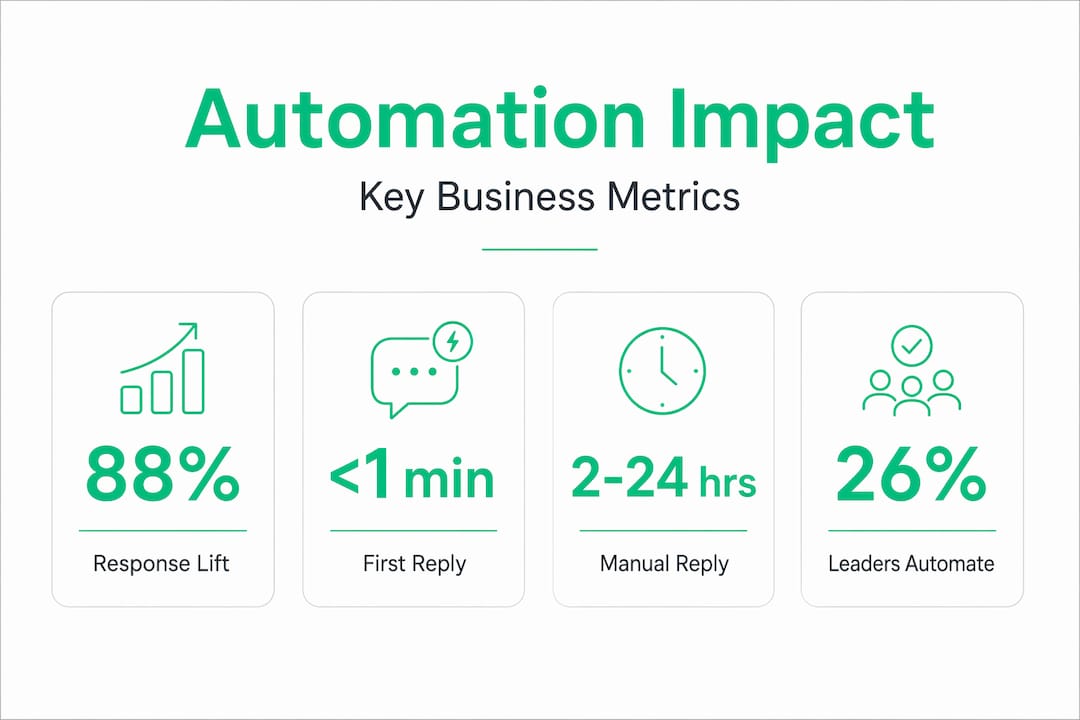
| Benefit | Manual messaging | Automated messaging |
|---|---|---|
| Average first response time | 2 to 24 hours | Under 1 minute |
| Lead follow-up rate | 60 to 80% on good days | 100%, every time |
| After-hours lead capture | Near zero | 35% more leads captured |
| Customer satisfaction impact | Variable | 15 to 70% higher CSAT reported |
| Staff required to scale volume | Grows linearly | Near flat curve |
Beyond speed, the benefits stack in ways that compound. Automation captures significantly more leads outside business hours, which is when a surprising share of purchase decisions and inquiry submissions happen. A lead who fills out your form at 10pm and hears nothing until 9am the next morning has often already contacted two competitors by then.

Consistency is another underrated advantage. Manual messaging introduces variance. Different reps write differently, follow up at different times, and forget different steps. Automation eliminates that inconsistency, so every lead gets the same quality of experience regardless of which rep is assigned or how busy the team is.
The sales impact is real too. Only 26% of sales and marketing leaders currently automate key tasks, yet those who do report up to a 10% uplift in sales performance. That gap represents a direct competitive advantage for anyone willing to implement effectively now.
How to implement messaging automation strategically
Good implementation starts before you touch any software. The work is in mapping your sales or support process and identifying the exact moments where a faster, more consistent message would change an outcome.
-
Audit your current touchpoints. Write down every moment a customer or lead receives a message from your team. Note which ones are reactive and which are proactive. Flag the ones where delays or inconsistency hurt conversion.
-
Pick your highest-impact starting point. For most businesses, that’s the initial lead response. Event-triggered workflows fired the moment a form is submitted consistently outperform batch follow-ups sent the next morning.
-
Customize your messages by segment. Don’t send the same text to a cold lead and a warm prospect who just viewed your pricing page. Use dynamic fields for names, reference the specific action they took, and keep the language natural. Interactive message formats like buttons and quick replies improve engagement and reduce friction.
-
Build and test before you scale. Start with one workflow. Send it to a test group. Measure open rates, reply rates, and conversion. Adjust tone and timing before you roll it out to your full contact list.
-
Integrate with your existing tools. Effective automation doesn’t live in a silo. Connect your messaging system to your CRM, your lead forms, and your calendar. A properly integrated setup means a booked appointment, a closed deal, or a resolved ticket automatically updates across your stack.
-
Stay compliant. Every contact in your automated sequences should have opted in to receive messages. Include a clear opt-out path in every sequence. This isn’t just legal protection. It’s also how you protect your sender reputation and deliverability long-term.
Pro Tip: Treat your first automated sequence like a product launch. Write every message, read it out loud, and ask yourself: “If I received this, would I reply?” If the answer is no, rewrite it before it goes live.
A practical marketing automation checklist can help SMBs structure this process without missing critical steps, particularly around integration and compliance.
Overcoming common objections to messaging automation
The hesitation most decision-makers have about automation falls into a few predictable categories. Understanding them is how you avoid the mistakes that give automation a bad reputation.
-
“It will feel robotic.” Only if you write robotic messages. Automation carries whatever tone you give it. Well-written automated messages feel like they came from a thoughtful human. The goal is to write once and deliver it perfectly every time, not to sound like a script.
-
“We’ll lose the personal touch.” The opposite happens when you implement correctly. Automation strengthens communication by handling the repetitive touchpoints, which frees your human team to focus entirely on the conversations that actually require empathy, negotiation, or creative problem-solving.
-
“Customers will hate it.” Customers prefer fast, accurate answers. They don’t prefer waiting 18 hours for a human reply over receiving a relevant automated response in 30 seconds. What customers dislike is irrelevant messaging. That’s a content problem, not an automation problem.
-
“It will replace my team.” Automation removes tedious busywork from sales reps and support agents, freeing them for higher-value work. Teams using messaging automation actually spend more time in meaningful customer interactions, not less.
-
“I can’t measure the ROI.” You can. Track response rates, lead-to-close conversion, cost per handled ticket, and customer satisfaction scores before and after automation. The ROI metrics for WhatsApp automation alone provide a practical framework any operations leader can apply.
Real-world use cases that show the scale advantage
The best way to understand the impact of automation is to look at specific scenarios across different business types.
A real estate agency with a small sales team of five people was manually responding to property inquiry forms. Average response time was four hours. After implementing trigger-based WhatsApp automation, first response dropped to under two minutes, and the team reported spending significantly more time on qualified calls rather than chasing cold leads.
A healthcare provider was losing 30 to 40% of appointment bookings to no-shows. They implemented automated reminder sequences, three days before, one day before, and two hours before each appointment. No-show rates dropped by more than half within 90 days.
An e-commerce brand with a product catalog of several thousand items was handling customer support manually. After building automated replies for the 15 most common questions, their support team handled twice the volume with the same headcount. The shift to messaging automation allowed them to move from broadcast thinking to building authentic connections with customers at each stage of their journey.
A B2B SaaS company used automated nurture sequences to follow up with trial users who hadn’t logged in after signup. Automated follow-up sequences re-engaged a meaningful percentage of dormant trials, converting users who would otherwise have churned silently.
Across all these examples, the pattern is consistent. Automation handles the volume and the timing. Humans handle the nuance. Together, they produce outcomes that neither could achieve alone.
My take: automation is not a shortcut, it’s a multiplier
I’ve spent years watching businesses approach messaging automation as either a magic fix or a threat to their culture. Both framings are wrong, and both lead to poor outcomes.
In my experience, the businesses that get the most out of automation are the ones that treat it as a multiplier, not a replacement. They still invest heavily in the quality of their messaging. They still train their teams to handle escalations and complex conversations. What they do differently is stop wasting human attention on tasks that a well-designed workflow can handle perfectly at scale.
The implementation mistakes I see most often are not technical. They’re strategic. Teams automate too broadly, too fast, without testing message quality. Or they automate the wrong touchpoints, focusing on low-impact sequences while leaving their lead response process entirely manual.
What I’ve learned is that the first automated workflow you build tells you more about your business than almost any other exercise. It forces you to answer: what exactly do we say to a new lead, and when? Most teams discover they’ve never had a consistent answer to that question.
The long-term value of automation isn’t just efficiency. It’s compounding loyalty. A customer who gets a relevant, timely message at every stage of their journey builds trust faster than one who experiences delays and inconsistency. That trust converts into retention, referrals, and lifetime value.
— Axel
How Whatsable powers scalable messaging for your business
If you’re ready to move from manual messaging to a system that works around the clock, Whatsable was built for exactly that.
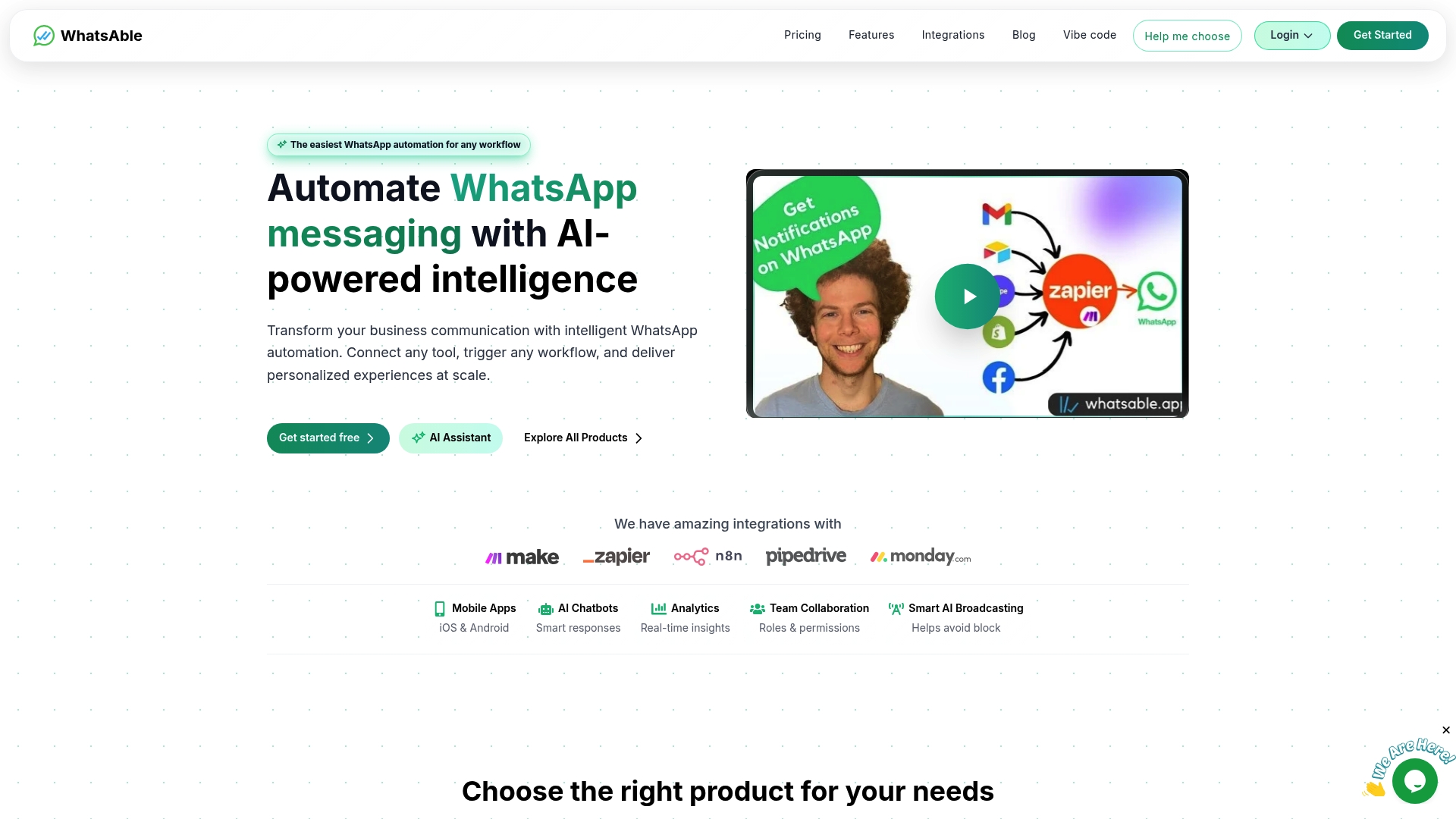
Whatsable’s platform gives businesses the ability to send unlimited branded WhatsApp messages, build automated follow-up sequences, and connect with tools like Zapier, Make, n8n, and Pipedrive without engineering resources. Whether you're a sales team looking to accelerate lead response, a marketing agency managing multiple client accounts, or an enterprise support operation handling high inbound volume, Whatsable delivers the infrastructure to scale without growing your headcount proportionally. AI-powered chatbots, detailed analytics, shared inboxes, and anti-block bulk messaging mean you get reliability and reach in one place. Explore Whatsable’s platform and see how businesses across industries are turning messaging into a measurable growth channel. For agencies and enterprises that need branded infrastructure, the white-label option offers a fully customizable solution.
FAQ
Why does messaging automation help businesses scale?
Messaging automation allows businesses to handle far greater communication volume without adding staff proportionally. Automated workflows respond instantly, follow up consistently, and capture leads around the clock, which creates scale that manual processes cannot match.
How does messaging automation affect sales performance?
Businesses that automate key sales touchpoints report up to a 10% uplift in sales, partly because speed of first response is a major driver of conversion. Automated first replies under one minute produce an 88% higher response rate compared to delayed manual follow-up.
Will automation make my messages feel impersonal?
Not if the messages are written well and triggered by relevant behavior. Automation delivers your message at exactly the right moment, with dynamic personalization fields for names and context. The tone is entirely within your control.
What is the best starting point for messaging automation?
Start with your lead response sequence. Automating the first reply to a new inquiry is the highest-impact, lowest-risk entry point for most businesses, and it produces measurable results within days of going live.
How do I measure ROI from messaging automation?
Track response rates, lead-to-close conversion rates, cost per support ticket resolved, and customer satisfaction scores before and after automation. Comparing these metrics over 60 to 90 days gives a clear picture of financial and operational return.
 Elias Navarro