 Whatsable







TL;DR:
- Cross-border messaging automation uses software and AI to send personalized messages to international customers efficiently. It manages localization, compliance, and carrier relationships for seamless global communication and revenue growth. The best solutions incorporate direct carrier connections, AI-driven personalization, and unified management of multiple channels.
Cross-border messaging automation is defined as the use of software and AI to send personalized, timely messages to customers across international markets without manual input. The industry term for this practice is “automated international messaging,” and it sits at the intersection of workflow automation, localization, and compliance management. SMS messages carry a 98% open rate and are typically read within 3 minutes. That single fact explains why businesses operating across borders treat automated messaging as a revenue function, not just a communication tool. For decision-makers evaluating cross-border communication tools, understanding what is cross-border messaging automation means understanding how to reach customers in Tokyo, São Paulo, and Berlin with the same operational efficiency you apply domestically.

What is cross-border messaging automation?
Cross-border messaging automation is the practice of triggering personalized messages to international audiences based on user behavior, schedules, or system events, without a human sending each message manually. The automation layer handles channel selection, language localization, sender ID formatting, and compliance checks simultaneously. Modern messaging automation uses AI to adapt content and channel based on user preferences and real-time engagement signals. That means the system does not just fire a fixed template. It selects the right message variant, in the right language, through the right channel, at the moment a customer is most likely to respond.
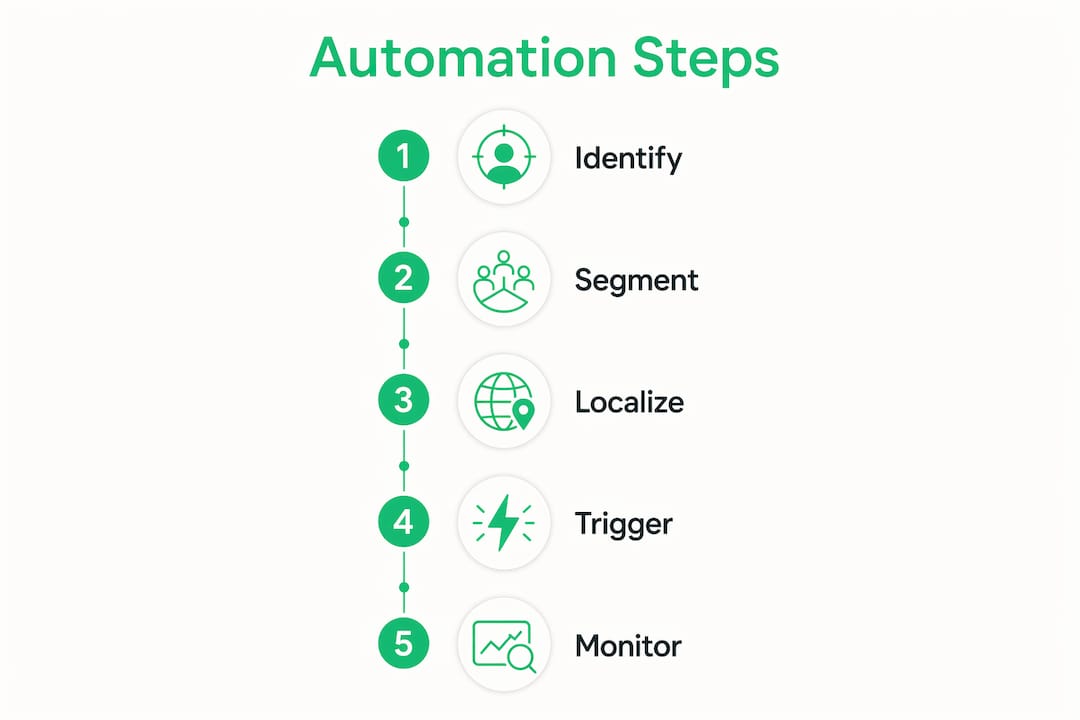
The distinction between basic messaging automation and true cross-border capability matters significantly. A domestic SMS tool sends messages through a single carrier with one regulatory framework. A cross-border system manages per-country carrier relationships, regional opt-in rules, and localized sender IDs across dozens of markets at once. Decision-makers who conflate the two often discover the gap when messages fail silently in markets they thought they were reaching.
How does cross-border messaging automation work?
The operational engine behind international messaging automation runs on four interconnected layers.
-
Trigger-based workflows. Every automated message starts with a trigger: a purchase, a form submission, a scheduled date, or a behavioral signal like cart abandonment. The workflow engine evaluates the trigger, identifies the customer’s country and preferred channel, and routes the message accordingly.
-
Channel and carrier routing. The system selects the appropriate channel, whether WhatsApp, SMS, WeChat, or another platform, based on regional usage patterns. True cross-border messaging requires direct carrier relationships per country, along with country-specific sender ID handling. Relying on aggregators alone risks high message failure rates and poor deliverability.
-
AI-driven personalization. The AI layer evaluates past engagement, language preference, and message history to select the best content variant. This goes beyond rule-based logic. The system learns which message types generate responses in each market and adjusts future sends accordingly.
-
Localization and compliance checks. Before a message sends, the system verifies the sender ID format for that country, confirms the recipient has opted in under local regulations, and applies any required translation or cultural adaptation. This layer runs automatically, in milliseconds, for every outbound message.
-
Human escalation with context. Automated AI agents handle 70–80% of routine cross-border inquiries fully, without human involvement. The remaining 20–30% escalate to human agents, with the full conversation context preserved so the handoff feels continuous to the customer.
Pro Tip: Build your escalation triggers around intent signals, not just message count. A customer asking about a refund policy in their third message needs a human faster than one asking about delivery timelines in their tenth.
What are the key benefits of implementing cross-border messaging automation?
The business case for automated international messaging rests on four measurable outcomes.
-
Revenue generation. Automated messages generate 18% of total revenue from only 9% of total sent messages. That ratio reflects the power of reaching customers at the exact moment they are ready to act, such as after cart abandonment or during a post-purchase follow-up sequence.
-
Engagement rates that outperform every other channel. SMS open rates at 98% are not a marketing claim. They reflect the fact that most people read every text they receive. For cross-border teams, this means a well-timed automated message in a customer’s local language outperforms a carefully crafted email campaign by a wide margin.
-
Operational efficiency at scale. A human support team cannot respond to inquiries from 12 time zones simultaneously. Automation reduces response times from hours to seconds. Messaging automation multiplies human effort by handling routine tasks automatically, freeing staff for complex interactions that actually require judgment.
-
Compliance and risk reduction. Automated opt-in capture, sender ID management, and opt-out processing happen without manual oversight. This removes the human error risk from compliance workflows, which matters significantly when operating across markets with different regulatory frameworks.
-
Global reach with local relevance. A business in the United States can send a message to a customer in Germany that reads as if it was written by a local team. Language detection, translation, and cultural adaptation happen inside the automation layer, not through a separate localization project.
What are the technical and compliance challenges in cross-border messaging?
Cross-border messaging introduces complexity that domestic automation tools are not built to handle. Decision-makers who underestimate these challenges face deliverability failures, regulatory penalties, and damaged customer trust.
-
Regulatory compliance across jurisdictions. Automated marketing messages must comply with TCPA and equivalent regulations in every target market. Each country has its own opt-in requirements, message content rules, and opt-out handling standards. A single compliance framework does not transfer across borders.
-
Carrier relationships and deliverability. Delivery success hinges on direct carrier relationships per country. Messages routed through aggregators may appear sent in your dashboard while being silently blocked at the carrier level. Businesses that rely solely on aggregator routing often discover this problem through customer complaints, not system alerts.
-
Sender ID fragmentation. Every country has different rules for sender ID formats. Some markets require numeric short codes. Others allow alphanumeric sender names. Some block international sender IDs entirely. Managing these variations manually across dozens of markets is not practical.
-
Channel fragmentation. Using multiple messaging platforms without a unified inbox reduces team efficiency and creates gaps in customer context. A customer who contacts you via WhatsApp in one country and SMS in another should not feel like they are starting a new conversation each time.
-
AI-human handoff quality. The moment a conversation escalates from automation to a human agent is the highest-risk point in any cross-border messaging workflow. If the agent receives the conversation without full context, the customer repeats themselves. That friction destroys the trust the automation built.
Pro Tip: Audit your deliverability by market, not just by total send volume. A 95% overall delivery rate can mask a 40% failure rate in a specific country where your carrier routing is weak.
How can businesses successfully implement cross-border messaging automation?
Successful implementation follows a clear sequence. Skipping steps in this process is the most common reason cross-border messaging programs underperform.
-
Select a platform with per-country infrastructure. The platform must have direct carrier connections in every market you target, not just global aggregator access. Authentic cross-border platforms invest in localized carrier connections rather than routing all traffic through a single international gateway.
-
Build AI workflows that handle the routine majority. Design your automation to resolve 70–80% of inquiries without human involvement. Hybrid AI-human models that escalate with full context maintain customer trust and improve conversion rates. The AI handles volume. The human handles nuance.
-
Integrate your CRM and analytics layer. Personalization without data is guesswork. Connect your customer relationship management system to the messaging platform so every automated message reflects actual purchase history, language preference, and engagement behavior.
-
Capture opt-ins at the point of contact. Every market requires explicit consent before you send automated marketing messages. Build opt-in capture into your onboarding flows, checkout processes, and landing pages. Store consent records with timestamps and source data for audit purposes.
-
Consolidate channels into a unified inbox. A unified inbox with auto-translation lets your team manage WhatsApp, SMS, and other channels from a single interface. This eliminates the context gaps that occur when conversations fragment across platforms.
-
Monitor and iterate by market. Review template performance, delivery rates, and response times per country on a monthly basis. Markets behave differently. A message sequence that drives strong engagement in Brazil may need significant adjustment for Japan.
Key Takeaways
Cross-border messaging automation delivers measurable revenue and efficiency gains only when it combines direct carrier infrastructure, AI-driven personalization, and per-country compliance management.
| Point | Details |
|---|---|
| Define the scope correctly | Cross-border automation requires per-country carrier relationships, not just global aggregator access. |
| AI handles the volume | Automated agents resolve 70–80% of routine inquiries, freeing human agents for complex cases. |
| Compliance is non-negotiable | Every target market has its own opt-in, sender ID, and opt-out rules that must be managed automatically. |
| Revenue impact is real | Automated messages generate 18% of total revenue from only 9% of total sends. |
| Unified inbox prevents fragmentation | Consolidating channels with auto-translation protects customer context and team efficiency. |
The case for treating automation as infrastructure, not a feature
I have watched businesses treat messaging automation as a marketing add-on for years. The ones that get it right treat it as core infrastructure, the same way they treat their CRM or their payment processor. That shift in thinking changes every decision that follows.
The hybrid model is not a compromise. It is the correct architecture. Automation without human escalation fails customers at the moments that matter most. Human-only support without automation fails businesses at scale. The 70–80% automation rate is not a ceiling to push through. It is the target that lets your human team operate at their highest value.
Compliance is where I see the most expensive mistakes. Decision-makers assume that a platform with “global reach” handles local regulations automatically. It often does not. Direct carrier relationships and per-country compliance logic are infrastructure investments that reputable platforms make and others skip. Ask your vendor specifically how they handle sender ID in Germany, opt-out processing in Brazil, and carrier routing in Southeast Asia. The answers will tell you everything about whether their “global” coverage is real.
The businesses that will win in cross-border messaging over the next three years are the ones building adaptive, AI-driven workflows now, not the ones waiting for the technology to mature. It has already matured. The gap is in implementation.
— Axel
Whatsable’s approach to international messaging automation
Businesses that need to move from manual outreach to automated international messaging without rebuilding their entire tech stack have a direct path forward with Whatsable.
Whatsable connects directly to tools like Zapier, Make, n8n, and Pipedrive, so your existing workflows trigger WhatsApp messages automatically without custom development. The platform includes AI-powered chatbots, bulk messaging with anti-block measures, and human handoff capability that preserves full conversation context. For teams managing cross-border customer engagement at scale, Whatsable handles the compliance and delivery infrastructure so your team focuses on the conversations that require human judgment. Review the available pricing plans to find the tier that matches your message volume and market coverage requirements.
FAQ
What is cross-border messaging automation?
Cross-border messaging automation is the use of software and AI to send personalized messages to international customers automatically, based on triggers like purchases or behaviors. It handles localization, compliance, and channel routing without manual input.
How does messaging automation handle different languages?
Automated international messaging platforms use language detection and built-in translation to send messages in a customer’s preferred language. Some platforms also support human review of translated content before sending.
What regulations apply to automated cross-border messages?
Automated messages must comply with TCPA in the United States and equivalent laws in each target country, requiring explicit opt-in, clear sender identification, and a working opt-out mechanism.
Why do cross-border messages sometimes fail to deliver?
Silent delivery failures occur when a platform routes messages through aggregators instead of direct carrier connections. Delivery success requires direct carrier relationships per country and correct sender ID formatting for each market.
What percentage of customer inquiries can automation handle?
Automated AI agents fully resolve 70–80% of routine cross-border customer inquiries. The remaining cases escalate to human agents with full conversation context preserved.

 Mira Okonkwo
 Elias Navarro