 Whatsable






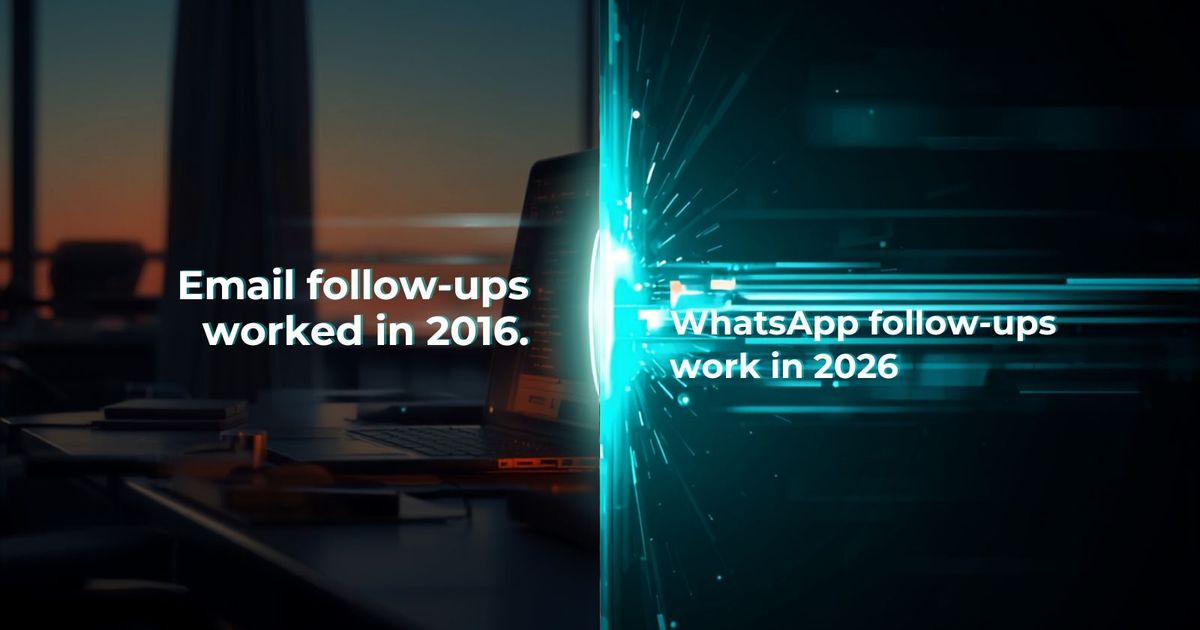
Email follow-ups were fine in 2016.
Back then, your follow-up email got opened. Inboxes were quieter. The promotions tab barely existed. People checked email a few times a day and actually read what was in it. "I'll email you" meant something - it meant they'd see it. If a deal went quiet, a well-timed follow-up email was a perfectly good way to bring it back.
So if your sales process still leans on email follow-ups, that's not a stupid choice. It's a choice that used to be right. The problem is that the world it was right for is gone, and most teams never noticed the ground shift underneath them.
Here's what changed - and why "send a better follow-up email" is no longer the fix.
What 2016 looked like
In 2016, email was still the default channel for business communication, and it mostly worked because it wasn't yet drowning. The average inbox got a fraction of the volume it gets today. Filters were simpler. The follow-up you sent on Tuesday was likely seen by Wednesday.
The whole follow-up playbook every sales team still runs - the day-3 nudge, the day-7 check-in, the break-up email - was built in and for that world. A world where the channel itself wasn't the bottleneck. Where if your message was good, it got read.
That assumption is the part that quietly expired.
What changed
Then a decade happened.
The inbox became a graveyard. Between newsletters, notifications, automated sequences, and the promotions tab, the average professional now gets buried under email volume that would have been unthinkable in 2016. Email open rates today hover around 20% (industry figures) - which means four out of five of your follow-ups are never even opened. Not rejected. Not read and ignored. Never seen.
Your perfectly-written follow-up lands under twelve newer emails, gets skimmed past in a triage scroll, and disappears. You did everything right and the channel ate it.
And here's the part most teams miss: while email was filling up, your customers quietly left. They moved their real conversations to messaging. They reply to WhatsApp in minutes, not days - WhatsApp open rates sit around 98% (industry data), because a WhatsApp notification still pulls attention the way email did in 2016. You're following up diligently on the channel they stopped checking, and wondering why good deals go quiet for no reason anyone can name.
That's the reason. The lead wasn't cold. Your channel got old.
Why a better email won't fix it
When follow-ups stop landing, the instinct is to optimise the email. Sharper subject line. Better opening line. A/B test the send time. Add a fourth touch.
But you can't optimise your way out of a channel problem. If 80% of your emails are never opened, a better subject line just means a slightly larger slice of a shrinking pie sees it. You're polishing the message while the medium is the thing failing.
The 2016 playbook isn't wrong because the tactics are wrong - the day-3 nudge, the value-add touch, the soft break-up are all still good moves. It's wrong because it runs them on a channel that no longer delivers them. Same playbook, dead channel.
The fix isn't a better follow-up. It's the same follow-up discipline, moved to where it actually gets seen.
The 2026 move: follow up where they reply, automatically
Here's what the modern version looks like. You keep the discipline that always worked - timely, relevant, persistent follow-up - and you change two things: the channel, and who's responsible for remembering.
Wire your CRM to WhatsApp, and the follow-up stops depending on a rep noticing and typing:
→ Out - a deal moves to a stage that matters (quote sent, new lead, proposal) → a WhatsApp fires itself within seconds, personalised from the record. Not "when the rep remembers" - the moment the event happens.
→ In - the customer replies on WhatsApp → it syncs straight back to the deal as a logged activity, resets the follow-up clock, and pings the owner. The CRM stays true to what's actually happening.
→ Caught - a deal goes quiet for three days without being marked won or lost → a soft, low-pressure nudge sends on its own before the deal dies of silence.
Same cadence you'd have run by email in 2016. Delivered on the channel that's actually read in 2026, and triggered by the event instead of someone's memory.
One mechanic worth knowing: WhatsApp business messages start with pre-approved templates, and the moment the customer replies, a 24-hour window opens for free-form conversation. So a good automated follow-up opens with a template designed to earn a reply - then hands a live, warm thread to a human. Automation does the remembering. People do the selling.
"But email still works for us"
Sometimes it does - and email isn't going anywhere for contracts, long-form updates, and audiences who genuinely live in their inbox. This isn't a call to delete email.
It's a call to be honest about one specific job: the follow-up that decides whether a deal moves or dies. For that job - the time-sensitive nudge that needs to be seen today - email in 2026 is the wrong tool, and the open-rate gap is too big to argue with. Keep email where it earns its place. Move the deciding follow-up to where the customer actually is.
How to set it up (no code)
You don't need a developer - and in 2016 you would have, which is exactly why email was the pragmatic choice then and isn't now.
- Connect your WhatsApp Business number to Whatsable via the official Meta verification flow - about five minutes, once.
- Connect your CRM - Pipedrive, HubSpot, monday.com, Zoho, Salesforce - directly or through Make, n8n, or Zapier.
- Write your follow-up templates once, with
{{variables}}for the personalised parts, and get them approved. - Wire the triggers - stage change → out, inbound reply → in, 3-day silence → caught.
The bar that used to require an engineering project is now an afternoon. That's the real reason 2016's trade-off no longer holds.
Why it's safe to run
Some tools automate WhatsApp by piggybacking on the regular app through unofficial access - and put your number at risk of a ban. Whatsable runs on the official WhatsApp Cloud API and is a verified Meta Tech Provider. Your follow-ups run on the sanctioned rails, not a grey-market workaround that can vanish overnight.
Where Whatsable fits
Whatsable is an official Meta Tech Provider, verified by Meta to provide access to the WhatsApp Cloud API. Whatsable is the layer that moves your follow-up off the graveyard inbox and onto the channel customers actually read - CRM triggers, templated sends, inbound sync, drip sequences, and AI bots. It's how SMBs across Europe, Latin America, and the Middle East run a 2026 follow-up process instead of a 2016 one.
The tactics from 2016 were never the problem. The channel was. Move it.
Free tier - connect your number and run your next follow-up where it'll actually be seen. No credit card.
whatsable.app
 Mira Okonkwo
 Elias Navarro