 Whatsable







TL;DR:
- WhatsApp Business is the leading customer engagement channel for Middle Eastern companies, with many prioritizing it for digital investments.
- Effective use cases include assisted selling, shipment tracking, dialect segmentation, appointment booking, and compliance-aware messaging, all tailored to the region’s regulatory and cultural context.
WhatsApp Business is the dominant customer engagement channel for Middle Eastern companies, with 55% of large UAE organizations naming it their top digital investment priority over the next five years. That figure alone signals a structural shift in how businesses across the GCC communicate, sell, and retain customers. The middle east WhatsApp business use cases covered in this article go well beyond basic customer service. They span assisted selling, logistics automation, dialect-targeted broadcasts, and compliance-aware messaging, each shaped by the region’s distinct regulatory environment, bilingual customer base, and mobile-first commerce habits.
1. Assisted selling from product discovery to checkout
In the UAE and Saudi Arabia, businesses use WhatsApp as a full commerce channel, not just a support inbox. Customers browse a product catalog shared via WhatsApp, ask questions in real time, and complete a purchase without leaving the chat. This mirrors the assisted selling model common in physical retail, but it scales digitally.

The practical setup involves a WhatsApp Business API account connected to a product catalog, an automated greeting that routes customers to relevant categories, and a human agent available for high-intent queries. Retailers in Dubai and Riyadh report that this model reduces cart abandonment because customers get answers before they hesitate. The local payment and regulatory environment shapes how checkout is handled, with many businesses directing customers to a payment link inside the chat rather than a full eCommerce storefront.
Pro Tip: Set up a quick-reply menu with your top five product categories as the first automated message. Customers who self-select a category convert at a higher rate than those who receive a generic greeting.
2. Automated order and shipment tracking notifications
Logistics companies across KSA and UAE integrate WhatsApp Business API for real-time shipment updates and predictive delay alerts, which directly reduces inbound customer inquiry calls. This is one of the highest-ROI use cases because it replaces a reactive, labor-intensive process with a proactive automated one.
The workflow connects a logistics or ERP system to WhatsApp via API. When a shipment status changes, a pre-approved message template fires automatically with the order number, current status, and estimated delivery window. Customers in Saudi Arabia and the UAE expect fast, accurate delivery information, and a WhatsApp notification lands with far higher visibility than an email. Businesses using automated text replies in this context report measurable drops in support ticket volume within the first month of deployment.
3. Dialect-specific segmented broadcast campaigns
Segmenting WhatsApp broadcasts by local dialect within the GCC can lift click rates 15 to 30% and generate $1,500 to $9,000 in revenue per send within 48 hours for active e-commerce lists. That range reflects the difference between a generic Arabic message and one written in Khaleeji, Levantine, or Egyptian dialect for the right audience segment. The lift is real and measurable.
The execution requires audience segmentation by country or origin, separate approved message templates per dialect variant, and a broadcast schedule timed to peak engagement windows. In the UAE, Friday evenings and post-Iftar windows during Ramadan consistently outperform standard send times. This is a Middle East WhatsApp marketing example that most businesses overlook because it requires more template preparation upfront, but the conversion improvement justifies the investment.
4. Appointment booking and reservation confirmations
Hospitality, healthcare, and government service providers across the GCC use WhatsApp to handle appointment booking, confirmation, and reminders. The channel suits this use case because customers already use it for personal scheduling and respond to messages faster than email or SMS.
A typical flow starts with a customer sending a keyword or clicking a WhatsApp link from a website. An automated bot presents available time slots, confirms the selection, and sends a reminder 24 hours before the appointment. For complex bookings, such as multi-service hotel reservations or medical consultations, the bot hands off to a human agent with full conversation context preserved. This intent-based handoff model, which avoids fully automated flows, is the standard for high-quality Gulf deployments because it reduces repetition and improves first-contact resolution.
5. Customer service automation with escalation logic
Routine customer service queries, including balance inquiries, order status checks, return requests, and FAQ responses, are well-suited to WhatsApp automation. Finance and telecom companies in Saudi Arabia and the UAE handle thousands of these interactions daily through WhatsApp bots connected to their core systems.
The critical design decision is escalation logic. Automate the common intents and escalate complex cases with full conversation context passed to the human agent. Customers who have to repeat themselves after a bot transfer report significantly lower satisfaction scores. The intent-based handoff approach solves this by tagging conversation intent before transfer, so the agent sees exactly what the customer was trying to accomplish.
6. Bilingual template campaigns in Arabic and English
The GCC customer base is genuinely bilingual. A retail brand in Dubai serves Emirati nationals, South Asian expats, and Western residents in the same city. Building separate Arabic and English message templates is not optional for serious WhatsApp business strategies in the Middle East. It is the baseline for effective communication.
GCC e-commerce best practice includes creating bilingual reply templates, mapping automation triggers by language preference, and maintaining manual handoffs for urgent requests in either language. The operational implication is that your template library doubles in size, and your approval workflow must account for both language versions. Meta’s template review process typically takes minutes to hours but can extend to 24 hours during high-volume periods, so bilingual campaigns require advance planning to avoid launch delays.
Pro Tip: Submit Arabic and English template versions simultaneously during low-volume periods, typically Tuesday through Thursday mornings, to minimize approval wait times and keep campaign timelines on track.
7. PDPL-compliant messaging for Saudi Arabia operations
Saudi Arabia’s Personal Data Protection Law (PDPL), enforced by the SDAIA, mandates explicit, logged customer consent with timestamps and documented purpose for every WhatsApp Business API interaction. Non-compliance carries heavy fines and potential suspension. This is not a legal footnote. It is a core design requirement for any Saudi deployment.
Compliance in practice means building consent collection into the first customer interaction, storing consent metadata with timestamps, providing clear opt-out options in every message, and maintaining audit logs that include message records, AI decisions, and escalation events. The audit-ready messaging standard under PDPL shifts WhatsApp from a marketing channel to a defensible communication platform. Businesses that treat compliance as an afterthought face retroactive remediation costs that far exceed the cost of building it correctly from the start.
8. Loyalty program updates and personalized offers
Retail and e-commerce brands across the Gulf use WhatsApp to deliver loyalty point balances, tier upgrade notifications, and personalized discount offers. This use case works because WhatsApp delivers messages into a space customers check constantly, unlike loyalty app push notifications that are frequently disabled.
The personalization layer connects a CRM or loyalty platform to WhatsApp via API. When a customer reaches a new tier or earns enough points for a reward, a triggered message fires with their name, current balance, and a relevant offer. Brands in Saudi Arabia have used this approach to increase repeat purchase rates by keeping loyalty status visible and rewards immediately redeemable through a chat-based checkout flow.
9. Public services and citizen notifications
Government entities and public service providers in the UAE and Saudi Arabia use WhatsApp for permit renewal reminders, appointment confirmations, and service status updates. The Abu Dhabi government and several Saudi ministries have deployed WhatsApp channels to reduce call center load and improve citizen satisfaction scores.
The business communication model here is one-way notification combined with a reply option for status queries. Citizens receive a permit expiry reminder with a direct link to renew online. If they reply with a query, an automated bot handles common questions and escalates to a human agent for complex cases. This mirrors the private sector model but operates at government scale, where message volume and compliance requirements are even more demanding.
10. Cart abandonment recovery for e-commerce
Cart abandonment recovery is one of the most direct revenue use cases for WhatsApp in Middle East e-commerce. When a customer adds items to a cart but does not complete checkout, a triggered WhatsApp message sent within one to two hours recovers a measurable percentage of those sales.
The message includes the specific items left in the cart, a direct checkout link, and optionally a limited-time offer. WhatsApp’s double the open rates of email make it far more effective for time-sensitive recovery messages than traditional email flows. The key constraint is that the customer must have opted in to WhatsApp marketing communications, which reinforces why consent management is a business performance issue, not just a compliance one.
Key takeaways
WhatsApp Business delivers the highest ROI in the Middle East when use cases are built around intent-based automation, dialect segmentation, and PDPL-compliant consent management from day one.
| Point | Details |
|---|---|
| Assisted selling drives conversion | WhatsApp bridges product discovery and checkout in a single chat, reducing abandonment for UAE and Saudi retailers. |
| Dialect segmentation lifts results | Segmenting broadcasts by GCC dialect increases click rates 15 to 30% compared to generic Arabic messages. |
| Compliance is a design requirement | Saudi PDPL mandates logged consent, opt-out options, and audit trails for every WhatsApp Business API deployment. |
| Intent-based handoff is the standard | Automating routine queries and escalating complex cases with full context is the proven model for Gulf deployments. |
| Bilingual templates are non-negotiable | Arabic and English template pairs are the baseline for reaching the GCC’s genuinely bilingual customer base. |
Why most WhatsApp deployments in the Middle East underperform
The businesses I see getting the most from WhatsApp in the GCC are not the ones with the most sophisticated bots. They are the ones that spent time mapping their customer journey before writing a single template. The common failure mode is launching a WhatsApp channel with a generic greeting and a phone number, then wondering why engagement drops after the first week.
What actually works is treating WhatsApp as a continuous conversational interface rather than a broadcast tool. Messaging is evolving into a unified channel that spans marketing, support, and authentication in a single thread. Businesses that design for that continuity, where a customer can receive a promotional offer, ask a product question, complete a purchase, and track delivery all within one WhatsApp conversation, are the ones building genuine loyalty.
The regulatory dimension is also underestimated. I have seen Saudi deployments get suspended mid-campaign because consent records were incomplete. Building PDPL compliance into your automation workflow from the start is not a burden. It is what separates a scalable WhatsApp program from one that creates legal exposure as it grows.
My honest recommendation: start with two or three use cases where you have clean data and clear customer intent, get those working well, then expand. WhatsApp is not a channel you can half-build and expect results from.
— Axel
How Whatsable helps you deploy these use cases faster
Implementing the use cases in this article requires a platform that handles API connectivity, template governance, compliance logging, and automation workflows without requiring a large technical team to manage it.
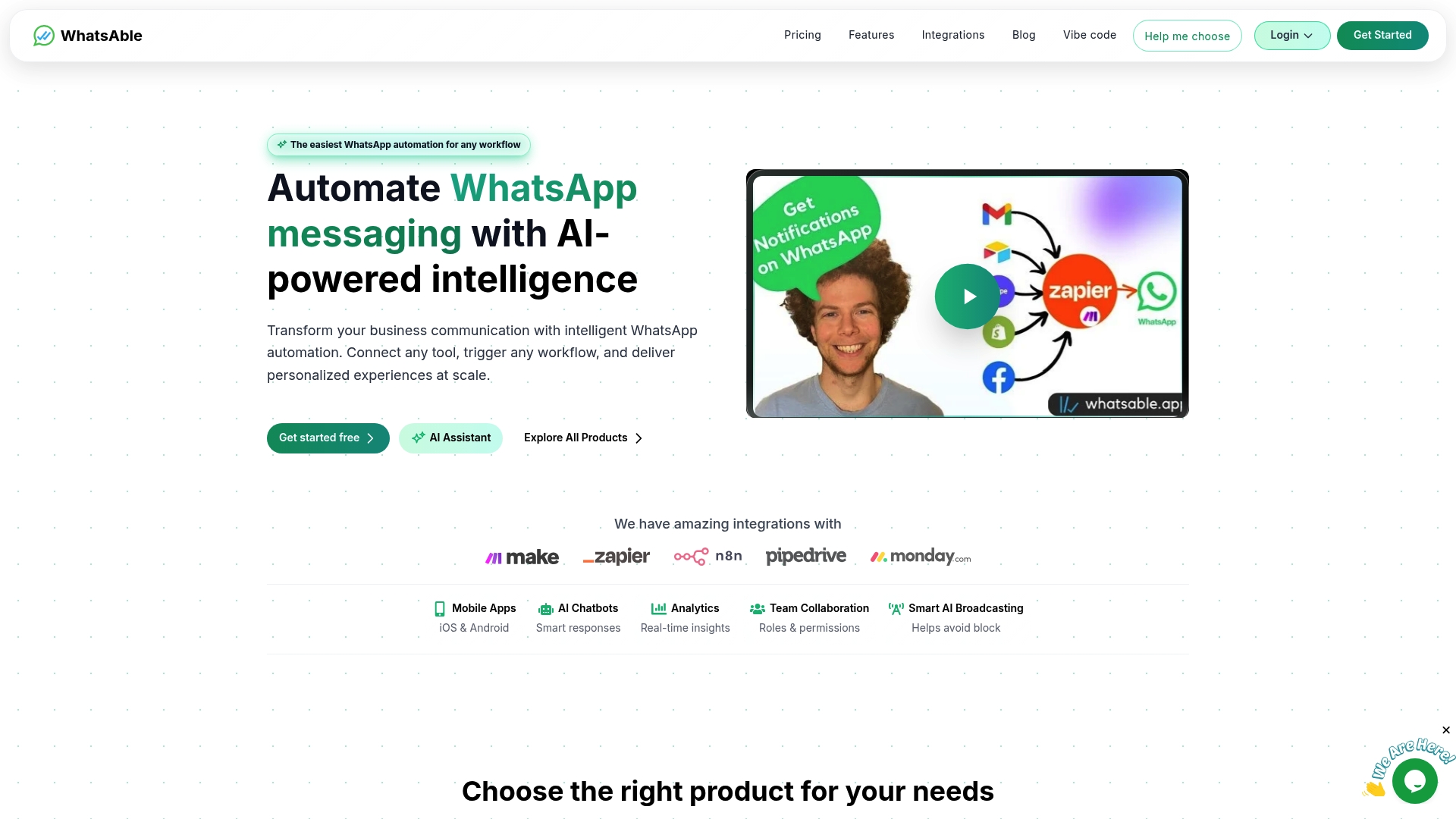
Whatsable is built specifically for this. Whatsable lets you send unlimited branded WhatsApp messages, automate follow-up sequences, and connect to Zapier, Make, n8n, and Pipedrive without custom development. The Whatsable Bot handles internal team notifications and alerts with quick setup. Both products include anti-block bulk messaging, detailed analytics, and onboarding support for Middle Eastern businesses. If you are ready to move from planning to execution, explore Whatsable and see which solution fits your current use case.
FAQ
What are the most effective WhatsApp Business use cases in the Middle East?
Assisted selling, automated shipment tracking, dialect-segmented broadcasts, and appointment booking are the highest-impact use cases for GCC businesses. Each use case works best when connected to a CRM or ERP system via the WhatsApp Business API.
Why does WhatsApp suit Middle East e-commerce specifically?
WhatsApp delivers double the open rates of email and triple the ROAS of SMS in the UAE, making it the preferred channel for high-intent customer interactions. The platform also supports Arabic natively and integrates with local payment link workflows.
Is WhatsApp Business API legal to use in Saudi Arabia?
Yes, but it requires full PDPL compliance, including explicit logged consent, opt-out mechanisms, and audit-ready message records enforced by the SDAIA. Non-compliance can result in fines and service suspension.
How long does WhatsApp template approval take?
Meta’s review process typically takes minutes to hours but can extend to 24 hours during high-volume periods or for templates with nuanced content. Submit templates well in advance of campaign launch dates.
What is the best automation model for WhatsApp in the Gulf?
The proven model is intent-based automation for routine queries combined with manual escalation for complex cases, with full conversation context passed to the human agent. This approach reduces customer repetition and improves first-contact resolution rates.
 Elias Navarro