 Whatsable







TL;DR:
- Messaging APIs connect applications to channels like SMS and WhatsApp, enabling automated message delivery and management. They use RESTful protocols with webhooks for real-time interaction, improving efficiency, security, and multi-channel integration. They allow businesses to enhance engagement, reduce support time, and streamline communication workflows effectively.
A messaging API is a programmatic interface that connects your application to messaging channels like SMS, WhatsApp, and RCS, enabling automated message delivery without manual intervention. The role of API in messaging automation goes far beyond simple message sending. APIs abstract the entire telecom infrastructure layer, so developers interact with a clean HTTP endpoint instead of carrier-specific protocols. Modern messaging APIs use REST principles with JSON payloads over HTTPS, making integration predictable and secure. Webhooks, OAuth, and RESTful standards are the three technical pillars that make this automation reliable at scale.
How does a messaging API enable automated message sending?
A messaging API works by exposing HTTP endpoints that your back-end application calls to send, receive, or track messages. The workflow is straightforward: your server sends a POST request with the recipient, message body, and authentication credentials. The API provider routes the message through its carrier network and returns a delivery status in the response.
Authentication is the first gate every developer must pass. Most providers use API keys for simple integrations and OAuth 2.0 for more complex, multi-tenant systems. API keys must never appear in client-side code or version control. Keeping them server-side is not optional; it is the minimum standard for production systems.
Real-time reply handling works through asynchronous webhooks. Instead of polling an endpoint every few seconds to check for new replies, your server registers a webhook URL. The API provider sends an HTTP POST to that URL the moment a user replies or a delivery event fires. Asynchronous event delivery via webhooks eliminates resource-heavy polling and makes your system far more responsive.
Common automation use cases built on this pattern include:
- Transactional notifications — order confirmations, shipping updates, and appointment reminders triggered by database events.
- Two-way chatbots — automated reply trees that parse inbound messages and respond based on keyword or intent matching.
- Drip campaigns — scheduled message sequences sent at defined intervals after a user action.
- Opt-in and opt-out management — automatic list updates when users reply STOP or START.
Pro Tip: Test your webhook handler with a tool like ngrok during local development. It exposes your localhost to the public internet so the API provider can reach your endpoint before you deploy.
What are the main benefits of using APIs in messaging automation?
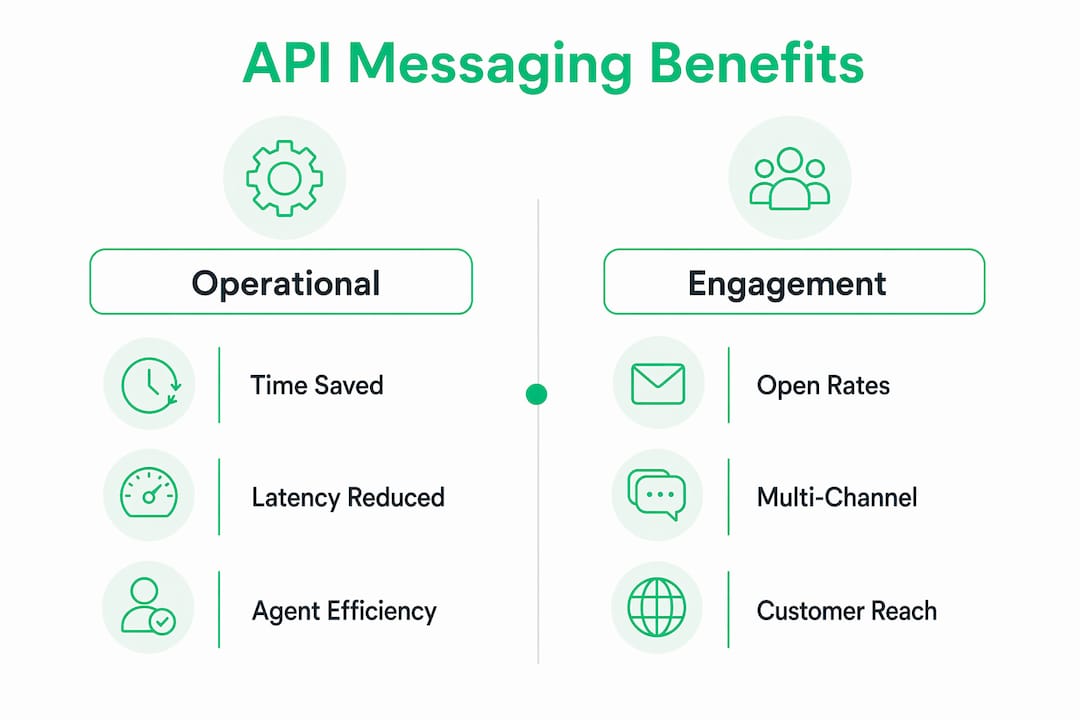
The business case for API-driven messaging is grounded in engagement data that email cannot match. SMS open rates reach up to 98%, with 90% of messages opened within 3 minutes of delivery. Email sits at 20–30% open rates by comparison. That gap is not a minor difference. It changes how you design customer communication entirely.

Operational efficiency gains
Enterprise contact centers using CPaaS APIs save 12–15 hours per agent monthly and reduce support latency by up to 40%. Those numbers reflect what happens when routine messages like password resets, appointment confirmations, and status updates stop requiring human involvement. Agents shift their time to conversations that actually need judgment.
Multi-channel reach from one integration
Messaging APIs unify integrations across SMS, WhatsApp, and RCS through a single RESTful interface. That means your team writes and maintains one integration instead of three separate channel-specific SDKs. When a new channel becomes relevant, you add it to the same pipeline.
The practical benefits break down across four dimensions:
- Speed: High-volume campaigns that would take hours to send manually go out in minutes through a single API call with batching.
- Compliance automation: Opt-in tracking, TCPA and GDPR consent records, and unsubscribe handling can all be managed programmatically rather than through manual spreadsheets.
- Error handling: Delivery failures trigger automatic retries or fallback channel routing without human oversight.
- Analytics: Delivery receipts, read rates, and reply rates feed directly into your data pipeline for real-time reporting.
| Benefit | Impact |
|---|---|
| Message open rate | Up to 98% for SMS vs. 20–30% for email |
| Agent hours saved | 12–15 hours per agent per month |
| Support latency reduction | Up to 40% with automated workflows |
| Integration overhead | One RESTful API replaces multiple channel SDKs |
Security best practices for integrating messaging APIs
Security in API integration in messaging starts with one non-negotiable rule: never hardcode API keys in source code. Store secrets using environment variables or dedicated tools like AWS Secrets Manager or HashiCorp Vault. A key committed to a public GitHub repository is a compromised key, often within minutes of the commit.
Webhook security is the second area developers most often overlook. Every inbound webhook request claims to come from your API provider, but your server has no way to verify that claim without checking the signature. Validate webhook signatures in request headers to confirm events originate from a trusted source. Most providers include an HMAC signature in a header like X-Signature. Compute the expected hash on your side and reject any request where the values do not match.
Reliability under failure conditions requires a deliberate retry strategy. Exponential backoff with jitter is the standard approach for retrying failed API requests. Each retry waits longer than the last, and a random delay prevents all retrying clients from hitting the server at the same moment. This avoids the “thundering herd” problem that can take a degraded service from slow to completely down.
Pro Tip: Set a maximum retry count and a dead-letter queue for messages that exhaust all retries. Silent failures are worse than visible ones because they give you no signal that something went wrong.
Additional security practices every team should follow:
- Rotate API keys on a defined schedule, not just after a suspected breach.
- Restrict API key permissions to the minimum scope required for the integration.
- Log all outbound API calls and inbound webhook events for audit trails.
- Use HTTPS exclusively. Never send API requests over plain HTTP.
- Keep messaging APIs server-side only, away from any client-facing code.
How to architect messaging automation workflows via APIs
Event-driven architecture is the right foundation for any serious messaging automation system. Your application listens for events, such as a new order in your database or a form submission, and fires an API call in response. The messaging API handles delivery, then sends a webhook back to your system with the result. Nothing in that chain requires a human to initiate or monitor it.
Common automation patterns
Transactional messaging is the simplest pattern. A database trigger or application event fires a single API call. The message goes to one recipient with dynamic content filled from the event payload. Order confirmations and two-factor authentication codes follow this pattern.
Drip campaigns require a scheduler. When a user completes an action, your system enrolls them in a sequence. A job queue sends message one immediately, message two after 24 hours, and message three after 72 hours. The API call structure is identical each time. Only the timing and content change.
Two-way conversations are the most complex pattern and the foundation of chatbot automation. Inbound messages arrive at your webhook endpoint. Your application parses the message body, matches it against a decision tree or an AI model, and sends a reply through the same API. The role of API in chatbots is to handle the transport layer so your logic layer can focus entirely on conversation design.
“The most effective messaging automation architectures treat the API as infrastructure, not as the product. The product is the conversation logic, the timing, and the personalization. The API just carries it.”
Integrating with CRM and contact center platforms
Connecting your messaging API to a CRM like Pipedrive or a contact center platform creates a feedback loop that makes automation genuinely useful. When a user replies to an automated message, that reply updates the contact record automatically. Sales teams see conversation history without switching tools. Support teams get context before they pick up a conversation. AI-driven outreach automation tools built on top of messaging APIs take this further by scoring replies and routing hot leads to the right rep in real time.
For enterprise contact centers, the integration between messaging APIs and contact routing systems means that a customer who starts a conversation over WhatsApp can be handed off to a live agent with full message history intact. API-enhanced contact center integrations reduce the friction of that handoff significantly.
Key Takeaways
APIs are the technical foundation of every reliable messaging automation system, and the combination of RESTful endpoints, webhook callbacks, and secure credential management determines whether that foundation holds under production load.
| Point | Details |
|---|---|
| SMS outperforms email | SMS open rates reach up to 98%, making it the highest-engagement channel for automated messages. |
| Webhooks beat polling | Asynchronous webhook delivery gives real-time event handling without wasting server resources on constant polling. |
| Security starts with secrets | Never hardcode API keys; use AWS Secrets Manager or HashiCorp Vault and validate every webhook signature. |
| One API, many channels | A single RESTful messaging API covers SMS, WhatsApp, and RCS, cutting integration and maintenance overhead. |
| Automation saves real hours | CPaaS API automation saves contact center agents 12–15 hours per month and cuts support latency by up to 40%. |
What I’ve learned about messaging APIs after years of building with them
The biggest mistake I see developers make is treating the messaging API as the hard part. They spend weeks on the integration and then ship a chatbot with a flat decision tree that frustrates every user who types something unexpected. The API is the easy part. It is well-documented, predictable, and forgiving. The conversation logic is where the real work lives.
The second thing I have learned is that unified RESTful APIs are not just a convenience. They are a strategic choice that compounds over time. Teams that build on channel-specific SDKs end up maintaining three separate codebases, three sets of error handling, and three upgrade cycles. A single RESTful interface means one team, one deployment, one place to fix bugs. That difference shows up in your sprint velocity within six months.
On security, I have seen too many teams treat API key rotation as a theoretical best practice rather than a scheduled task. Keys get committed to repos. Repos get forked. Forks get made public. The breach happens months later and nobody connects it to that one commit. Treat your API keys like passwords. Rotate them. Audit them. Never let them touch client-side code.
The trend I am watching most closely in 2026 is the convergence of messaging APIs with AI inference at the edge. The gap between “automated message” and “intelligent conversation” is closing fast. The teams that will win are the ones who built modular, event-driven communication stacks now, because adding an AI layer to a well-architected webhook pipeline is straightforward. Adding it to a monolithic polling system is not.
— Axel
Whatsable: built for developers who need messaging automation that works
If you are building on top of a messaging API and need a platform that handles WhatsApp automation at scale, Whatsable is worth a close look.
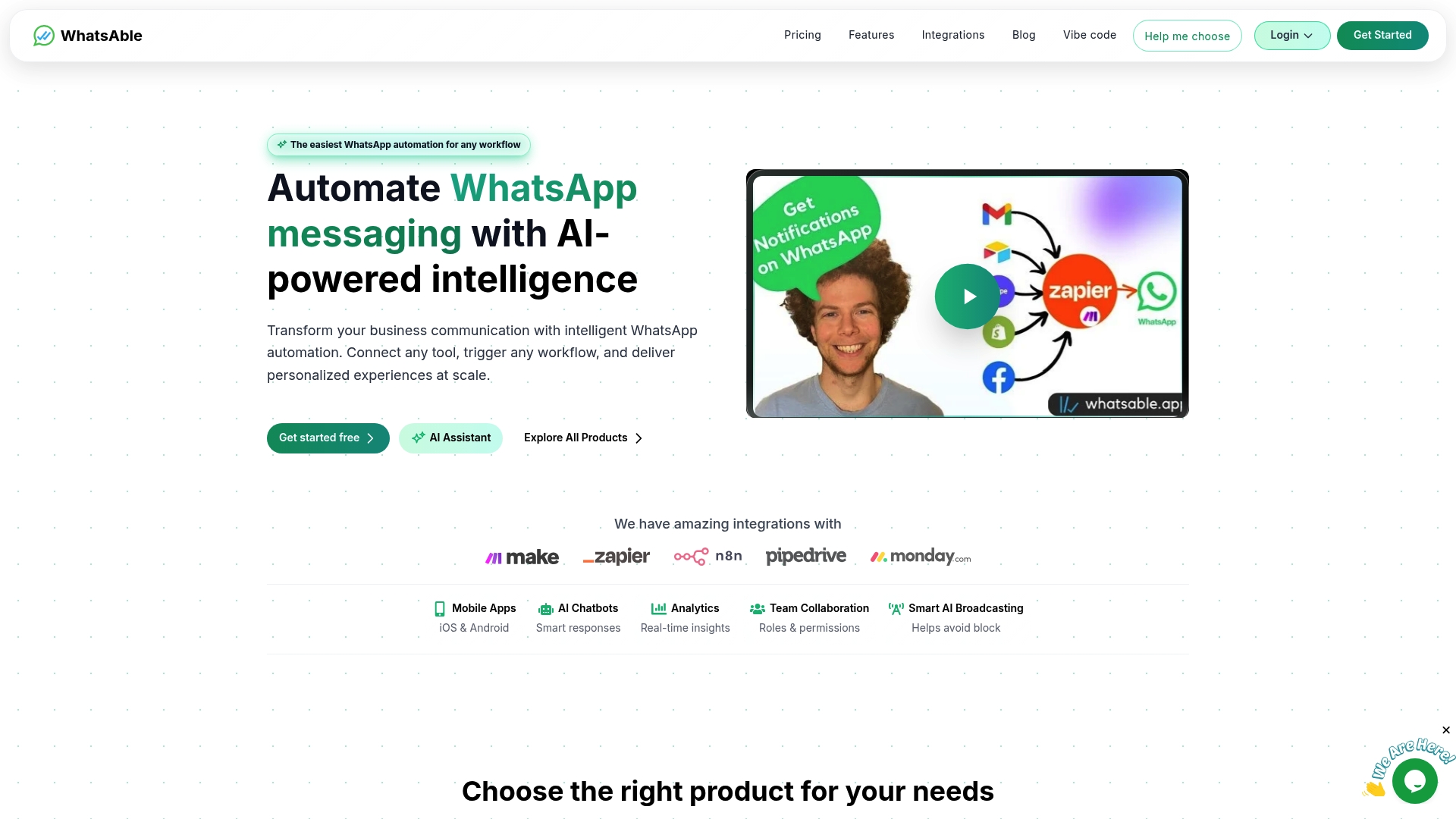
Whatsable connects directly to tools like Zapier, Make, n8n, and Pipedrive, so your existing event-driven workflows plug in without custom middleware. The platform handles bulk messaging with anti-block measures, automated follow-up sequences, and detailed delivery analytics out of the box. For teams that need internal alerting, Whatsable Bot gives you fast setup for team notifications without touching the customer-facing pipeline. Whatsable is built for the teams that need production-grade messaging infrastructure without building it from scratch.
FAQ
What is the role of API in messaging automation?
A messaging API is the programmatic interface that lets applications send, receive, and track messages across channels like SMS and WhatsApp without manual intervention. It abstracts carrier infrastructure so developers interact with a single HTTP endpoint.
Why are webhooks better than polling for messaging automation?
Webhooks deliver events to your server the moment they occur, using far fewer resources than polling an endpoint repeatedly. Asynchronous webhook delivery is the standard approach for real-time message status updates and inbound reply handling.
How do messaging APIs support multi-channel communication?
A single RESTful messaging API can route messages across SMS, WhatsApp, and RCS simultaneously. This eliminates the need for separate channel-specific SDKs and reduces integration maintenance overhead significantly.
What security practices apply to messaging API integrations?
Store API keys in environment variables or secrets managers like AWS Secrets Manager, validate webhook signatures on every inbound request, and use exponential backoff with jitter for retries. Never invoke messaging APIs from client-side code.
How much efficiency can businesses gain from messaging API automation?
Enterprise contact centers using CPaaS APIs report saving 12–15 hours per agent per month and reducing support latency by up to 40%, based on documented CPaaS deployment outcomes.

 Elias Navarro
 Jonah Reed
 Mira Okonkwo