 Whatsable






TL;DR:
- WhatsApp offers unmatched engagement with a 98 percent open rate and high click-through rates. It functions as a full-funnel conversational channel that drives revenue through behavioral triggers and CRM integrations.
WhatsApp is the highest-engagement channel available to performance marketers today, delivering 98% open rates and 45–60% click-through rates that no email or SMS campaign can match. The role of WhatsApp in performance campaigns goes far beyond sending bulk messages. It functions as a full-funnel, conversational marketing channel where behavioral triggers, pre-approved message templates, and CRM integrations work together to drive measurable revenue. Platforms like the WhatsApp Business API, click-to-WhatsApp ads, and tools like HubSpot have made this channel accessible at scale. This guide covers the metrics, mechanics, use cases, and pitfalls every marketing leader needs to know.
What key performance benefits does WhatsApp offer in marketing campaigns?
WhatsApp outperforms every traditional digital channel on the metrics that matter most. Its 98% open rate compares to an industry average of roughly 20% for email. That gap is not marginal. It fundamentally changes how you think about reach and frequency.
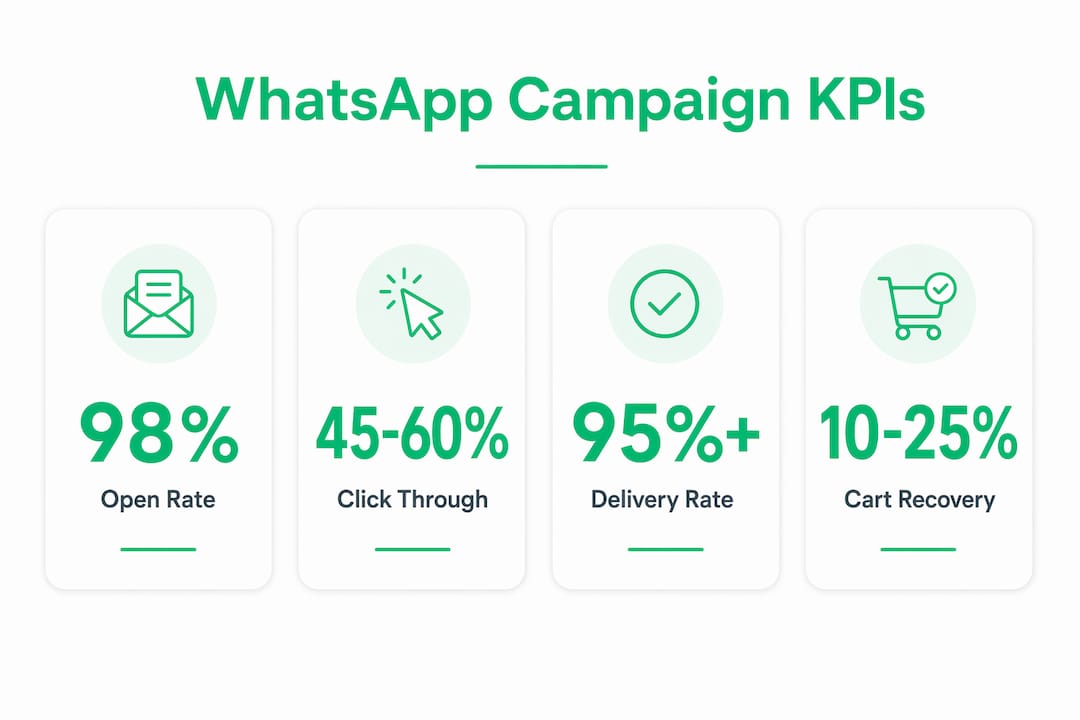
Click-through rates tell the same story. WhatsApp campaigns consistently achieve 45–60% CTR, while email averages 2–5% and SMS sits around 10–15%. The reason is context. WhatsApp messages arrive in a personal, trusted inbox where users are already engaged. They do not land in a promotions tab or get filtered by spam algorithms.
Cart recovery is where the performance gap becomes revenue. Automated abandoned cart recovery via WhatsApp recovers 10–25% of lost sales, compared to 5–8% for SMS or email. For an e-commerce brand doing $1 million in monthly revenue, that difference in recovery rate translates directly to the bottom line.
Delivery and read rates set the baseline for any campaign. Effective WhatsApp campaigns target a delivery rate above 95% and a read rate above 85%. These benchmarks are achievable with proper list hygiene and compliant messaging practices.
| Metric | SMS | ||
|---|---|---|---|
| Open rate | 98% | ~20% | ~30% |
| Click-through rate | 45–60% | 2–5% | 10–15% |
| Cart recovery rate | 10–25% | 5–8% | 5–8% |
| Read rate target | 85%+ | N/A | N/A |
How does WhatsApp transform campaign mechanics into conversational marketing?
WhatsApp replaces the static landing page with a live conversation. That shift changes everything about how a campaign performs. Instead of driving traffic to a page and hoping for a conversion, you open a dialog where the prospect can ask questions, receive personalized offers, and complete a purchase without ever leaving the app.

The best WhatsApp performance campaigns treat messaging templates as high-conversion landing pages rather than simple notifications. A well-designed template includes a clear offer, a single call to action, and a conversational hook that invites a reply. The reply triggers the next step in the funnel automatically.
Behavioral triggers like cart abandonment and site visits launch drip sequences that nurture prospects through the funnel over days or weeks. A user who views a product page gets a message 30 minutes later. If they do not reply, a follow-up with a limited-time offer goes out 24 hours later. Each message is triggered by behavior, not a calendar.
Click-to-WhatsApp ads are the acquisition engine for this approach. A user clicks an ad on Facebook or Instagram and lands directly in a WhatsApp conversation. That click opens a 72-hour free messaging window during which you can send messages without additional per-message costs. This lowers acquisition costs compared to driving traffic to a traditional landing page where conversion rates are far lower.
Fast response time is the variable most marketers underestimate. A prospect who starts a WhatsApp conversation expects a reply within minutes, not hours. AI-powered chatbots handle the first response instantly, qualify the lead with a few questions, and route high-intent prospects to a human agent. Without that automation layer, the channel underperforms.
- Pre-approved message templates act as the entry point for every proactive campaign.
- Behavioral drip sequences replace static email nurture flows with real-time, triggered messaging.
- Click-to-WhatsApp ads open a cost-efficient 72-hour conversation window.
- AI chatbots handle qualification and routing at scale without human delay.
- CRM integration connects every conversation to a contact record and pipeline stage.
Pro Tip: Design your first WhatsApp message template with a yes/no question at the end. A simple “Would you like 10% off your order?” generates a reply that opens the conversation window and triggers your next automated message.
What are the top campaign types for WhatsApp performance marketing?
Abandoned cart recovery is the highest-ROI starting point for most brands. A three-message sequence works best: the first message reminds the customer of the cart, the second adds social proof or urgency, and the third offers a small discount. This sequence, sent over 24–48 hours, consistently outperforms email-only recovery flows.
Re-engagement campaigns target dormant customers who have not purchased in 60–90 days. A well-crafted 3-message re-engagement sequence over 2 weeks can reactivate 15–25% of dormant customers. That reactivation rate makes WhatsApp the most cost-efficient channel for winning back lapsed buyers.
- Abandoned cart recovery. Send a 3-message sequence over 24–48 hours. Target: 10–25% recovery rate.
- Re-engagement campaigns. Run a 2-week sequence for dormant customers. Target: 15–25% reactivation.
- Post-purchase flows. Send order updates, cross-sell offers, and review requests. Target: higher lifetime value and repeat purchase rate.
- Click-to-WhatsApp acquisition. Drive ad traffic directly into a WhatsApp conversation for lead qualification. Target: lower cost per qualified lead than landing page campaigns.
- Real-time customer support. Handle objections and questions during the purchase decision. Target: reduced drop-off at checkout.
| Campaign type | Primary KPI | Expected performance |
|---|---|---|
| Abandoned cart recovery | Recovery rate | 10–25% |
| Re-engagement | Reactivation rate | 15–25% |
| Post-purchase cross-sell | Repeat purchase rate | Varies by category |
| Click-to-WhatsApp acquisition | Cost per qualified lead | Lower than landing page |
| Customer support | Resolution time and CSAT | Near-real-time |
Post-purchase engagement is the most underused campaign type. Sending an order confirmation, a shipping update, and a cross-sell offer through WhatsApp keeps the customer in a conversation rather than sending them back to their inbox. That ongoing dialog increases retention and lifetime value without additional acquisition spend.
What pitfalls should marketers avoid when using WhatsApp in campaigns?
The most damaging mistake is treating WhatsApp like an email blast tool. The key mistake is treating WhatsApp like a broadcast channel. Mass-sending promotional messages without behavioral context destroys deliverability, triggers opt-outs, and risks getting your WhatsApp Business account flagged or banned.
WhatsApp’s 24-hour messaging window creates a compliance requirement most marketers miss. Outside the 24-hour window, proactive messaging requires pre-approved templates. Sending non-template messages outside that window violates WhatsApp’s policies and can result in account suspension. Every campaign sequence must account for this rule.
- Skipping behavioral triggers. Sending messages on a fixed schedule rather than based on user actions produces lower conversion and higher opt-out rates.
- Ignoring template quality. Poorly written templates get rejected by WhatsApp’s approval process and delay campaign launches.
- Over-messaging. Sending more than 2–3 messages per week per contact accelerates opt-outs and damages your sender reputation.
- No CRM integration. Without connecting WhatsApp conversations to your CRM, you cannot attribute revenue, score leads, or route high-intent prospects to sales.
- No bot automation. Relying on human agents to respond to every first message creates delays that kill conversion rates.
Pro Tip: Set a hard cap on message frequency per contact. Two messages per week is the ceiling for most audiences. Monitor your opt-out rate weekly. If it rises above 2%, reduce frequency before adjusting content.
How do you measure and optimize WhatsApp campaign performance?
Measurement starts with defining the right metrics before a campaign launches. WhatsApp campaigns can track reach, CTR, cost per messaging contact, leads, and sales to guide optimization and ROI calculation. Without these metrics defined upfront, you cannot distinguish a high-performing sequence from a mediocre one.
CRM integration enables automatic contact creation, chat logging, follow-ups, and routing of high-intent leads to sales. This connection is what turns WhatsApp from a messaging tool into a revenue-attributable channel. Every conversation maps to a contact record, a pipeline stage, and eventually a closed deal or a lost opportunity.
Experienced marketers score leads on chat keywords and route high-intent prospects instantly to human agents. A prospect who types “price” or “buy now” gets routed to a sales rep within seconds. A prospect who asks a general question gets handled by the bot. This routing logic is the difference between a WhatsApp channel that generates revenue and one that generates conversations.
| KPI | Target benchmark | What it tells you |
|---|---|---|
| Delivery rate | 95%+ | List quality and account health |
| Read rate | 85%+ | Message timing and relevance |
| CTR | 45–60% | Template quality and offer strength |
| Reply rate | 20%+ | Conversational engagement |
| Cost per qualified conversation | Varies by industry | Acquisition efficiency |
Continuous testing drives improvement. Test one variable per campaign: message copy, send time, offer type, or sequence length. WhatsApp Business Manager provides delivery and read data at the message level. Third-party platforms add CTR, reply rate, and revenue attribution on top of that native data.
Key Takeaways
WhatsApp drives superior performance campaign results because its 98% open rate, conversational mechanics, and behavioral triggers produce engagement and conversion rates that email and SMS cannot match.
| Point | Details |
|---|---|
| Open and click rates | WhatsApp delivers 98% open rates and 45–60% CTR, far above email and SMS benchmarks. |
| Cart recovery advantage | WhatsApp recovers 10–25% of abandoned carts versus 5–8% for email or SMS. |
| Conversational funnel design | Treat message templates as landing pages and trigger sequences from user behavior, not calendars. |
| Compliance and frequency | Respect the 24-hour messaging window and cap contact frequency at 2–3 messages per week. |
| Revenue attribution | Connect WhatsApp to your CRM to track cost per conversation, lead quality, and closed revenue. |
WhatsApp’s role is bigger than most marketing leaders realize
I have watched brands spend six figures on paid social while their WhatsApp channel sat idle or was used only for order confirmations. That is a significant missed opportunity. The channel is not just a support tool. It is a full-funnel sales environment where the prospect is already in a buying mindset.
What changed my thinking was watching a mid-sized e-commerce brand replace 40% of its email nurture sequences with WhatsApp drip campaigns. Their cost per conversion dropped, their re-engagement rates went up, and their customer support volume actually decreased because proactive messaging answered questions before customers had to ask. The results were not marginal. They were structural.
The brands that get WhatsApp right in 2026 are the ones that build conversational funnels, not message blasts. They use AI chatbots to handle volume, human agents to close high-intent leads, and CRM data to connect every conversation to revenue. WhatsApp’s semi-private, closed-loop communication creates a multiplier effect that open social channels cannot replicate. A message in WhatsApp feels personal. That feeling drives action.
The marketers who will fall behind are the ones waiting for WhatsApp to become “mainstream” before investing. It already is. The question is whether you are building the infrastructure to use it well.
— Axel
How Whatsable helps you run WhatsApp performance campaigns
Running WhatsApp campaigns at scale requires automation, tracking, and CRM integration working together. Whatsable is built for exactly that.
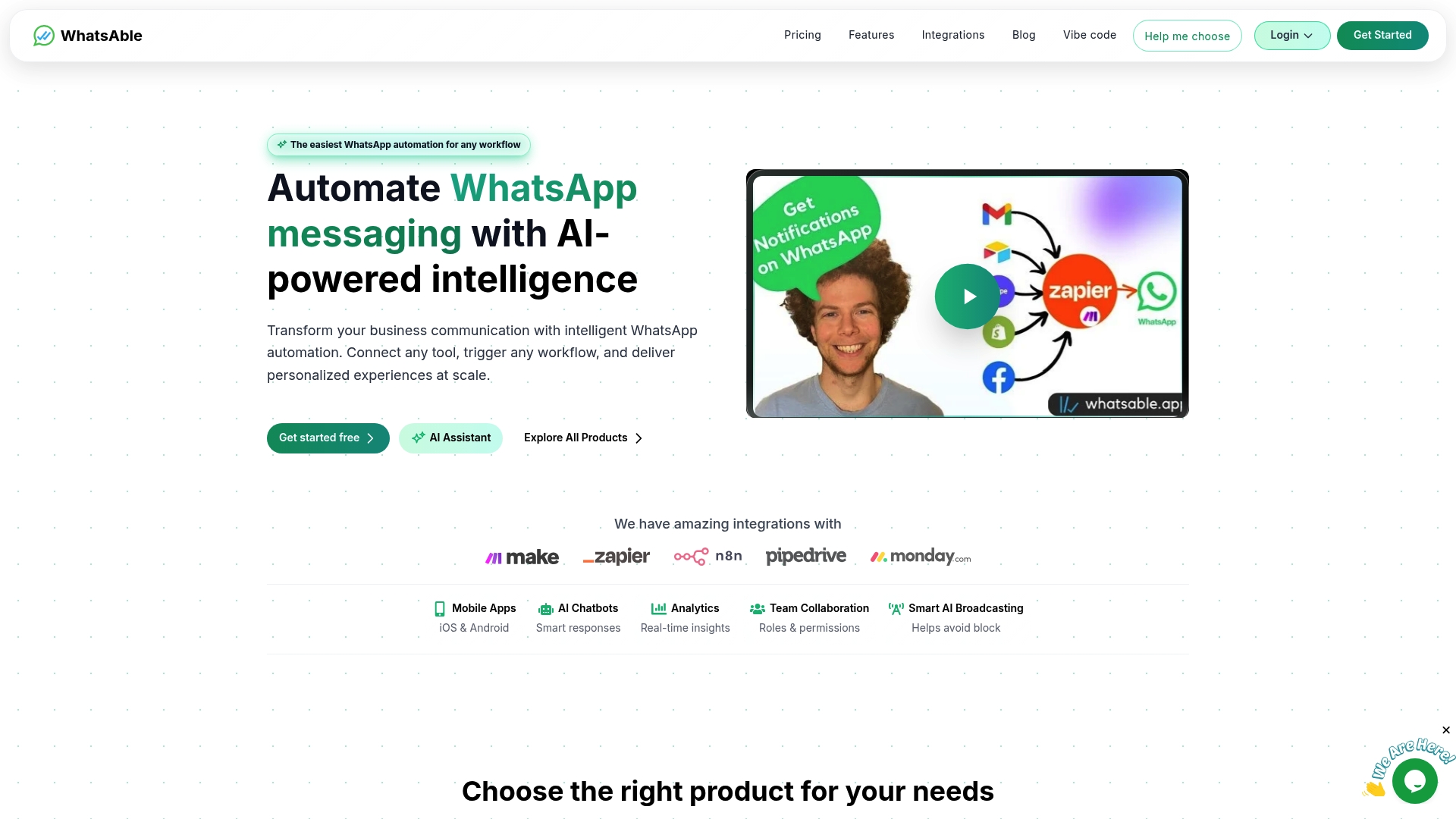
Whatsable lets you send unlimited branded WhatsApp messages, build automated follow-up sequences, and connect to tools like Zapier, Make, n8n, and Pipedrive without custom development. The platform includes AI-powered chatbots, bulk messaging with anti-block measures, and detailed analytics so you can track delivery rate, read rate, CTR, and revenue attribution from a single dashboard. Whether you are running abandoned cart recovery, re-engagement campaigns, or click-to-WhatsApp acquisition flows, Whatsable’s platform gives your team the infrastructure to execute and measure every campaign with precision.
FAQ
What open rate can WhatsApp campaigns realistically achieve?
WhatsApp campaigns consistently achieve 98% open rates. That figure reflects the personal, high-trust nature of the WhatsApp inbox compared to email or SMS.
How does the WhatsApp 24-hour messaging window affect campaigns?
Outside the 24-hour window after a customer’s last message, you must use pre-approved message templates for outbound contact. Sending non-template messages outside that window violates WhatsApp’s policies and risks account suspension.
What is a click-to-WhatsApp ad?
A click-to-WhatsApp ad is a Facebook or Instagram ad that opens a WhatsApp conversation when clicked. It creates a 72-hour free messaging window, lowering acquisition costs compared to traditional landing page campaigns.
How do you measure ROI on WhatsApp campaigns?
Track reach, delivery rate, read rate, CTR, reply rate, and cost per qualified conversation. Connect WhatsApp to your CRM to attribute closed revenue to specific campaigns and sequences.
What is the biggest mistake brands make on WhatsApp?
The biggest mistake is treating WhatsApp as a broadcast channel. Effective campaigns use behavioral triggers, conversational templates, and sequenced follow-ups rather than mass promotional blasts.
 Mira Okonkwo