 Whatsable






TL;DR:
- WhatsApp is the most effective channel for post-sale support because it offers real-time, contextual communication within an app used by over 2 billion people daily. It supports proactive updates, issue resolution, feedback collection, and loyalty building through personalized follow-ups, combining AI automation with human agents to scale personalized service. Integrating WhatsApp with CRM platforms and following best practices enhances response rates, reduces customer effort, and helps support teams deliver faster, more connected assistance.
WhatsApp is the most effective channel for post-sale customer support because it delivers real-time, contextual communication inside an app that over 2 billion people already use daily. The role of WhatsApp in post-sale support goes far beyond sending order confirmations. It covers the full arc of post-purchase communication: resolving issues, collecting feedback, sending proactive updates, and building loyalty through personalized follow-ups. Businesses using the WhatsApp Business Platform and its API can combine AI-powered automation with human agents to create a support experience that feels personal at scale. WhatsApp reduces customer effort by delivering fast, contextual help in a channel customers habitually check.
How WhatsApp enables fast and personalized post-sale support
WhatsApp customer support works because it collapses the distance between a customer’s problem and its resolution. There is no hold music, no email thread to dig through, and no separate app to download. The conversation happens where the customer already is, and that convenience translates directly into higher satisfaction scores.

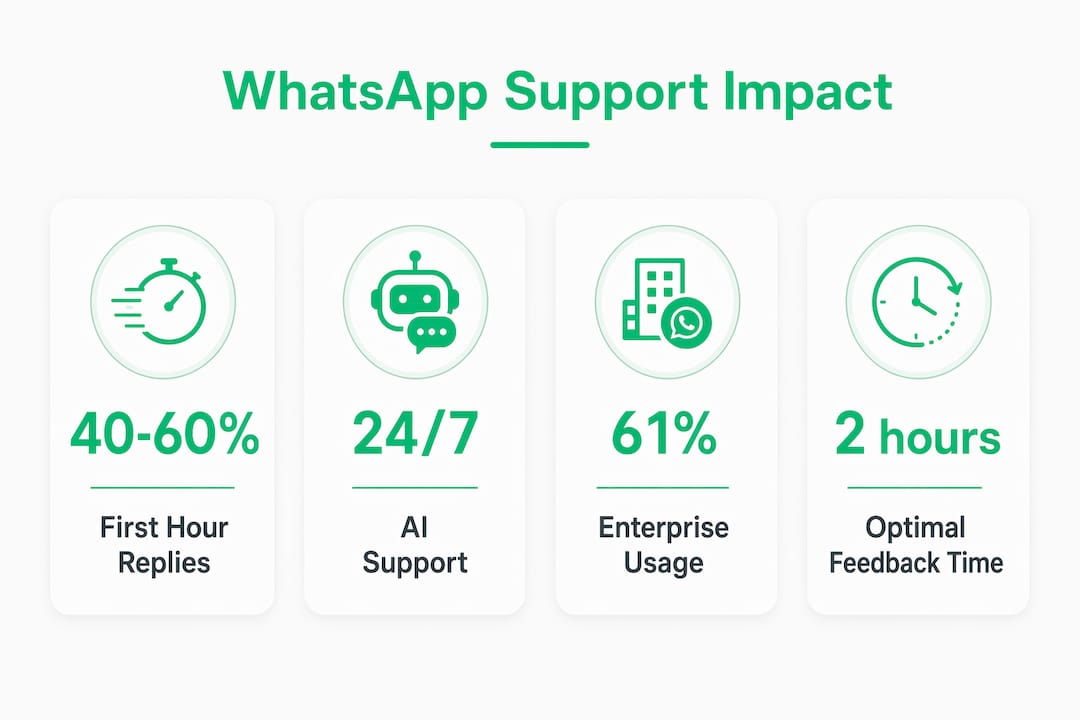
The WhatsApp Business Platform supports 24/7 AI-powered support with seamless escalation to human agents, keeping the full conversation history intact throughout the handoff. This matters more than most support teams realize. When a customer explains a defective product to a chatbot and then gets transferred to a human agent who already sees that context, the resolution time drops and the customer does not have to repeat themselves. That single improvement eliminates one of the most common frustrations in traditional support.
AI chatbots handle the high-volume, repetitive queries: order status, return policies, warranty information, and account access. Human agents handle the nuanced, emotionally charged, or technically complex cases. The split is not just about efficiency. It is about matching the right resource to the right problem. A well-configured WhatsApp support setup routes based on customer intent, sentiment signals, and query complexity, not just keyword matching.
CRM integration amplifies this further. When WhatsApp connects to platforms like Zendesk or Salesforce Service Cloud, every conversation becomes part of the customer’s unified record. Support teams see purchase history, previous tickets, and communication preferences before typing a single word. That context is what separates a generic reply from a genuinely helpful one.
Pro Tip: Set up a welcome message that fires automatically when a customer first contacts your WhatsApp support number after a purchase. Include their order number and a quick-reply menu with the three most common post-sale requests. This alone cuts average handle time significantly.
What are the main post-purchase communication use cases on WhatsApp?
Post-purchase communication on WhatsApp covers a wider range of interactions than most businesses initially deploy. The channel supports both reactive support and proactive outreach, which makes it uniquely versatile compared to email or phone.
The most common use cases include:
- Order confirmations and shipping updates. Businesses send proactive order updates through approved message templates the moment a purchase is confirmed, shipped, or delivered. Customers get real-time visibility without opening a separate tracking app.
- Appointment reminders and service notifications. Service businesses, healthcare providers, and SaaS companies use WhatsApp to send reminders 24 hours and 1 hour before scheduled events, reducing no-shows and support calls.
- Feedback requests and satisfaction surveys. Using WhatsApp for feedback collection produces higher response rates than email surveys. A short, conversational message asking “How did we do?” with a 1-5 quick-reply scale takes seconds for the customer to complete.
- Personalized recommendations and renewal prompts. Based on purchase history, businesses send targeted product suggestions or subscription renewal reminders through WhatsApp, keeping the relationship active between purchases.
- Return and warranty support. Customers initiate return requests or warranty claims directly in WhatsApp, upload photos of damaged items, and receive resolution steps without calling a support line.
The WhatsApp Business Platform supports rich outbound messaging with customizable text, media, and interactive templates, which means these use cases are not limited to plain text. Businesses can include images, PDFs, video tutorials, and clickable buttons within a single message.
Pro Tip: When using WhatsApp for feedback collection, send the survey within 2 hours of delivery or service completion. Response rates drop sharply after 24 hours. Keep the message to one question with quick-reply options to maximize completion.
How does WhatsApp post-sale support compare to email and phone?
The comparison between WhatsApp and traditional support channels is not about which is better in absolute terms. It is about understanding where each channel performs and where it falls short.
| Dimension | Phone | ||
|---|---|---|---|
| Response rate (first hour) | 40-60% | 15-25% | Depends on hold time |
| Customer effort | Low (familiar app, no login) | Medium (inbox clutter) | High (hold queues, callbacks) |
| AI scalability | High (chatbots handle volume) | Medium (auto-replies only) | Low (requires human agents) |
| Async messaging | Yes (customer replies when ready) | Yes | No (real-time required) |
| Media support | Rich (images, video, PDFs) | Rich | Voice only |
| Platform restrictions | 24-hour window, template rules | None | None |
| Cost per interaction | Low at scale | Low | High |
WhatsApp messages achieve 40-60% reply rates within the first hour, compared to 15-25% for email. That gap reflects a fundamental difference in how customers treat each channel. Email inboxes are cluttered and deprioritized. WhatsApp notifications are opened almost immediately.
The asynchronous nature of WhatsApp messaging is a genuine operational advantage. Customers can reply when it suits them, and agents can manage multiple conversations simultaneously. Phone support requires one agent per active call, which creates a hard ceiling on throughput. WhatsApp removes that ceiling.
The platform does have real constraints. The 24-hour messaging window limits free-form business replies. Once that window closes after a customer’s last message, businesses must use pre-approved templates to re-engage. This requires operational discipline and a library of well-crafted templates ready to deploy. Teams that do not plan for this find themselves unable to follow up on open issues.
Global market penetration also varies. WhatsApp dominates in Europe, Latin America, India, and the Middle East. In the United States, SMS and iMessage still hold significant share. Support teams serving North American customers primarily should factor this into channel strategy before committing fully to WhatsApp.
What are best practices for integrating WhatsApp into post-sale support workflows?
Deploying WhatsApp for post-sale support without a structured workflow produces inconsistent results. These are the practices that separate high-performing implementations from chaotic ones.
-
Obtain explicit customer opt-in. Business-initiated messages on WhatsApp require customer consent. Collect opt-in at checkout, in post-purchase emails, or through QR codes on packaging. Document consent records for compliance purposes.
-
Build and maintain a template library. Pre-approved message templates are the backbone of proactive WhatsApp outreach. Create templates for every key post-sale milestone: order confirmation, shipping update, delivery confirmation, feedback request, and re-engagement. Review and refresh them quarterly.
-
Configure confidence-threshold escalation. AI chatbots should hand off to human agents when they fall below a confidence threshold on a query, when negative sentiment is detected, or when a customer explicitly requests a human. IrisAgent recommends using customer intent triggers and sentiment signals as primary escalation criteria.
-
Centralize management in a CRM or CX platform. Integrating WhatsApp with Zendesk or Salesforce Service Cloud gives support teams a single view of every customer interaction across channels. This prevents duplicate responses, missed follow-ups, and context loss during agent handoffs. For teams exploring how to connect these systems, resources on WhatsApp and Zendesk integration offer practical technical guidance.
-
Train agents on conversational tone. WhatsApp is a messaging app, not an email client. Responses should be concise, warm, and written in plain language. Long, formal paragraphs feel out of place and reduce customer trust. Set tone guidelines and review sample conversations during onboarding.
-
Monitor and act on analytics. Track resolution time, first-contact resolution rate, customer satisfaction scores, and template open rates. These metrics reveal which parts of your WhatsApp support workflow are working and which need adjustment.
The adoption data supports urgency here. 61% of enterprise support organizations have deployed or plan to deploy WhatsApp as a support channel, with adoption reaching 74% among Zendesk and Salesforce users. Businesses that delay structured deployment fall behind competitors who are already building customer loyalty through this channel.
Key takeaways
WhatsApp is the highest-performing post-sale support channel for businesses that combine AI automation, proactive templates, and CRM integration into a single, well-managed workflow.
| Point | Details |
|---|---|
| WhatsApp outperforms email on response rates | WhatsApp achieves 40-60% reply rates in the first hour versus 15-25% for email. |
| AI and human agents work best together | Chatbots handle routine queries while human agents resolve complex or emotional cases with full context. |
| Proactive templates drive post-purchase engagement | Order updates, feedback requests, and renewal prompts keep customers informed without requiring them to reach out first. |
| CRM integration is non-negotiable | Connecting WhatsApp to Zendesk or Salesforce centralizes conversation history and prevents context loss. |
| Opt-in and template compliance protect operations | Businesses must collect consent and use approved templates outside the 24-hour window to avoid platform restrictions. |
WhatsApp in post-sale support: what I’ve actually seen work
Most businesses treat WhatsApp as a notification pipe. They set up order confirmations, maybe a shipping update, and call it done. That is the lowest-value version of this channel, and it misses the point entirely.
The businesses I have seen get real results from WhatsApp in customer service treat it as a two-way relationship channel, not a broadcast tool. They use it to close the loop after a purchase, ask a genuine question about the experience, and respond to the answer within minutes. That responsiveness is what builds the kind of loyalty that shows up in repeat purchase rates and referrals.
The biggest operational mistake I see is under-investing in template management. Teams launch with three templates, hit the 24-hour window on an open issue, and have nothing approved to send. The customer goes silent. The issue stays unresolved. A template library of 15 to 20 well-crafted messages covering every post-sale scenario costs very little to build and prevents that failure mode entirely.
The future of enhancing support through messaging on WhatsApp points toward richer AI integration: sentiment analysis triggering automatic escalation, purchase-history-driven personalization at the message level, and video support within the chat window. The infrastructure for all of this already exists. The gap is in how many support teams are actually using it versus how many are still treating WhatsApp as a slightly faster email.
— Axel
Take your WhatsApp post-sale support further with Whatsable
Running post-sale support on WhatsApp manually does not scale. Whatsable is built specifically for businesses that need to automate WhatsApp conversations, manage follow-up sequences, and connect their messaging workflows to the tools they already use.
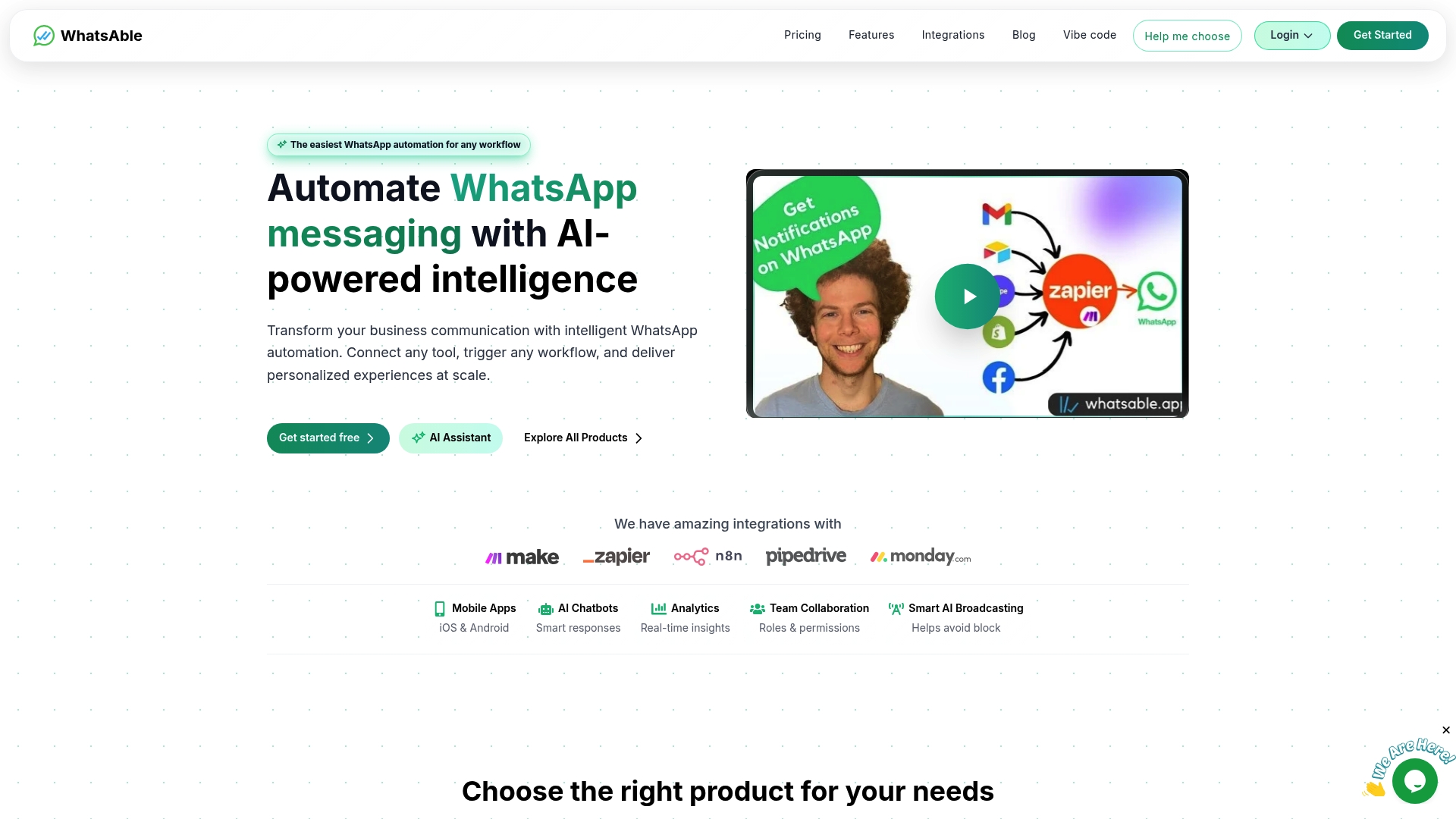
Whatsable lets you send unlimited branded WhatsApp messages, build automated post-purchase sequences, and integrate directly with Zapier, Make, n8n, and Pipedrive. Whether you are managing order updates, feedback collection, or re-engagement campaigns, the platform handles the operational complexity so your team focuses on conversations that need a human touch. If you are ready to build a WhatsApp support operation that actually scales, explore Whatsable and see how it fits your workflow.
FAQ
What is the role of WhatsApp in post-sale support?
WhatsApp serves as a real-time, two-way communication channel for post-sale support, enabling businesses to send proactive updates, resolve customer issues, collect feedback, and build loyalty through personalized follow-up messages.
How does WhatsApp compare to email for customer support?
WhatsApp achieves 40-60% reply rates within the first hour, compared to 15-25% for email, making it significantly more effective for time-sensitive post-purchase communication.
What are the main limitations of using WhatsApp for business support?
The 24-hour messaging window restricts free-form replies after a customer’s last message, requiring businesses to use pre-approved templates for outbound outreach. This makes template planning a critical operational requirement.
Do businesses need customer permission to message on WhatsApp?
Yes. Business-initiated messages on WhatsApp require explicit customer opt-in. Consent should be collected at checkout or through post-purchase touchpoints and documented for compliance.
How do AI chatbots improve WhatsApp post-sale support?
AI chatbots handle high-volume routine queries around the clock and escalate complex cases to human agents with full conversation context intact, reducing resolution time and improving customer satisfaction without increasing headcount.

 Mira Okonkwo