 Whatsable







TL;DR:
- Most businesses treat WhatsApp as a faster email, but it is a full-service communication channel that supports every customer journey stage. Successful use requires mapping each touchpoint, utilizing automation, and adhering to compliance rules like the 24-hour window to build genuine, two-way relationships. Building a robust infrastructure with personalized, timely messaging enhances engagement, loyalty, and operational efficiency at scale.
Most businesses treat WhatsApp like a faster email. They blast promotions, answer questions one at a time, and wonder why their open rates are high but conversions stay flat. The WhatsApp customer journey explained properly looks nothing like that. WhatsApp is a full-service communication channel capable of handling every stage from first contact to post-purchase loyalty, and the businesses winning on it in 2026 have mapped every touchpoint with the same rigor they apply to their website. This article breaks down each stage, the message types that belong there, and the automation tools that make it all work at scale.
Table of Contents
- Key Takeaways
- The WhatsApp customer journey explained stage by stage
- Why asynchronous messaging changes the customer experience
- Automation and AI in WhatsApp customer journeys
- Best practices for optimizing WhatsApp engagement
- Post-purchase engagement that builds loyalty
- My take on what businesses keep getting wrong
- How Whatsable helps you build this at scale
- FAQ
Key Takeaways
| Point | Details |
|---|---|
| Journey has five stages | Awareness, consideration, decision, retention, and advocacy each require different WhatsApp message types. |
| Asynchronous design is an advantage | Customers can pause and resume without repeating themselves, which reduces friction and improves satisfaction. |
| Automation scales the journey | No-code flows and AI agents handle routine queries 24/7, freeing human agents for complex issues. |
| Compliance shapes your strategy | WhatsApp’s 24-hour rule limits proactive outreach and requires opt-in management to stay compliant. |
| Post-purchase messages cut costs | Utility messages for order updates and confirmations reduce inbound inquiries before they start. |
The WhatsApp customer journey explained stage by stage
The WhatsApp customer journey maps every point at which a customer or prospect interacts with your business through the app, from the moment they first discover your brand to the moment they recommend you to someone else. Each stage has different goals, different message types, and different rules about what you are actually allowed to send.
Here is how the five core stages break down, and what WhatsApp uniquely brings to each one.
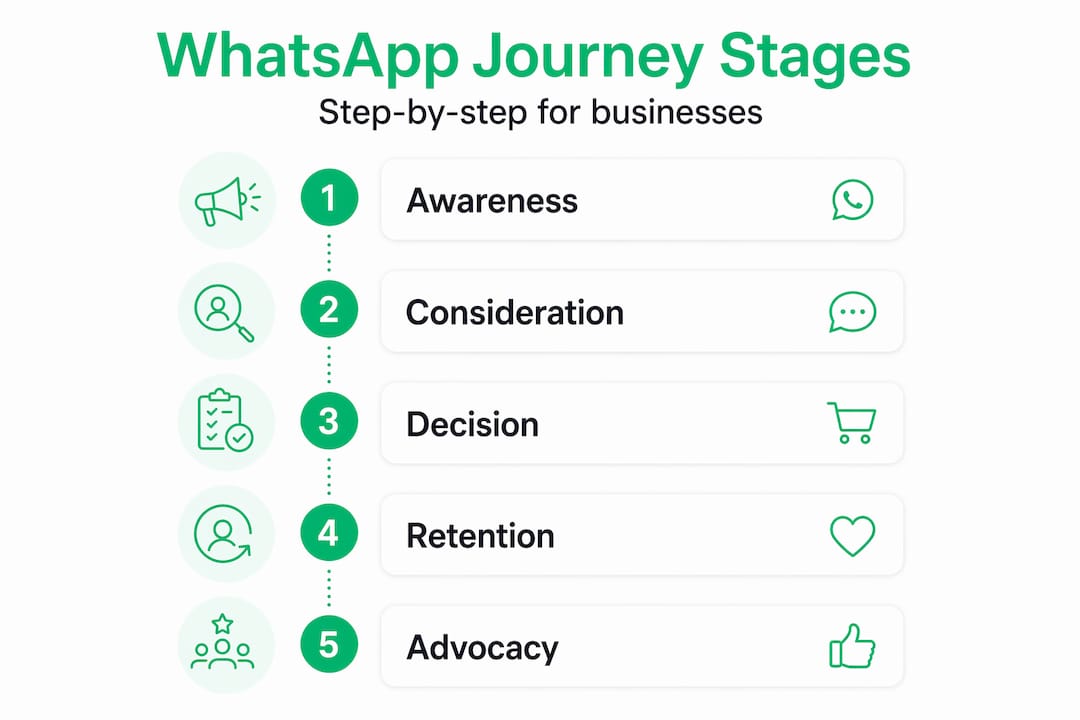
Awareness. This is where customers find out you exist on WhatsApp. Click-to-chat links in Meta ads, QR codes in physical stores, and website chat buttons all serve as entry points. At this stage, your goal is not to sell. It is to get the conversation started and get permission to continue it.
Consideration. Once a prospect has messaged you, the channel stays open. You can send product catalogs, answer detailed questions through chatbots or agents, and share content like videos or PDFs that help them evaluate your offer. This is where WhatsApp Flows become genuinely powerful. These no-code, multi-step interactive journeys let customers browse options, fill out forms, and select preferences all inside the app without opening a browser.
Decision. The conversion moment. Interactive buttons for completing purchases, scheduling appointments, or requesting quotes belong here. Automated follow-ups for abandoned carts or unanswered quotes also live at this stage.
Retention. After the sale, utility and service messages keep customers informed and connected. Order confirmations, shipping updates, payment receipts, and booking reminders all fall into this category. These messages have high open rates because customers expect and want them.
Advocacy. Satisfied customers share experiences. You can use WhatsApp to request reviews, offer referral incentives, or invite customers into VIP broadcast lists. The two-way nature of the channel makes advocacy feel personal rather than transactional.
Here is a quick reference for how message categories align with journey stages:
| WhatsApp message category | Journey stage | Primary purpose |
|---|---|---|
| Marketing messages | Awareness, consideration | Promotions, offers, product discovery |
| Utility messages | Decision, retention | Order updates, confirmations, reminders |
| Service messages | Retention, advocacy | Support responses, feedback, two-way help |
| Interactive flows | Consideration, decision | Guided tasks, bookings, form completion |
Why asynchronous messaging changes the customer experience
There is a fundamental difference between a live chat widget and WhatsApp, and it is not just the platform. It is the conversation model. WhatsApp is asynchronous by design. A customer can message you at 11 PM, go to sleep, and pick up your response in the morning without losing any context. No need to start the conversation over. No hold music. No urgency to stay glued to a screen.
Customers prefer this flexibility because it respects their schedule. Every prior message stays visible, so neither the customer nor the agent has to repeat what was already said.
From an operational standpoint, asynchronous design also changes how you staff support. Agents can manage multiple conversations at once because they are not locked into a real-time exchange. Response time expectations shift from seconds to minutes or hours, which means you can distribute workload more effectively.
The benefits stack up quickly:
- Customers can respond when it suits them, which reduces abandonment mid-conversation.
- Full conversation history is preserved, so agents always have context.
- Multi-agent management becomes practical because no conversation requires immediate exclusive attention.
- Integration with helpdesk platforms means the WhatsApp thread becomes part of a unified customer record.
Pro Tip: Set clear response time expectations inside your opening auto-reply. Something like “We typically respond within 2 hours” prevents frustration without committing you to real-time availability.
Integrating WhatsApp with CRMs and support platforms turns the channel into a scalable inbox. Every conversation is logged, searchable, and assignable. That is the infrastructure behind any serious WhatsApp customer experience program.
Automation and AI in WhatsApp customer journeys
Scaling a WhatsApp strategy without automation is just hiring more people to type faster. The real leverage comes from building automated flows and AI-driven responses that handle the repetitive, high-volume parts of the journey while leaving complex interactions for human agents.
WhatsApp Flows are the most direct tool here. They allow you to build guided, multi-step experiences without writing a single line of code. A customer can select a product category, filter by size and color, and add to cart entirely within a WhatsApp conversation. A service team can use flows to collect issue details before routing to an agent, cutting handle time significantly.
AI agents extend this further. Automation enables 24/7 support for handling routine queries, booking confirmation, and personalized responses at scale. Here are the most effective automated use cases businesses are running right now:
- Order tracking: A customer sends their order number and the bot pulls live shipping data from your logistics API and responds in seconds.
- FAQ handling: Common questions about returns, sizing, pricing, or store hours are answered automatically with no agent involvement.
- Appointment booking: Flows present available time slots and confirm bookings, syncing directly with your calendar or scheduling tool.
- Lead qualification: New contacts answer a short sequence of questions. Qualified leads are flagged and assigned to sales reps automatically.
- Post-purchase surveys: A short feedback request fires 24 hours after delivery. Responses feed directly into your CRM.
CRM integration is what ties all of this together. When your WhatsApp automation connects to your CRM, every interaction enriches the customer record. You know what they asked, what they bought, and what stage of the journey they are in. That data makes every future message smarter.
Pro Tip: Start your automation with one high-volume use case, like order tracking or FAQ responses, before building complex multi-step flows. You will learn what customers actually ask before you try to anticipate everything.
Best practices for optimizing WhatsApp engagement
Getting the message types right is only half the job. Timing, tone, and compliance determine whether your WhatsApp strategy builds trust or gets your number blocked.
The most critical rule to understand is the 24-hour messaging window. When a customer messages you, WhatsApp opens a 24-hour window during which you can send any type of message, including marketing content. Once that window closes, you can only send pre-approved template messages for utility or authentication purposes. This is not a limitation to work around. It is a framework that actually protects your engagement rates by keeping messages relevant.
Here is what strong WhatsApp engagement practice looks like in action:
- Opt-ins are non-negotiable. Always get explicit consent before adding anyone to a broadcast list or sending proactive messages. Use your website, checkout flow, or physical touchpoint to collect opt-ins cleanly.
- Personalize with data you already have. Address customers by name, reference their last order, and tailor offers to their purchase history. Generic messages perform worse on WhatsApp than on any other channel because the app feels personal.
- Time your messages thoughtfully. Messages sent during morning commute hours or early evenings see better response rates than midday blasts. Test and adjust based on your specific audience.
- Use analytics to improve flows. Track message read rates, response rates, and drop-off points within flows. A step where 60% of customers abandon is a signal that something needs to change.
Keeping customers engaged on WhatsApp also means keeping the conversation two-way. If every message you send is a push notification with no option to reply, you are using a conversation channel as a broadcast tool. That disconnect is exactly what causes opt-outs.
Post-purchase engagement that builds loyalty
The period immediately after a purchase is where most businesses go quiet. That silence costs them. A customer who just bought from you is at peak engagement. They want confirmation, updates, and reassurance that everything is on track.
WhatsApp utility messages were built precisely for this moment. Order confirmations, shipping notifications, delivery alerts, and payment receipts all qualify. These messages are sent proactively, are exempt from the 24-hour window restriction, and consistently achieve read rates above 80%.
Prompt post-purchase messages reduce inbound support inquiries significantly. When a customer already knows their order shipped and arrives Thursday, they have no reason to message asking where it is.
| Post-purchase message type | Customer benefit | Business benefit |
|---|---|---|
| Order confirmation | Immediate purchase reassurance | Reduces “did my order go through?” tickets |
| Shipping update | Real-time delivery visibility | Cuts “where is my order?” contacts by up to 40% |
| Delivery notification | Confident retrieval planning | Reduces missed delivery redelivery costs |
| Feedback request | Feels heard and valued | Generates reviews and retention insights |
Two-way messaging at this stage also opens the door for exchanges, returns, and issue resolution without customers ever leaving WhatsApp. A customer who can report a problem and get it resolved in the same thread they received their confirmation has a qualitatively different experience than one navigating a support portal.
My take on what businesses keep getting wrong
I have worked with dozens of businesses trying to figure out WhatsApp as a business channel, and the pattern I keep seeing is the same. They treat it like a megaphone. They get excited about the open rates, load up a broadcast list, and start pushing messages. Response rates crater, opt-outs follow, and then they conclude that WhatsApp does not work for their audience.
What they missed is that asynchronous conversation design is the whole point. WhatsApp works because it feels like talking to a person, even when automation is doing the heavy lifting. The moment you strip out the conversational quality, you are just another notification the customer swipes away.
The businesses I have seen succeed on WhatsApp treat it as infrastructure, not a campaign channel. They connect it to their CRM for personalization, build flows that actually serve customer needs, and staff it like any other serious support channel. The payoff is a customer relationship that is harder to break because every interaction lives in one continuous thread.
My honest advice: before you build anything complex, map one customer journey from opt-in to post-purchase. Understand every message you need to send, every reply you might receive, and every point where automation helps versus hurts. That map will tell you more about your WhatsApp strategy than any platform comparison ever will.
— Axel
How Whatsable helps you build this at scale
Running a WhatsApp customer journey well requires more than good intentions. It requires the right infrastructure behind every message.
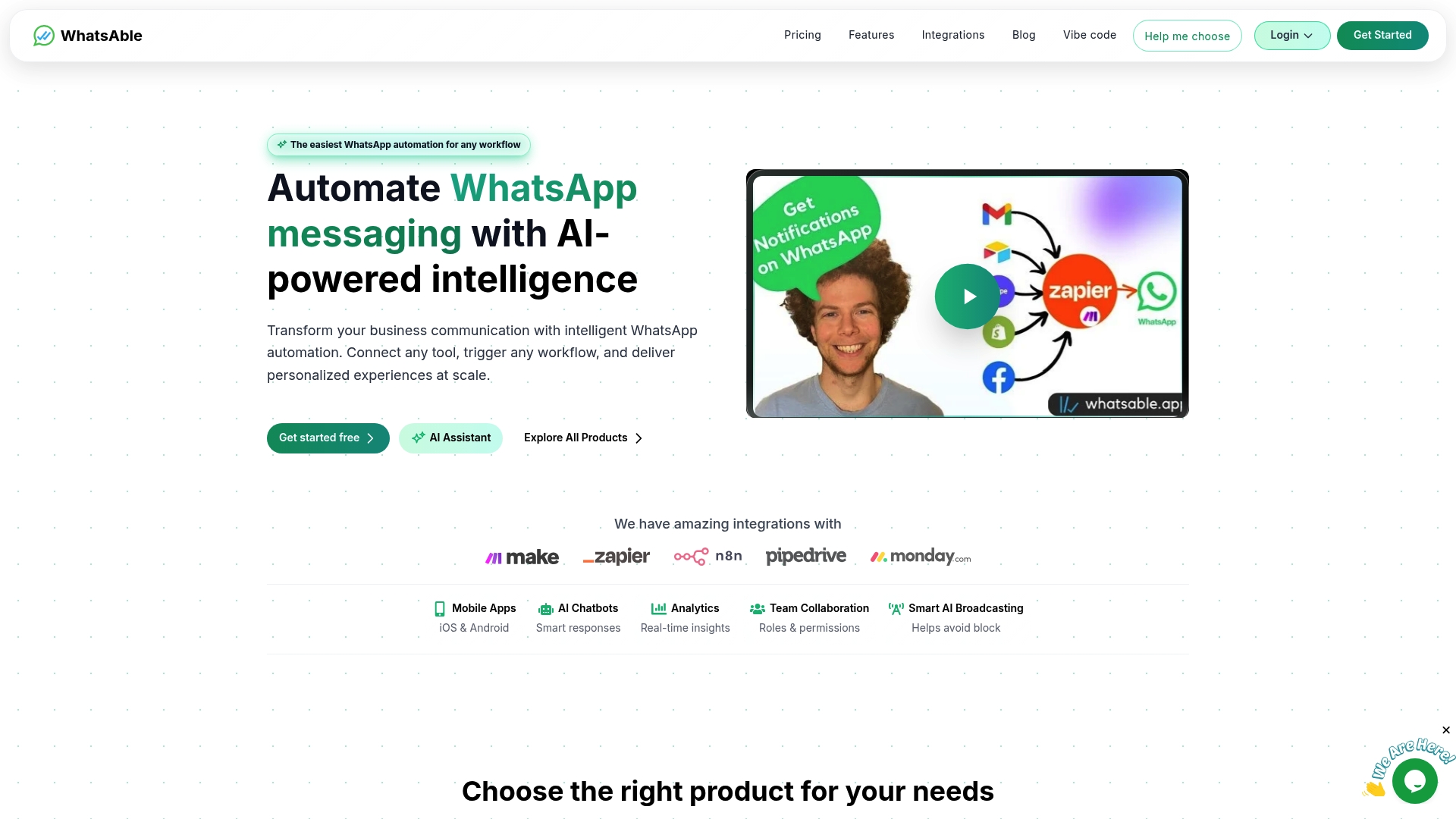
Whatsable is built specifically for this. The platform covers broadcast messaging with anti-block protection, AI-powered chatbot flows, automated follow-up sequences, and deep integrations with Zapier, Make, Pipedrive, and other tools your team already uses. Whether you are managing customer-facing conversations or internal alerts, Whatsable gives you the control and analytics to optimize every touchpoint. Businesses looking for a customized approach can also explore white-label solutions tailored to their specific workflow. Start building your WhatsApp journey the right way.
FAQ
What are the main stages in a WhatsApp customer journey?
The five stages are awareness, consideration, decision, retention, and advocacy. Each stage uses different WhatsApp message types, ranging from marketing messages at the top of the funnel to utility and service messages after purchase.
What is the WhatsApp 24-hour rule?
The 24-hour rule means businesses can send any type of message within 24 hours of a customer-initiated conversation. Outside that window, only pre-approved utility or authentication templates are allowed.
How does asynchronous messaging improve WhatsApp customer experience?
Asynchronous messaging lets customers respond on their own schedule without losing conversation history. This reduces repetition, increases satisfaction, and allows agents to manage more conversations simultaneously.
Can WhatsApp automation replace human customer support agents?
Automation handles high-volume, repetitive tasks like FAQs, order tracking, and appointment booking very well. Complex, sensitive, or escalation-level issues still benefit from human agents, and the best setups combine both.
What types of messages work best for post-purchase WhatsApp engagement?
Utility messages work best after purchase. Order confirmations, shipping updates, delivery alerts, and feedback requests all perform well because customers expect and want them. These messages also fall outside the 24-hour restriction and can be sent proactively.
 Mira Okonkwo