 Whatsable







TL;DR:
- WhatsApp Business adoption varies greatly by region, with Latin America and South Asia leading in market penetration. Businesses must assess local penetration, regulations, and language needs to optimize messaging strategies and choose appropriate verification tiers. Regional data-driven planning is essential for effective multi-market deployment and maximizing customer engagement.
WhatsApp Business availability by region is not uniform. Over 200 million businesses use the platform globally, split between 175 million on the free app and 25 million using the Business API for automation. That number sounds universal, but the reality is sharply concentrated. Latin America, South Asia, and parts of Europe account for the overwhelming majority of active business use. If you are deciding whether WhatsApp belongs in your communication stack, the single most important variable is not the platform itself. It is where your customers live.
WhatsApp Business availability by region: who leads and who lags?
The global picture of WhatsApp for business access is one of dramatic contrasts. Brazil alone accounts for 32.9% of all WhatsApp Business integrations worldwide. Spain follows at 6.2%, India at 6.1%, and the United States at 7.1%. Latin America as a whole represents over 40% of total business adoption. That concentration tells you something concrete: WhatsApp Business is not a global default. It is a regional powerhouse with pockets of dominance.
Latin America and South Asia: the core markets
In Brazil, WhatsApp penetration exceeds 90% of internet users, making it the default channel for customer engagement rather than a supplementary one. The same is true in Kenya and South Africa. India presents a different profile: massive raw user numbers driven by a population exceeding 1.4 billion, with business adoption accelerating rapidly across e-commerce, banking, and logistics verticals. For businesses operating in these markets, WhatsApp is not a channel to test. It is the channel to build around.

Europe, North America, and Southeast Asia
Europe shows strong adoption in Southern and Western countries, particularly Spain, Italy, Germany, and the Netherlands, where WhatsApp is the dominant personal messaging app. North America is a different story. WhatsApp grows at 30% year over year in the US, but smartphone penetration sits at roughly 29%, far behind iMessage and SMS. Businesses targeting American consumers cannot treat WhatsApp as a primary channel yet. Southeast Asia occupies the middle ground. Malaysia reaches 84% penetration among internet users, Singapore hits 76%, and approximately 12,000 businesses across the region actively use the API for automation.
Pro Tip: Before committing budget to WhatsApp Business in any market, check the country-level penetration data from sources like Statista or DataReportal. A 30-percentage-point difference in penetration translates directly into customer reach.
How does regional availability shape communication strategy?
Knowing where WhatsApp Business is available is only half the equation. The more useful question is how that availability should change what you actually do.
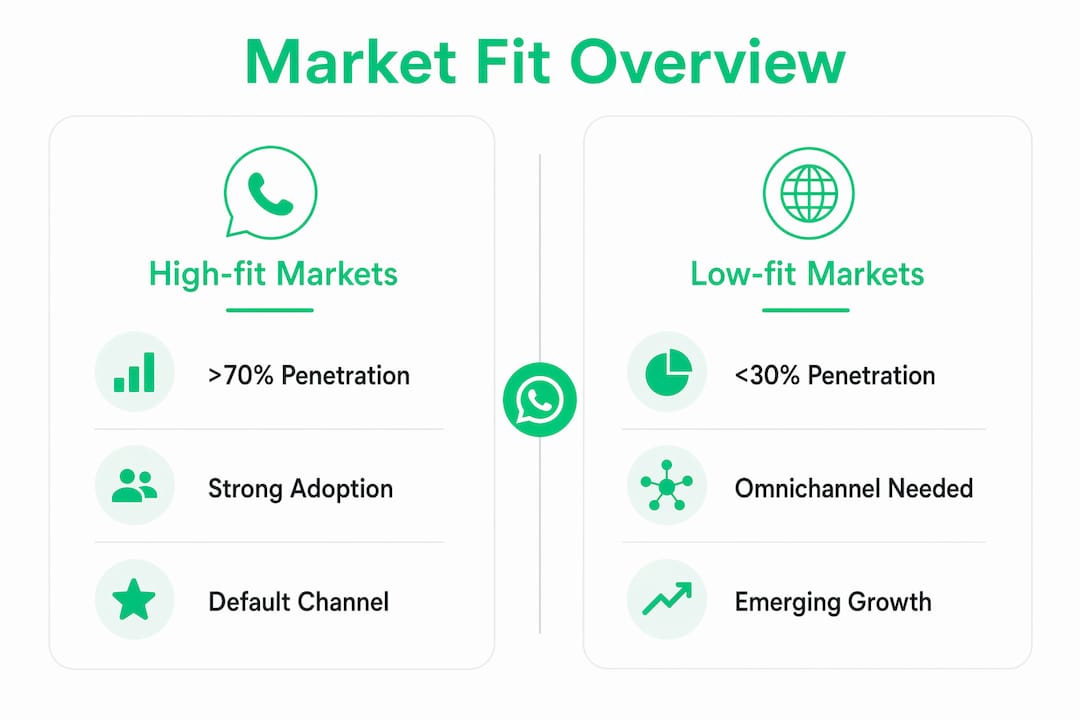
In markets where penetration exceeds 90%, WhatsApp functions as the default customer communication channel. Businesses in Brazil, Kenya, and South Africa that route support tickets, order confirmations, and promotional messages through WhatsApp see near 100% open rates via the Business API. That performance gap versus email or SMS is not marginal. It changes the economics of customer communication entirely.
In lower-penetration markets like the US or Japan, the right approach is omnichannel. WhatsApp sits alongside SMS, iMessage, and email rather than replacing them. Businesses that force WhatsApp as the sole channel in these markets create friction for customers who simply do not use it regularly.
Industry vertical also shapes adoption patterns. E-commerce and retail lead globally, using WhatsApp for order tracking, cart recovery, and post-purchase support. Hospitality businesses in Southeast Asia and Europe were early adopters, using it for booking confirmations and concierge-style messaging. For B2C automation strategies, pairing WhatsApp with SMS marketing automation creates coverage across both high and low penetration markets without abandoning either audience.
Key factors that should guide your channel strategy by region:
- Penetration rate: Markets above 70% justify WhatsApp as a primary channel.
- Demographic profile: Younger audiences in Southeast Asia and Latin America are heavy WhatsApp users.
- Language complexity: Multilingual markets like Malaysia require message templates in multiple languages.
- Regulatory environment: Some markets have stricter rules around promotional messaging via WhatsApp.
- Competitor channel dominance: WeChat in China, LINE in Japan and Thailand, and iMessage in the US each reduce WhatsApp’s effective reach.
What are the different WhatsApp Business verification types by region?
WhatsApp Business offers two distinct account tiers, and understanding which is available in your region directly affects what you can do on the platform.
-
Standard WhatsApp Business account. Available globally through the free app. Businesses get a profile with a description, address, and catalog. There is no visible verification badge, but the account is clearly labeled as a business. This tier suits small businesses and solopreneurs testing the channel.
-
Official Business Account (green badge). This is the verified tier, marked by a green checkmark next to the business name. Meta grants this status to select brands that meet eligibility criteria, including brand recognition, policy compliance, and account activity. Access to verification varies by country and region, with larger markets like Brazil, India, and Germany having more verified accounts than smaller or emerging markets.
-
WhatsApp Business API access. Not a badge, but a functional tier that unlocks message templates, automation, bulk messaging, and CRM integration. API access is available globally but requires a Meta Business Manager account, a verified phone number, and approval from a Meta Business Solution Provider. Approval timelines and template approval rates differ by region.
Pro Tip: If your business operates in a high-penetration market and you plan to send more than a few hundred messages per month, apply for API access through a verified Business Solution Provider rather than the free app. The automation and analytics capabilities alone justify the setup cost.
To obtain verification, businesses typically follow these steps:
- Create and complete a Meta Business Manager profile with accurate business details.
- Connect a dedicated phone number to WhatsApp Business.
- Submit a verification request through Meta’s Business Support portal.
- Provide business documentation, including registration certificates where required.
- Wait for Meta’s review, which can take days to weeks depending on region and account history.
How to assess if WhatsApp Business fits your target region
Before deploying WhatsApp Business in a new market, run a structured assessment. The goal is to match channel investment to actual customer behavior, not assumed global trends.
| Factor | High-fit market | Low-fit market |
|---|---|---|
| WhatsApp penetration | Above 70% of internet users | Below 40% of internet users |
| Primary messaging app | iMessage, LINE, WeChat, or SMS | |
| Industry vertical | E-commerce, retail, hospitality | B2B enterprise, government services |
| Audience age range | 18 to 45 | 55 and above in Western markets |
| Regulatory environment | Permissive for business messaging | Strict opt-in and data laws |
Start with penetration data from DataReportal or Statista for your specific country. Cross-reference with your existing customer data: if a meaningful share of your customers already contact you via WhatsApp, that is a stronger signal than any regional average. Run a 30-day pilot with a defined segment, track open rates, response rates, and conversion, then compare against your existing channels before scaling.
For businesses managing multiple regional markets simultaneously, B2C automation platforms that integrate with WhatsApp Business API can centralize performance data across regions, making it easier to allocate budget where WhatsApp actually delivers.
What are the common challenges and best practices across regions?
Regional WhatsApp Business deployment surfaces predictable problems. Knowing them in advance saves time and budget.
Fragmented messaging markets are the most common obstacle. A business serving customers in Brazil, the US, and Japan simultaneously cannot use a single-channel WhatsApp strategy. Each market requires a different primary channel, and WhatsApp plays a different role in each.
Regulatory differences add complexity. The EU’s GDPR requires explicit opt-in for marketing messages. Brazil’s LGPD mirrors similar requirements. India’s TRAI regulations govern commercial messaging. Businesses that copy a WhatsApp campaign from one region to another without legal review risk fines and account suspension.
Language barriers are underestimated. 63% of WhatsApp conversations in Malaysia mix English and Bahasa Malaysia. Indonesia skews almost entirely toward Bahasa Indonesia. A single English-language message template will underperform in both markets. Localized templates are not optional in multilingual regions. They are the baseline.
Best practices that consistently produce results across WhatsApp business regions:
- Build an omnichannel stack. WhatsApp performs best when it complements SMS and email rather than replacing them entirely.
- Use the WhatsApp Business API for any market where you send more than a few hundred messages monthly. The free app does not scale.
- Localize message templates by language and cultural context, not just by translation.
- Track opt-out rates by region. A spike in opt-outs signals that your messaging frequency or content is misaligned with local expectations.
- Assign dedicated team members or chatbot flows to handle WhatsApp conversations in each major language your customers use.
Key takeaways
WhatsApp Business availability by region is the single most important variable businesses must assess before committing to it as a primary communication channel.
| Point | Details |
|---|---|
| Regional concentration is extreme | Brazil alone holds 32.9% of global WhatsApp Business integrations, making Latin America the dominant market. |
| Penetration drives strategy | Markets above 70% penetration justify WhatsApp as a primary channel; below 40%, treat it as supplementary. |
| Verification affects functionality | Official Business Account status and API access vary by region and unlock automation, templates, and trust signals. |
| Multilingual markets need localized templates | Markets like Malaysia and Indonesia require language-specific message templates, not just translations. |
| Omnichannel beats single-channel | In North America and East Asia, pairing WhatsApp with SMS and email produces better coverage than WhatsApp alone. |
Why regional data should drive your WhatsApp investment decisions
Most businesses I have seen make the same mistake: they hear that WhatsApp has over two billion users and assume it works everywhere. It does not. The businesses that get real returns from WhatsApp are the ones that looked at their specific market first. A retail brand in São Paulo and a SaaS company in San Francisco are not operating in the same WhatsApp reality, even if they use the same platform.
The verification gap is also underappreciated. I have watched businesses in emerging markets spend months trying to obtain a green badge, only to discover that their country has a much longer approval queue than markets like Germany or Brazil. That delay costs them the trust signal that makes customers actually respond to messages. The practical fix is to invest in API access and message quality first. A well-structured, personalized message from an unverified account outperforms a generic blast from a verified one.
The multilingual dimension is where most global teams cut corners. Sending English templates to Malaysian or Indonesian customers is not a localization strategy. It is a missed conversion. The data on bilingual conversation rates in Southeast Asia is clear, and businesses that invest in proper language support see measurably better engagement. Regional WhatsApp Business features are not just about what Meta offers. They are about what your customers actually expect.
My honest recommendation: treat WhatsApp Business like any other market-entry decision. Run the penetration numbers, check the regulatory requirements, pilot before scaling, and never assume that what works in Brazil will work in Japan.
— Axel
Scale your WhatsApp Business across every region with Whatsable
Understanding regional availability is the first step. Executing across multiple markets at scale is where most businesses hit a wall.
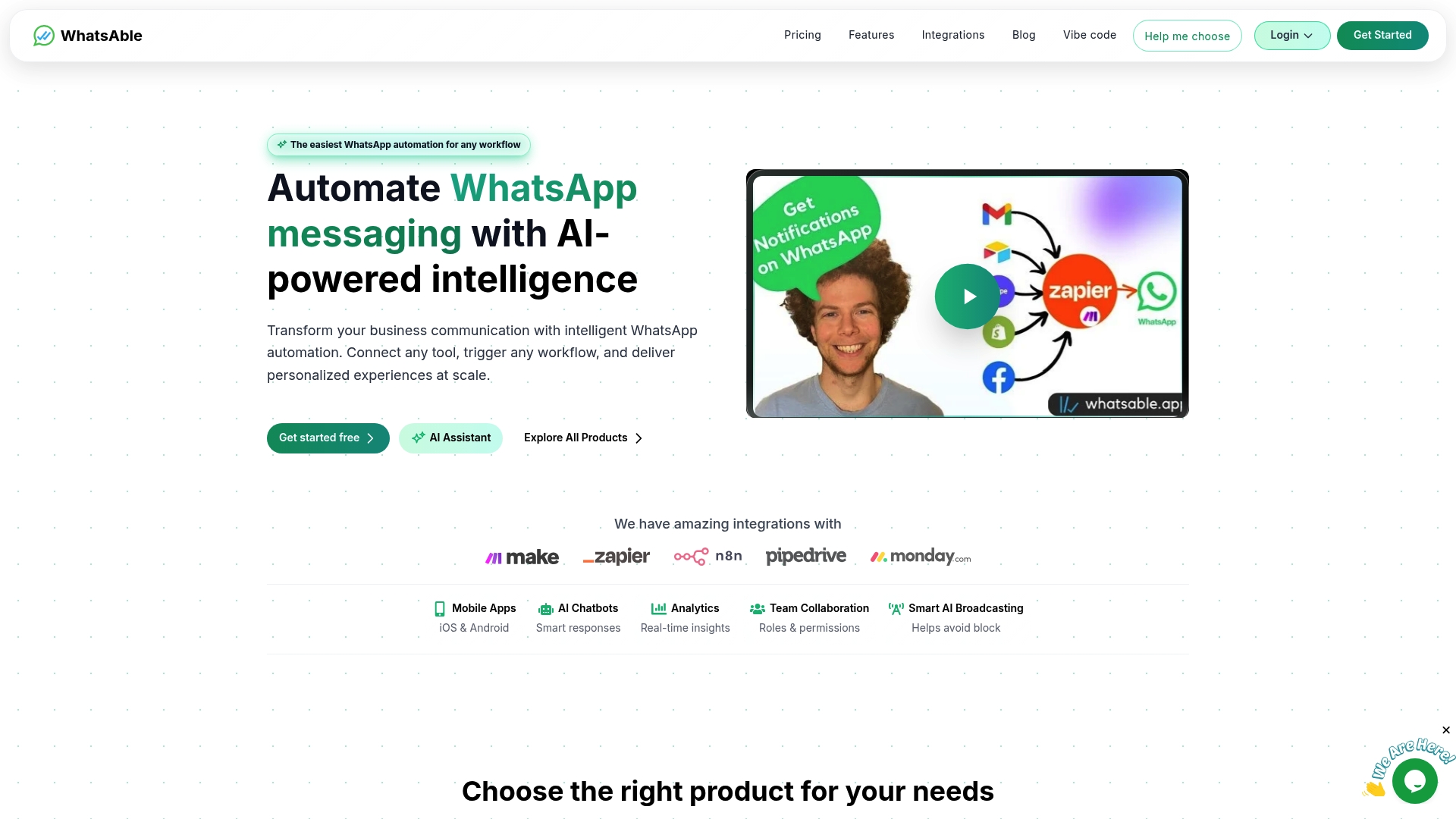
Whatsable is built specifically for businesses that need to automate, localize, and scale WhatsApp Business messaging across regions. Whatsable supports unlimited branded messages, automated follow-up sequences, and direct integrations with Zapier, Make, n8n, and Pipedrive. For businesses exploring whitelabel WhatsApp solutions for agencies or multi-market deployments, Whatsable provides the infrastructure to customize messaging by region without rebuilding from scratch. Whether you are entering a high-penetration market like Brazil or piloting WhatsApp alongside SMS in North America, Whatsable’s platform gives you the automation layer to do it efficiently.
FAQ
Which region has the highest WhatsApp Business adoption?
Latin America leads globally, with Brazil accounting for 32.9% of all WhatsApp Business integrations. The region as a whole represents over 40% of total business adoption worldwide.
Is WhatsApp Business available in the United States?
WhatsApp Business is available in the US, but penetration among smartphone users sits at roughly 29%, well below iMessage and SMS. It is the fastest-growing messaging app in the US with 30% year-over-year growth, but it functions best as a supplementary channel rather than a primary one.
What is the difference between WhatsApp Business verification types?
WhatsApp Business offers a standard business account available globally and an Official Business Account with a green verified badge granted by Meta to recognized brands. API access is a separate tier that unlocks automation and bulk messaging, with approval requirements and timelines that vary by region.
How does WhatsApp Business penetration affect open rates?
In high-penetration markets like Brazil and South Africa, businesses using the WhatsApp Business API report near 100% open rates, significantly outperforming email and SMS. Lower-penetration markets produce more modest results that align closer to standard email benchmarks.
Does WhatsApp Business support multilingual messaging?
Yes. WhatsApp Business supports multiple languages, and in markets like Malaysia, 63% of conversations mix English and Bahasa Malaysia. Businesses operating in multilingual regions should create separate message templates for each language rather than relying on a single translated version.

 Jonah Reed
 Mira Okonkwo