 Whatsable







TL;DR:
- WhatsApp commerce enables businesses to sell products and services directly within chat using interactive features, AI, and in-chat payments. It effectively consolidates the customer journey inside WhatsApp, increasing conversion rates across retail, services, and emerging markets. Success depends on strategic planning, template approval, and starting small to optimize each touchpoint before scaling.
WhatsApp commerce is the practice of selling products and services directly inside WhatsApp chat using the WhatsApp Business Platform’s interactive features, AI agents, and in-chat payment systems. Over 200 million businesses use WhatsApp Business monthly, and the most forward-thinking among them have moved well beyond simple customer service. Retailers like Magalu, real estate developers, COD merchants in South Asia and MENA, and service businesses across healthcare and beauty are now running complete commerce loops inside a single chat window. These WhatsApp commerce examples by industry prove that the channel is not a supplement to your sales funnel. It is the funnel.

1. How retail businesses use WhatsApp for end-to-end commerce
Retail is where WhatsApp commerce examples by industry are most dramatic. Brazilian retail giant Magalu built a full conversational shopping experience inside WhatsApp using an AI agent called “Lu’s Brain,” card carousels for product browsing, and payments integrated with Pix, Brazil’s instant payment system. The result was a 3X higher conversion rate compared to their traditional ecommerce channels. That gap exists because customers never leave the conversation to complete a purchase.
The mechanics behind Magalu’s approach are worth studying closely:
- AI-powered product discovery: Lu’s Brain interprets natural language queries, recommends products, and surfaces catalog items without the customer typing a search term into a website.
- Card carousels: Customers swipe through product options with images, prices, and descriptions inside the chat window itself.
- WhatsApp Flows: Multi-step in-chat forms collect order details, delivery addresses, and payment preferences without a browser redirect.
- In-chat payments with Pix: The entire transaction completes inside WhatsApp, and real-time shipping updates arrive in the same thread.
The core insight from Magalu’s model is that removing channel breaks between discovery, purchase, and post-purchase communication is what drives conversion. Every redirect to an external site is a potential exit point. Keeping the entire loop inside WhatsApp eliminates those exits.
Pro Tip: Pair an AI shopping assistant with a dynamic product catalog and WhatsApp Flows to replicate the Magalu model at any scale. You do not need a Magalu-sized engineering team. Platforms like Whatsable provide the infrastructure to connect catalog feeds, automate responses, and trigger payment flows from a single dashboard.
2. How service industries use WhatsApp Flows for bookings and lead capture
Service businesses in healthcare, beauty, real estate, and professional services have adopted WhatsApp Flows as their primary intake mechanism. WhatsApp Flows are multi-step in-chat forms that collect structured data without redirecting users to an external page. This distinction matters because every redirect reduces completion rates.
Here is how different service verticals deploy Flows in practice:
- Healthcare appointment booking: A clinic Flow collects the patient’s preferred service type, available date and time, and contact information. The backend integration then writes directly to the scheduling system and sends a confirmation message in the same thread.
- Beauty and wellness: Salons use Flows to capture service selection, stylist preference, and deposit payment before confirming a slot. This eliminates no-shows and reduces manual back-and-forth.
- Real estate lead qualification: Agencies deploy Flows that ask prospects for their budget range, preferred location, timeline to purchase, and contact details. The structured output feeds directly into a CRM without any manual data entry.
- Support ticket creation: Instead of waiting for a human agent, customers complete a Flow that captures the issue type, order number, and description. The ticket is created automatically and routed to the right team.
- NPS and survey collection: WhatsApp Flows surveys achieve 40 to 60% completion rates compared to 5 to 15% for email surveys. That difference translates directly into better feedback data and more reliable loyalty metrics.
The reason Flows outperform email forms and chatbot sequential questioning is that they feel native to the conversation. The user never senses a context switch.
Pro Tip: Design your Flows with the minimum number of steps required to qualify or book. Every additional screen increases drop-off. Use conditional logic to skip irrelevant questions based on earlier answers, and connect the Flow output to a webhook so your CRM or scheduling tool updates in real time.
3. How COD merchants in emerging markets run order flows on WhatsApp
Cash on delivery is the dominant payment method across South Asia, MENA, and Southeast Asia. The standard ecommerce checkout model, which requires a browser redirect and card entry, fails this audience. WhatsApp Flows for COD solve this by keeping the entire order placement inside the chat.
The conversion numbers are striking. COD merchants running in-chat order forms see 45 to 60% conversion rates, roughly five times higher than average Shopify checkout completion rates. That gap exists for two structural reasons. First, mobile-first consumers in these markets are already inside WhatsApp for most of their daily communication. Second, browser-based checkouts fail frequently on unstable mobile networks, and a native in-chat Flow does not depend on a reliable browser session.
A typical COD WhatsApp commerce flow works like this:
- The customer browses a product catalog shared inside WhatsApp or clicks a Click-to-WhatsApp ad.
- A Flow collects the shipping address, confirms the product and quantity, and presents COD as the payment option.
- The order is written to Shopify or a connected order management system via webhook.
- A confirmation message with order details is sent immediately in the same chat.
- A post-order verification message asks the customer to confirm the order is correct.
That last step is critical. COD order verification via WhatsApp reduces return-to-origin rates, which can consume 15 to 30% of revenue for merchants who skip this step. A simple “Please confirm your order of [product] to [address]” message with a Yes/No button cuts fraud and fulfillment errors significantly.
Pro Tip: Use WhatsApp as your post-order verification channel even if you already have a working checkout. The confirmation message alone, sent within minutes of order placement, reduces returns and builds customer trust in markets where fraud anxiety is high.
4. How real estate developers use WhatsApp CRM automation to convert leads
Real estate is a high-stakes, long-cycle sales process where speed to first contact determines whether a lead converts or goes to a competitor. One residential developer improved site-visit conversion from 0.8% to 3.4%, a 4.2x lift, by deploying WhatsApp Cloud API automation with a structured message template strategy.
The automation sequence worked across three stages:
- Lead acknowledgment: Within 90 seconds of a form submission or ad click, the prospect received a personalized WhatsApp message confirming receipt and offering to schedule a site visit.
- Reminder cadence: Automated template messages sent 24 hours and 2 hours before the scheduled visit reduced no-show rates significantly.
- Post-visit drip: A multi-message sequence sent over 7 days after the visit shared floor plans, financing options, and testimonials, keeping the property top of mind without requiring a salesperson to follow up manually.
The operational lesson here is that message template management is as important as the automation logic itself. Meta requires pre-approval for all outbound WhatsApp template messages. Developers who map every journey stage and submit templates before launch avoid the delays that kill momentum in competitive markets.
Pro Tip: Build your template library before you build your automation. Map every touchpoint in the buyer journey, write a template for each one, and submit them for Meta approval at least two weeks before your campaign launch. One rejected template can stall an entire pipeline.
5. How D2C brands and hyperlocal retail use Click-to-WhatsApp ads
Direct-to-consumer brands in fashion, food, and beauty have found that Click-to-WhatsApp ads convert 3 to 5 times better than Click-to-Site ads for consumer goods. The reason is intent alignment. A customer who clicks a WhatsApp button is signaling they want a conversation, not a product page. Meeting them with an automated but personalized response inside WhatsApp captures that intent before it cools.
A hyperlocal food brand running Click-to-WhatsApp ads on Instagram can automate the entire intake: the ad click opens a WhatsApp chat, a Flow captures the order and delivery address, and a confirmation with estimated delivery time arrives within seconds. No app download, no account creation, no checkout friction. The customer is already in WhatsApp. The brand just shows up there.
This model scales well for beauty and fashion brands that sell through social media. A customer who sees a product in a Reel and clicks through to WhatsApp can receive a personalized recommendation, a size guide, and a payment link inside a single conversation. Platforms that support AI-powered conversational search take this further by letting customers describe what they want in natural language and receiving matched product suggestions instantly.
6. How financial services and insurance use WhatsApp for policy and account management
Financial services firms use WhatsApp for policy renewals, claim status updates, and account notifications because the channel reaches customers where they already are. An insurance company sending a renewal reminder via WhatsApp gets significantly higher open and response rates than the same message sent by email. The conversation format also allows the customer to ask follow-up questions immediately, reducing inbound call volume.
The WhatsApp Business Platform’s messaging infrastructure supports the compliance requirements financial services firms need, including message logging, opt-in management, and template-based outbound communication. Banks use WhatsApp to send transaction alerts, fraud warnings, and one-time passwords. Insurance firms use it for claim submission Flows that collect photos, descriptions, and policy numbers inside the chat.
The key differentiator for financial services is trust. WhatsApp’s end-to-end encryption and the verified business profile badge signal legitimacy to customers who are rightly cautious about financial communications. This is why industries using WhatsApp commerce in the financial sector focus on notification and verification use cases before moving to full transactional commerce.
Key takeaways
WhatsApp commerce succeeds when the entire customer journey, from discovery to payment to post-purchase support, stays inside a single chat thread without a redirect.
| Point | Details |
|---|---|
| Retail conversion lift | Magalu achieved 3X higher conversion by combining AI agents, card carousels, and Pix payments inside WhatsApp. |
| Flows beat external forms | WhatsApp Flows deliver 40 to 60% survey completion rates versus 5 to 15% for email, making them the strongest intake tool for service businesses. |
| COD market opportunity | In-chat COD order forms produce 45 to 60% conversion rates, five times higher than standard Shopify checkout in mobile-first markets. |
| Real estate speed wins | A 4.2x site-visit conversion lift came from automating first-touch within 90 seconds and managing a full template library across the buyer journey. |
| Template preparation is non-negotiable | Pre-approving Meta message templates before campaign launch prevents delays that stall pipeline momentum across every industry. |
What I’ve learned from watching WhatsApp commerce mature across industries
I’ve watched businesses in a dozen verticals attempt WhatsApp commerce, and the pattern of failure is almost always the same. They build the automation before they build the template library. They launch a Flow without testing the webhook integration. They send a campaign and have no human handoff protocol when a customer replies with something the bot cannot handle.
The businesses that succeed treat WhatsApp as a channel that requires the same strategic rigor as a website or a paid media program. Magalu did not bolt an AI agent onto WhatsApp as an experiment. They designed the entire commerce experience around the channel’s constraints and capabilities. That is the mindset shift most businesses have not made yet.
The other thing I’d push back on is the assumption that WhatsApp commerce is primarily a developing-market story. Yes, COD flows in South Asia and MENA are compelling. But the Magalu model works in any market where mobile is the primary commerce device. The U.S. and Western Europe are catching up faster than most people expect, and the brands that build WhatsApp commerce infrastructure now will have a meaningful head start.
One practical recommendation I give every team I work with: do not try to automate everything on day one. Start with the single highest-friction point in your customer journey, whether that is appointment booking, order confirmation, or lead qualification, and build one Flow that handles it well. Measure completion rates. Iterate. Then expand. The businesses that try to launch a full WhatsApp commerce suite in one sprint almost always end up with a fragile system that breaks at the worst possible moment.
— Axel
How Whatsable helps you launch WhatsApp commerce faster
If these examples have shown you where WhatsApp commerce fits your business, the next question is execution. Whatsable is built specifically for businesses that need to move from strategy to live campaigns without a six-month development cycle.
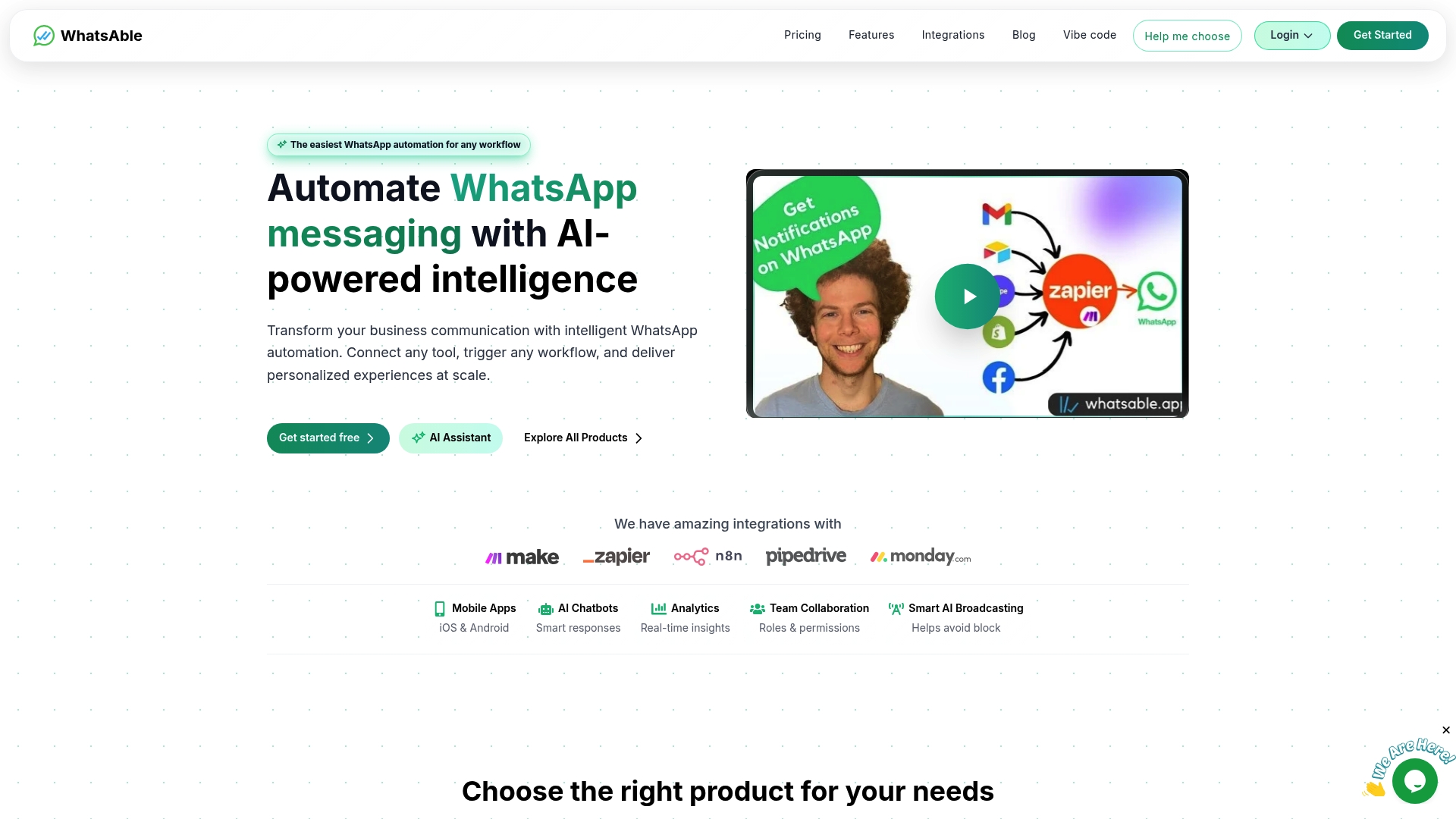
The Whatsable platform supports catalog integration, WhatsApp Flows setup, bulk messaging with anti-block measures, AI chatbot configuration, and webhook connections to tools like Zapier, Make, n8n, and Pipedrive. Whether you are a D2C brand running Click-to-WhatsApp campaigns, a real estate team automating lead nurture, or a service business deploying booking Flows, Whatsable provides the infrastructure to build and scale without custom engineering. For agencies managing multiple clients, the white-label option lets you deliver branded WhatsApp commerce solutions under your own name.
FAQ
What is WhatsApp commerce?
WhatsApp commerce is the practice of selling products and services directly inside WhatsApp using the Business Platform’s interactive features, including catalogs, Flows, AI agents, and in-chat payments. It keeps the entire customer journey inside a single chat thread.
Which industries benefit most from WhatsApp commerce?
Retail, real estate, healthcare, beauty, food and beverage, financial services, and COD-focused D2C brands in South Asia and MENA see the strongest results. Mobile-first D2C brands in fashion and beauty report Click-to-WhatsApp ads converting 3 to 5 times better than Click-to-Site alternatives.
What are WhatsApp Flows and why do they matter?
WhatsApp Flows are multi-step in-chat forms that collect structured data without redirecting users to an external page. They are used for appointment booking, lead qualification, support ticketing, and order placement, and they consistently outperform email forms on completion rates.
How do COD merchants use WhatsApp for orders?
COD merchants use WhatsApp Flows to collect shipping details, confirm product selection, and verify orders inside the chat. This approach produces 45 to 60% conversion rates, far above standard ecommerce checkout benchmarks in mobile-first markets.
How many businesses use WhatsApp Business?
Over 200 million businesses use WhatsApp Business monthly for sales, marketing, and customer service, making it the largest business messaging platform in the world by active business accounts.
 Elias Navarro