 Whatsable







TL;DR:
- WhatsApp surpasses email and SMS in customer retention thanks to high open and response rates, fostering personalized, behavior-triggered conversations. Its multi-modal messaging, lifecycle framework, and AI integrations enable brands to build long-term loyalty and increase revenue through timely, relevant interactions. Success depends on strategic segmentation, automation, and investing in infrastructure that treats WhatsApp as a relationship channel rather than just a broadcast tool.
WhatsApp for customer retention is the practice of using WhatsApp’s messaging platform to engage customers through personalized, timely, and behavior-triggered communication that drives repeat purchases and long-term loyalty. With 98% open rates and 30–40% response rates, WhatsApp outperforms email and SMS by a wide margin on every engagement metric that matters. That gap is not a minor advantage. It means customers actually read what you send, respond to it, and buy again. The WhatsApp Business API, AI-powered chatbots, and behavior-triggered messaging sequences give support teams and marketers the tools to turn a single purchase into a lasting relationship.
How WhatsApp for customer retention outperforms traditional channels
Most businesses still treat retention as an email problem. They build drip sequences, A/B test subject lines, and wonder why repeat purchase rates stay flat. The data tells a different story.
WhatsApp campaigns double or triple repeat purchases compared to email alone. Customers treat WhatsApp messages the way they treat texts from friends, not promotional noise. That behavioral difference is the foundation of every effective retention strategy on the platform.
| Channel | Open rate | Response rate | Repeat purchase impact |
|---|---|---|---|
| 98% | 30–40% | High (2–3x email) | |
| 20–25% | 2–5% | Baseline | |
| SMS | 85–90% | 10–15% | Moderate |
| Push notifications | 5–10% | Under 5% | Low |
The table above shows why WhatsApp is not just another channel. The combination of near-universal open rates and genuine two-way response rates creates a conversation dynamic that email and push notifications cannot replicate. When a customer replies to your WhatsApp message, you have a live thread with purchase history, preferences, and context all in one place.
WhatsApp also supports multi-modal messaging. You can send images, short videos, voice notes, and product catalogs inside a single thread. That richness reduces the friction between discovery and purchase. A customer who sees a product video, asks a question, and completes a purchase without leaving the app is far more likely to return than one who clicks through three pages on a mobile browser.
A common misperception is that WhatsApp is only useful for customer service tickets. Businesses that limit it to reactive support miss the proactive retention opportunity entirely.
Pro Tip: Send no more than two to three WhatsApp messages per week to active customers, and drop to one per month for dormant segments. Frequency above that threshold increases opt-outs faster than it increases conversions.
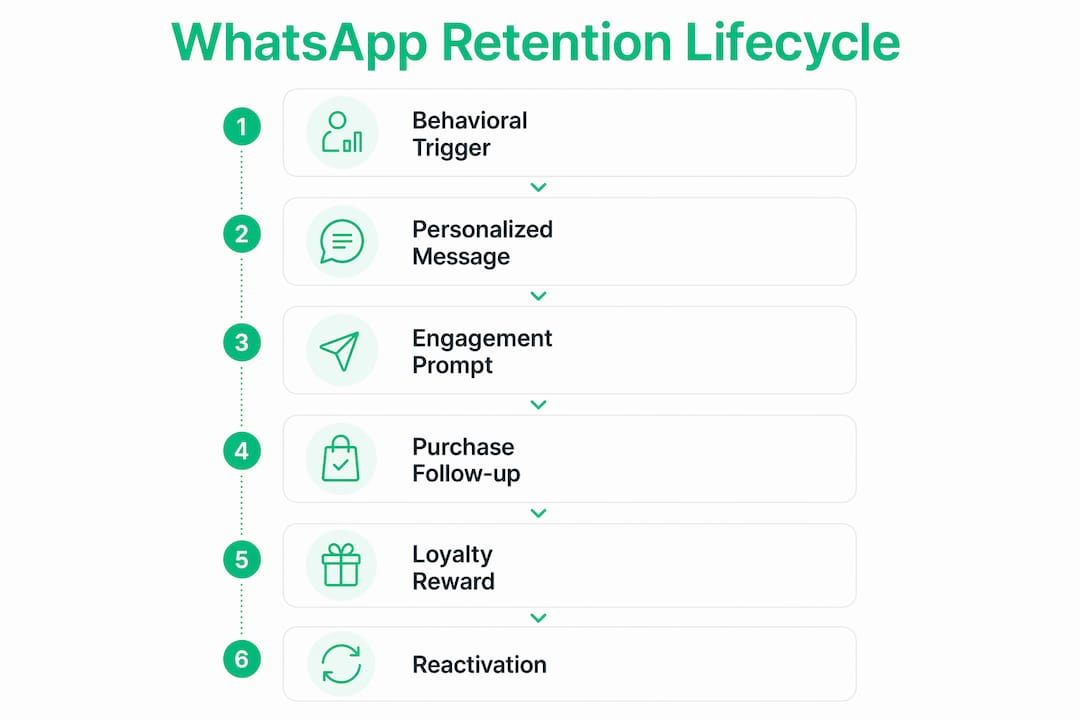
What is the 6-stage WhatsApp retention lifecycle?
A 6-stage lifecycle framework targeting customers at key post-purchase touchpoints delivers 3 to 6 times the revenue of email-only retention programs. The stages are not arbitrary. Each one maps to a moment when the customer is psychologically primed to engage.
- Delivery confirmation. Send within hours of shipment. Confirm the order, provide tracking, and set expectations. This is the highest-open message in the entire sequence.
- Product success tips. Send 24 to 48 hours after delivery. Share a short how-to video or usage tip relevant to what they bought. Brands like SNOCKS use this stage to reduce returns and build confidence in the product.
- Review request. Send three to five days post-delivery. Ask for feedback while the experience is fresh. Customers who leave reviews have measurably higher lifetime value than those who do not.
- Cross-sell. Send seven to ten days after purchase. Recommend a complementary product based on what they bought, not a generic bestseller list. Personalization at this stage is the difference between a click and an ignore.
- Replenishment reminder. Timed to the product’s natural consumption cycle. A skincare brand sending a refill reminder at day 28 is not guessing. It is using purchase data to be useful at exactly the right moment.
- Win-back. Triggered when a customer goes 60 to 90 days without a purchase. Brands like Uncover use a personalized offer at this stage to recover customers who would otherwise churn silently.
Messages sent within 7 days of delivery show 98% repeat purchase receptivity. That number explains why the first three stages of this framework carry disproportionate weight. The window is short and the customer is paying attention.
The critical distinction between this framework and a standard email drip is behavioral triggering. Calendar-scheduled messages go out whether or not the customer has taken an action. Behavior-triggered messages fire only when a specific event occurs, such as a delivery scan, a product page revisit, or a lapse in purchase activity. Behavior-triggered messaging dramatically reduces opt-outs because every message arrives at a moment of relevance.
Pro Tip: Connect your WhatsApp messaging platform to your order management system or CRM before building any lifecycle sequence. Without event data feeding the triggers, you are back to calendar scheduling and the results will reflect that.
How to integrate WhatsApp into your customer service strategy
Effective WhatsApp retention requires integration across the entire customer journey, not just the post-purchase phase. That means connecting WhatsApp to your CRM, your order system, and your support queue so that every agent and every automated message has full context.
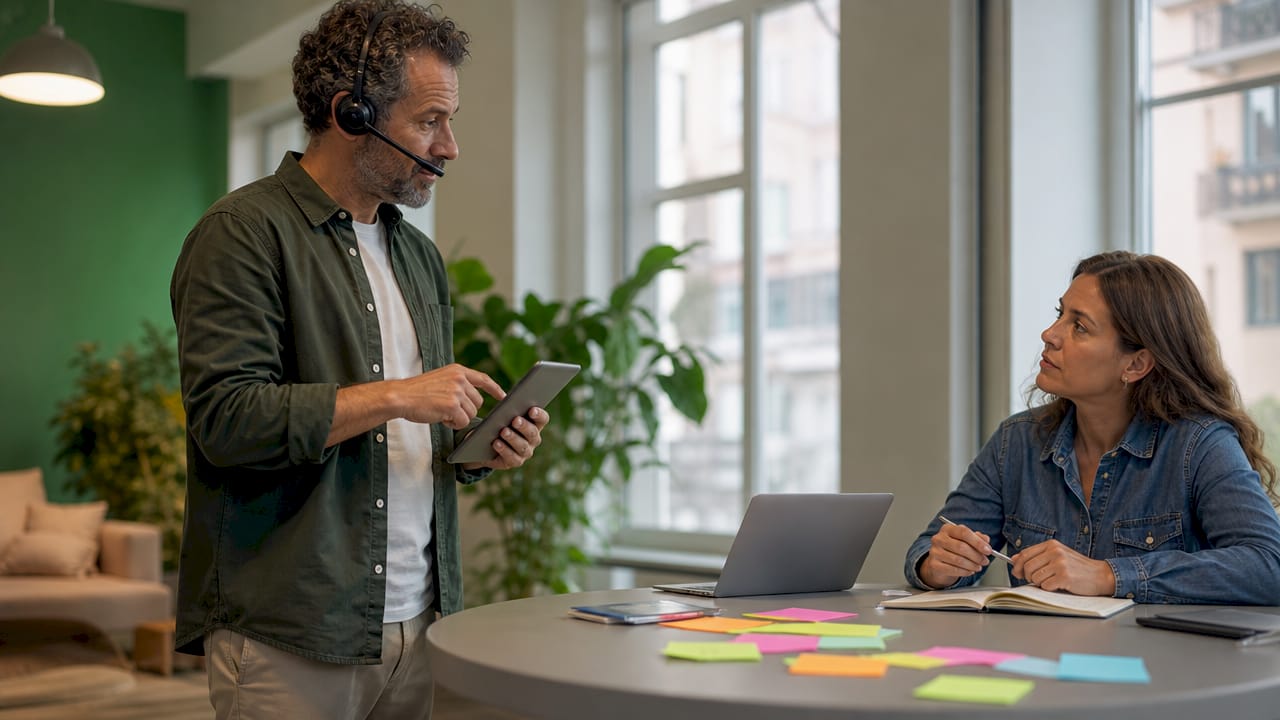
AI-powered chatbots handle routine queries 24/7, freeing human agents to focus on the complex, emotionally charged interactions that actually build loyalty. A chatbot can resolve a tracking question in 30 seconds. A human agent is the right choice when a customer is frustrated about a damaged product or a billing dispute. The skill is knowing which situation calls for which response. AI automation complements rather than replaces human interaction, and the best support teams design their handoff logic before they go live.
There is also a hard operational constraint to understand. WhatsApp enforces a 24-hour session window for freeform messaging after a customer contacts you. Outside that window, you can only send pre-approved message templates. This rule requires your CRM to track session status in real time. Teams that ignore it send messages that never arrive and cannot diagnose why.
Key integration practices for customer support teams:
- Segment your contacts with WhatsApp labels. Tag customers as new, loyal, dormant, or VIP. Send different message sequences to each group. A win-back offer sent to a loyal customer is wasted spend and a minor annoyance.
- Get explicit opt-in before messaging. WhatsApp’s policies require consent, and customers who opt in voluntarily have significantly higher engagement than those added to broadcast lists without permission.
- Maintain consistent tone across channels. If your brand voice on email is warm and direct, your WhatsApp messages should match. Inconsistency erodes trust faster than most teams realize.
- Monitor opt-out rates weekly. A spike in opt-outs is a signal that message frequency or relevance has slipped. Catch it early before it becomes a deliverability problem.
Customers prefer quick, mobile-friendly interactions on WhatsApp, and 90%+ open rates confirm they are paying attention. That attention is a privilege, not a right. Treat it accordingly.
What advanced WhatsApp features drive loyalty and engagement?
Beyond the basics of text messaging and chatbots, WhatsApp offers a set of capabilities that most businesses have not fully deployed. Each one reduces friction between the customer and the next purchase.
Rich media communication including images, videos, and voice notes makes interactions more dynamic and effective than plain text. A furniture brand sending a short assembly video inside the delivery confirmation thread solves a problem before the customer thinks to ask. A skincare brand sending a 30-second voice note from a founder feels personal in a way that a templated email never will.
In-chat purchase options are the most underused feature in WhatsApp retention. When a customer can browse a product catalog, ask a question, and complete a payment without leaving the app, conversion rates rise and cart abandonment drops. The fewer steps between intent and purchase, the better.
Loyalty programs integrated within WhatsApp combine the platform’s 98% open rates with points and rewards visibility inside the app. American Eagle has used this approach to drive higher engagement than standalone loyalty app notifications. When customers can check their points balance and redeem rewards in the same thread where they get support, the loyalty program becomes part of the relationship rather than a separate system to remember.
AI-powered personalization at scale is now accessible through platforms that connect WhatsApp to product recommendation engines. Instead of sending the same cross-sell message to every customer who bought a running shoe, you send a message about compression socks to the runner who bought trail shoes and a message about insoles to the customer who bought walking shoes. The AI strategies for building customer loyalty available in 2026 make this level of segmentation practical for mid-market businesses, not just enterprise teams.
Multilingual support and 24/7 availability through AI chatbots remove two of the biggest barriers to global retention programs. A customer in Mexico City and a customer in Berlin can both get a relevant, personalized message in their language at the right time in their local context.
Key takeaways
WhatsApp retention works because behavior-triggered, personalized messaging at the right moment in the customer lifecycle produces engagement rates that no other channel currently matches.
| Point | Details |
|---|---|
| Open and response rates | WhatsApp achieves 98% open rates and 30–40% response rates, far above email and SMS benchmarks. |
| 6-stage lifecycle framework | Delivery confirmation through win-back sequences deliver 3 to 6 times the revenue of email-only programs. |
| Behavioral triggers over broadcasts | One relevant triggered message outperforms ten generic blasts and produces far fewer opt-outs. |
| AI plus human balance | Chatbots handle routine queries while human agents manage complex, loyalty-building interactions. |
| 24-hour session window | WhatsApp’s messaging policy requires CRM integration to track session status and send compliant messages. |
Why most businesses are still getting WhatsApp retention wrong
I have watched dozens of businesses launch WhatsApp programs with genuine excitement and then quietly abandon them six months later because the results were disappointing. Almost every failure traces back to the same mistake: they treated WhatsApp like a faster email list.
They uploaded their entire contact database, sent a promotional broadcast on the first of every month, and measured success by whether the message was delivered. They never connected purchase behavior to message timing. They never segmented by lifecycle stage. They sent the same win-back offer to customers who had bought three times in the past month. The opt-outs came quickly, and the team concluded that “WhatsApp doesn’t work for our audience.”
What actually does not work is ignoring the behavioral context that makes WhatsApp powerful in the first place. The 98% open rate is real, but it is earned by relevance and timing, not by the channel itself. A message that arrives the day after delivery, references the specific product the customer bought, and offers a genuinely useful tip will get a response. A generic “We miss you, here’s 10% off” message sent to everyone who has not bought in 30 days will get ignored or blocked.
The other mistake I see consistently is under-investing in the handoff between automation and human agents. Teams build a chatbot, set it to handle everything, and then wonder why customer satisfaction scores drop. The chatbot is excellent at tracking queries and FAQs. It is not equipped to handle a customer who received a damaged product and is genuinely upset. That customer needs a human, and they need one quickly. Building that escalation logic before launch is not optional.
The businesses I have seen succeed with WhatsApp retention share one trait: they treat it as a relationship channel, not a broadcast channel. They measure response rates and conversation quality, not just delivery rates. They watch opt-out trends weekly. And they invest in the CRM integrations that make behavioral triggering possible. That infrastructure takes time to build, but the revenue lift makes it one of the highest-return investments a retention team can make in 2026.
— Axel
Put WhatsApp retention to work with Whatsable
If the 6-stage lifecycle framework and behavioral triggering approach described in this article sounds like the right direction for your business, Whatsable is built to make that infrastructure practical without a six-month engineering project.
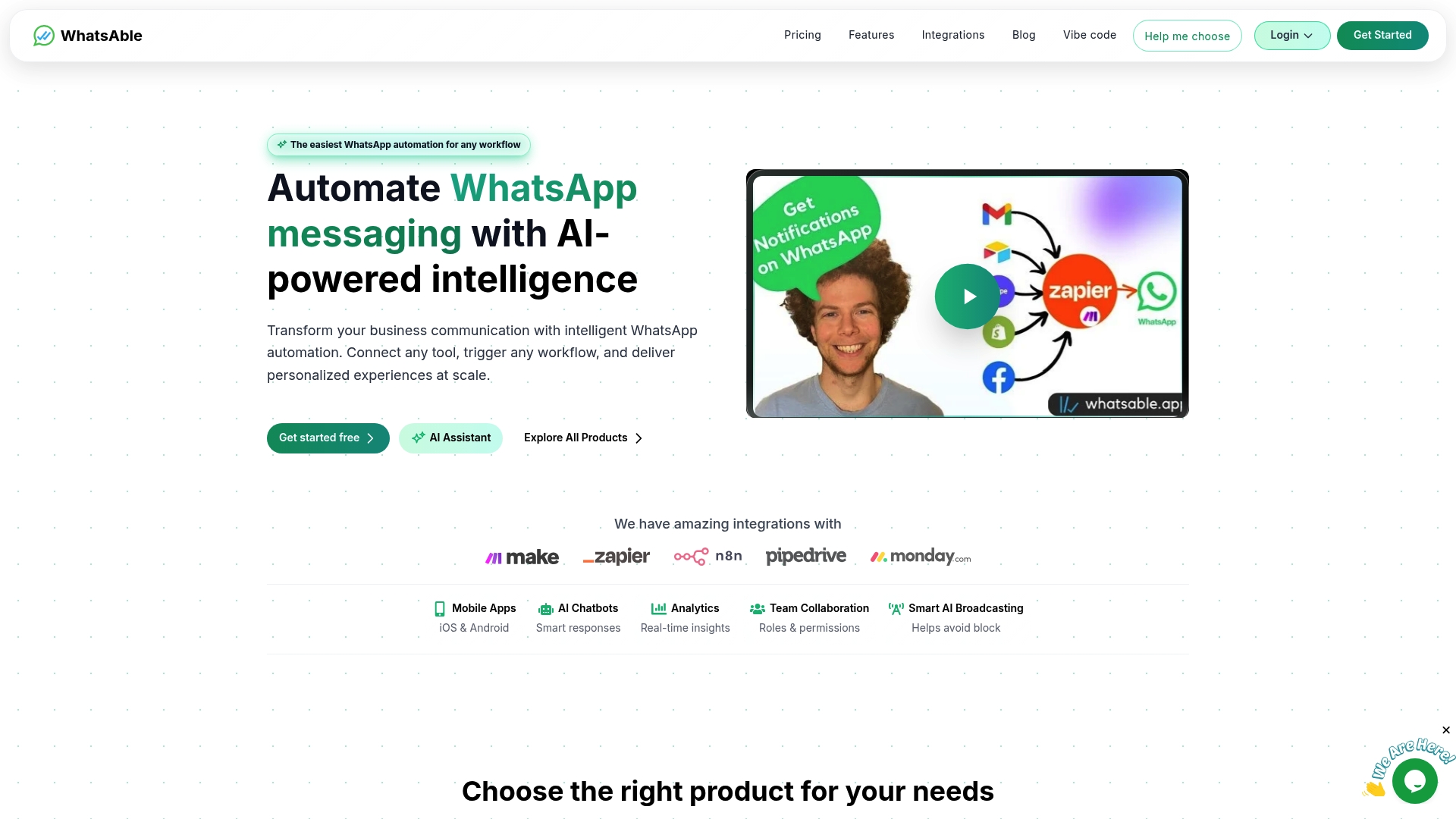
Whatsable lets you send unlimited branded WhatsApp messages, build automated follow-up sequences triggered by customer behavior, and connect to tools like Zapier, Make, n8n, and Pipedrive without custom code. AI-powered chatbots handle routine support queries around the clock, and human agent handoff is built into the workflow so your team steps in at exactly the right moment. From bulk messaging with anti-block protection to detailed analytics that track response rates and opt-outs, Whatsable gives your retention program the infrastructure it needs to perform at the level the data in this article describes.
FAQ
What is WhatsApp for customer retention?
WhatsApp for customer retention is the use of WhatsApp’s messaging platform to send personalized, behavior-triggered messages that drive repeat purchases and long-term loyalty. It differs from broadcast marketing by targeting customers at specific moments in their post-purchase journey.
Why does WhatsApp outperform email for retention?
WhatsApp achieves 98% open rates and 30–40% response rates compared to email’s 20–25% open rates and 2–5% response rates. That gap in engagement directly translates to higher repeat purchase rates and lower churn.
What is the 24-hour session window rule?
WhatsApp allows freeform messaging only within 24 hours of a customer contacting your business. After that window closes, you must use pre-approved message templates, which requires your CRM to track session timing in real time.
How many WhatsApp messages should I send per week?
Two to three messages per week is the recommended ceiling for active customers, with one message per month for dormant segments. Exceeding that frequency increases opt-outs without a proportional increase in conversions.
Do I need the WhatsApp Business API for retention campaigns?
Yes. The WhatsApp Business app supports only basic messaging and is limited to small contact volumes. The WhatsApp Business API is required for behavior-triggered sequences, CRM integration, AI chatbots, and the bulk messaging capabilities that make retention campaigns scalable.
 Elias Navarro