 Whatsable







TL;DR:
- WhatsApp is the most engaging communication channel for European retail, with a nearly 98% open rate. AI automation significantly improves campaign performance, with up to 2.25 times higher GMV compared to manual broadcasts. Retailers must adhere to strict GDPR opt-in rules and use integrated platforms to ensure compliance and personalization.
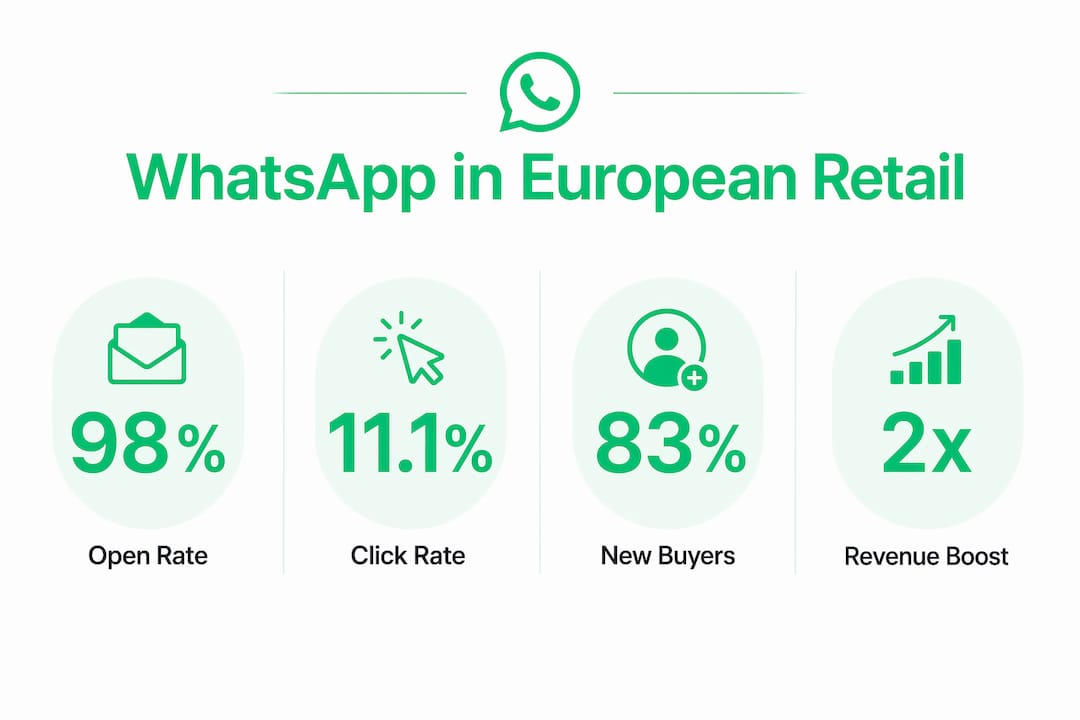
WhatsApp is the leading conversational channel in European retail communication, replacing broadcast email and SMS with personalized, two-way messaging that customers actually read. The platform’s average open rate sits at roughly 98%, a figure that makes every other digital channel look anemic by comparison. That number means a promotional message sent via WhatsApp reaches nearly every recipient, while the same message in an inbox competes with hundreds of others. For European retailers navigating tighter margins and rising acquisition costs, that reach is not a nice-to-have. It is a structural advantage.
The role of WhatsApp in European retail communication has shifted decisively from mass blasting to conversational commerce. Retailers who treat it as another broadcast tool miss the point entirely. The platform’s real power comes from AI-driven automation, GDPR-compliant opt-in frameworks, and interactive message formats that turn a single customer touchpoint into a full sales conversation.

How do European retailers integrate WhatsApp into multi-channel strategies?
Channel orchestration is the principle that assigns each channel a specific job. Email handles long-form storytelling, product launches, and editorial content. SMS delivers time-sensitive alerts like shipping updates or flash sale countdowns. WhatsApp owns the interactive, conversational middle ground where customers ask questions, confirm orders, and receive personalized recommendations.
Retailers who run all three channels without coordination create fatigue fast. A customer who receives a promotional email on Monday, an SMS on Tuesday, and a WhatsApp message on Wednesday about the same product will opt out of at least one channel. The fix is sequencing: trigger WhatsApp only after email engagement drops below a threshold, or use it exclusively for customers who have already clicked through an SMS. That kind of logic requires a platform that connects all three channels under one decision engine.
GDPR adds a layer of complexity that European retailers cannot ignore. WhatsApp requires explicit, unambiguous opt-in consent before any business-initiated message. That means a checkbox buried in a terms-and-conditions page does not qualify. Retailers need a dedicated consent flow, typically at checkout or account creation, that clearly states the customer is agreeing to receive WhatsApp marketing messages.
- Collect opt-ins at high-intent moments: Checkout pages and post-purchase confirmation screens convert at higher rates than generic pop-ups.
- Segment by channel preference: Ask customers which channel they prefer during onboarding. Customers who choose WhatsApp are your highest-engagement segment.
- Stagger message timing: Space WhatsApp messages at least 48–72 hours apart from email sends targeting the same audience.
- Document consent records: Store opt-in timestamps and source pages. GDPR enforcement requires proof of consent, not just its existence.
Pro Tip: Set up a suppression list that automatically removes customers from WhatsApp campaigns after they receive an email on the same topic. This single rule cuts opt-out rates significantly without reducing campaign frequency.
What message types make WhatsApp effective for retail customer engagement?
WhatsApp for business divides messages into three categories: marketing, utility, and service. Marketing messages include promotions, product launches, and personalized offers. Utility messages cover order confirmations, shipping updates, and appointment reminders. Service messages handle customer-initiated conversations and support. Each category has different rules for when and how retailers can send them, and mixing them up leads to template rejections by Meta.
Interactive elements separate WhatsApp from every other retail messaging channel. Quick-reply buttons let customers respond to a size question with one tap. Call-to-action buttons route them directly to a product page or checkout. These features turn a passive notification into a two-way exchange, and the data confirms the impact. Messages with call-to-action buttons generate 83% higher click-through rates than messages without them.
The most effective WhatsApp retail flows follow a predictable structure:
- Trigger: A customer action or inaction starts the sequence. Cart abandonment, a browsed product, or a lapsed purchase window all qualify.
- First message: A personalized, single-product message with a quick-reply option. Keep it under 160 characters.
- Response handling: If the customer replies, route to a live agent or AI chatbot. If no reply after 24 hours, send a follow-up with a different angle or offer.
- Conversion message: Include a direct CTA button linking to checkout. Add a time-limited incentive only if the customer has not converted after two touchpoints.
- Post-purchase nurture: Send a utility message confirming the order, then a marketing message 7–10 days later with a complementary product recommendation.
Pro Tip: Always submit message templates to Meta at least 48 hours before a campaign launch. Approval times vary, and a rejected template on launch day kills the entire flow.
How is AI-powered automation shaping WhatsApp’s effectiveness in European retail?
AI changes WhatsApp from a messaging tool into a revenue engine. Brands using AI-powered WhatsApp automation see up to 2.25 times higher median gross merchandise value growth compared to non-automated approaches. That gap does not come from sending more messages. It comes from sending the right message to the right customer at the exact moment they are most likely to buy.
The performance difference between broadcast and automated journeys is measurable and large. Automated customer journeys on WhatsApp deliver an average click-through rate of 11.1%. Broadcast campaigns average 2.6%. That is a four-times gap created entirely by timing and personalization logic.
| Approach | Average CTR | GMV Impact |
|---|---|---|
| Broadcast campaigns | 2.6% | Baseline |
| AI-automated journeys | 11.1% | Up to 2.25x higher |
AI-driven decision engines optimize timing, message personalization, and audience segmentation on WhatsApp, creating a structural performance gap that non-AI methods cannot close through volume alone.
The most valuable AI use cases in European retail WhatsApp programs are cart recovery, post-purchase nurturing, and VIP customer alerts. Cart recovery sequences triggered within one hour of abandonment consistently outperform those sent after 24 hours. Post-purchase nurturing that references the specific product purchased, rather than a generic “thank you,” drives repeat purchase rates. Fashion retailers see conversion rates 2.5 times the category average when WhatsApp messages match the exact product category the customer browsed. Beauty and personal care brands using WhatsApp retain over 30% repeat customer rates through personalized reorder reminders.
Market leaders use AI to suppress messages to customers who are already in an active conversation or who have recently purchased. That suppression logic is as important as the targeting logic. Sending a promotional message to a customer who bought 48 hours ago damages trust and increases opt-outs.
WhatsApp also plays a growing role in customer acquisition, not just retention. During peak retail seasons, 83% of WhatsApp-driven orders come from first-time buyers. That finding flips the conventional assumption that WhatsApp is primarily a retention channel. Retailers who build acquisition flows alongside retention flows capture both ends of the customer lifecycle.
What are best practices and compliance requirements for WhatsApp in European retail?
Compliance is not optional in Europe. WhatsApp requires business verification and GDPR-aligned opt-ins before any marketing message can be sent. Meta enforces these requirements at the account level, meaning a single violation can suspend your messaging privileges entirely.
The practical compliance checklist for European retailers covers five areas:
- Business verification: Complete Meta’s business verification process before sending any customer-facing messages. Unverified accounts face strict sending limits.
- Explicit opt-in: Collect consent through a dedicated flow that names WhatsApp specifically. Generic marketing consent does not cover WhatsApp under GDPR.
- Template approval: Submit all business-initiated message templates to Meta for approval. Unapproved templates cannot be sent, regardless of urgency.
- Opt-out handling: Include a clear opt-out mechanism in every marketing message. Process opt-outs within 24 hours to stay compliant.
- Performance monitoring: Track opt-out rates, block rates, and read rates weekly. A block rate above 0.5% signals that your messaging frequency or relevance needs adjustment.
Sender reputation on WhatsApp works similarly to email deliverability. Meta assigns a quality rating to each business account based on how recipients respond to messages. High block rates and opt-outs lower your rating and restrict your sending capacity. Retailers who maintain high-quality, relevant messaging protect their account health and their ability to scale.
Pro Tip: Run a re-consent campaign every 12 months for your WhatsApp subscriber list. Customers whose preferences have changed will opt out cleanly, and your remaining list will be more engaged and less likely to block you.
Platforms like Shopware and commercetools increasingly support native WhatsApp integrations, making it easier for retailers to connect their e-commerce stack to a WhatsApp automation layer without custom development. That integration reduces the technical barrier for mid-market retailers who want to run sophisticated flows without a dedicated engineering team.
Key Takeaways
WhatsApp is the highest-engagement channel available to European retailers, and AI-powered automation is the only way to use it at scale without sacrificing personalization or compliance.
| Point | Details |
|---|---|
| Open rate advantage | WhatsApp’s ~98% open rate makes it the most reliable channel for reaching retail customers. |
| AI drives GMV growth | AI-automated WhatsApp programs deliver up to 2.25x higher median GMV than broadcast approaches. |
| Interactive messages convert | Call-to-action buttons increase click-through rates by 83% compared to plain-text messages. |
| GDPR compliance is non-negotiable | European retailers must collect explicit WhatsApp opt-ins and verify their business account before sending. |
| WhatsApp acquires new customers | During peak seasons, 83% of WhatsApp-driven orders come from first-time buyers, not repeat customers. |
WhatsApp in European retail: what the data is actually telling us
I have watched European retailers treat WhatsApp the same way they treated email in 2012. They blast a list, celebrate the open rate, and wonder why opt-outs climb after the third campaign. The 98% open rate is real, but it is also a trap. Customers grant WhatsApp access to their personal phone number. That is a higher-trust relationship than an email address, and it requires a higher standard of relevance.
The retailers I find most interesting are the ones building WhatsApp into their post-purchase workflow before they build it into their promotional calendar. A shipping update, a care guide for a purchased product, a personalized reorder reminder at the right interval. These flows build the relationship that makes a promotional message feel welcome rather than intrusive.
The AI angle is where I think most retailers are still underinvesting. The performance gap between broadcast and automated journeys is not marginal. It is four times the click-through rate. That gap will widen as AI tools become more accessible, because the retailers who adopt early will train better models on better data. The ones who wait will face a compounding disadvantage.
Regulatory pressure in Europe will also push WhatsApp marketing toward higher quality over time. GDPR enforcement is tightening, and Meta’s own quality rating system punishes sloppy senders. That is actually good news for retailers who do this properly. A cleaner, more compliant WhatsApp ecosystem rewards the brands that invest in genuine personalization and consent-based communication.
— Axel
Whatsable’s WhatsApp automation for European retailers
European retailers who want to move beyond manual messaging need a platform built for scale, compliance, and real personalization.
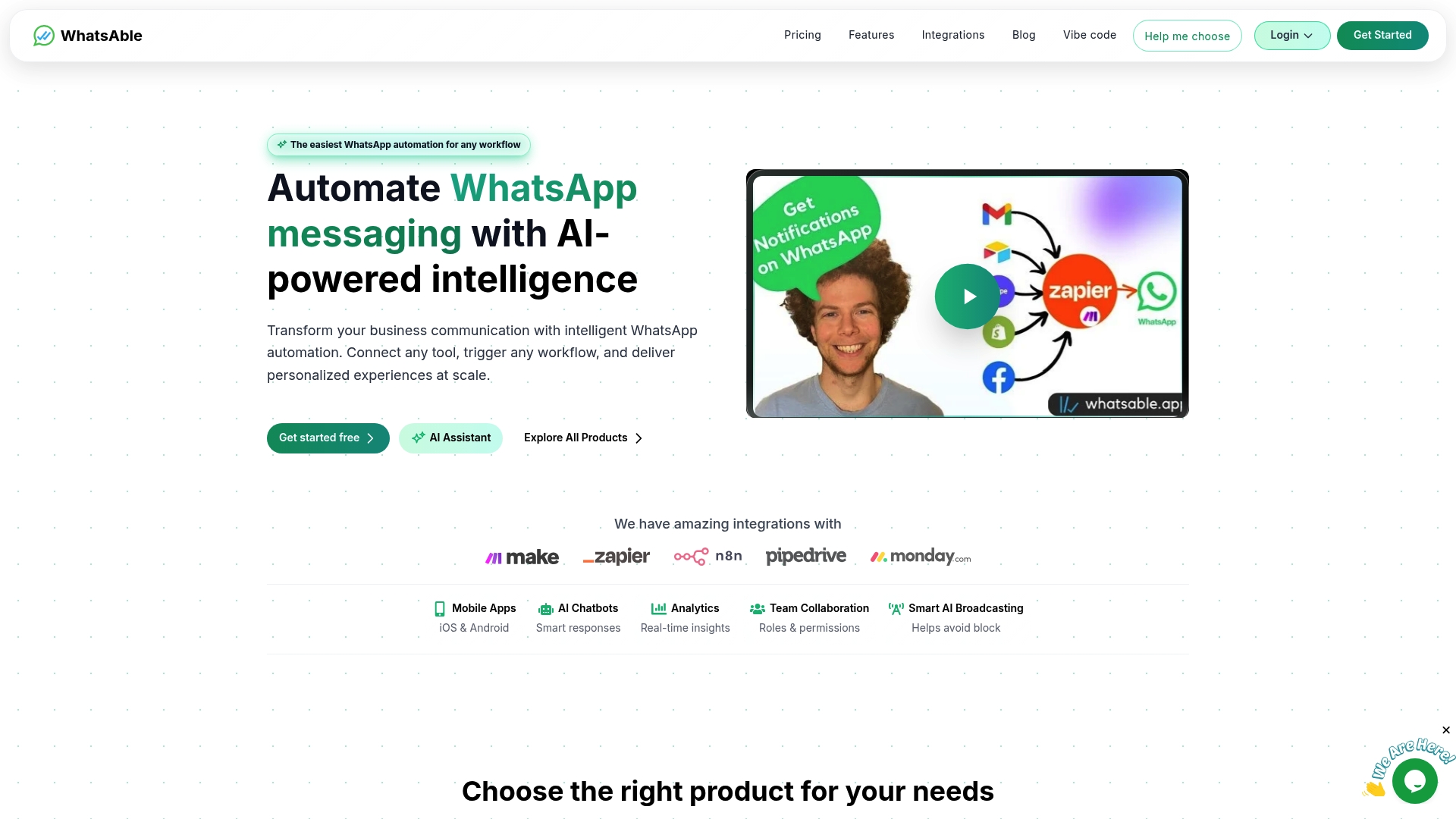
Whatsable gives retailers the infrastructure to send unlimited branded WhatsApp messages, automate multi-step follow-up sequences, and connect to tools like Zapier, Make, n8n, and Pipedrive without custom development. The platform includes AI-powered chatbots, bulk messaging with anti-block measures, and detailed analytics that show exactly where customers drop off in a flow. For retailers who need internal alerting alongside customer-facing campaigns, Whatsable Bot handles team notifications and workflow triggers from a single dashboard. Explore Whatsable’s pricing plans to find the tier that fits your current message volume and automation needs.
FAQ
What is WhatsApp’s average open rate for retail messages?
WhatsApp messages average a roughly 98% open rate, making it the highest-engagement channel available to European retailers for direct customer communication.
How does GDPR affect WhatsApp marketing in Europe?
GDPR requires explicit, unambiguous opt-in consent before any business-initiated WhatsApp message. Generic marketing consent does not qualify, and Meta also requires business account verification before sending.
What click-through rate do automated WhatsApp journeys achieve?
Automated WhatsApp customer journeys deliver an average click-through rate of 11.1%, compared to 2.6% for broadcast campaigns. That four-times gap comes from AI-driven timing and personalization.
Does WhatsApp work for customer acquisition or only retention?
WhatsApp drives both. During peak retail seasons, 83% of WhatsApp-driven orders come from first-time buyers, showing the channel performs strongly as an acquisition tool alongside its retention use cases.
What message types can European retailers send on WhatsApp?
Retailers can send marketing messages (promotions and offers), utility messages (order and shipping updates), and service messages (customer support). Each type has separate Meta approval requirements and rules for when they can be sent.

 Elias Navarro

 Mira Okonkwo