 Whatsable







TL;DR:
- Businesses often mistake auto-replies for real response speed, which can lead to customer loss. Properly designed WhatsApp bots deliver meaningful replies in under 5 seconds, reducing manual workload and improving customer experience. Architectural choices like async processing and full context handoff are essential for maintaining speed at scale.
Most businesses assume fast customer responses just mean sending an auto-reply that says “We got your message.” That assumption costs them customers. Understanding why WhatsApp bots improve response time requires separating the appearance of speed from its actual mechanics. A bot that acknowledges a message without answering it has failed. What bots genuinely accomplish, when built correctly, is delivering meaningful replies under 5 seconds that answer questions, route inquiries, and move conversations forward at scale.
Table of Contents
- Key Takeaways
- Why response time matters on WhatsApp
- How WhatsApp bots improve response time
- Technical factors that keep bots fast at scale
- Business benefits from faster bot responses
- Implementation best practices and common pitfalls
- My perspective on what really changes when you automate WhatsApp
- How Whatsable helps you put this into practice
- FAQ
Key Takeaways
| Point | Details |
|---|---|
| Speed alone is not enough | A fast reply must address the customer’s actual question, not just confirm message receipt. |
| Bots reduce human queue load | Handling repetitive inquiries automatically lets agents focus on complex issues without creating wait times. |
| Architecture determines reliability | Async webhook processing and durable queues prevent delays under high message volume. |
| Human handoff must carry context | Bots should pass full conversation history to agents so customers never repeat themselves. |
| Percentile tracking beats averages | Monitoring P90 and P99 response times reveals worst-case delays that averages hide. |
Why response time matters on WhatsApp
WhatsApp is not email. Customers who open it expect conversation-speed replies. The platform’s read receipts, typing indicators, and message delivery signals create an environment where silence feels conspicuous. When you send a WhatsApp message and see the double blue checkmarks, you know the recipient has read it. That creates psychological pressure that simply does not exist with other channels.
The numbers behind this are stark. Every extra minute beyond 2 minutes waiting for a reply lowers customer satisfaction by roughly 15%, and 89% of customers have switched brands after a single poor service experience. On messaging apps specifically, 53% of customers abandon the interaction entirely if they wait longer than 5 minutes for a meaningful reply.
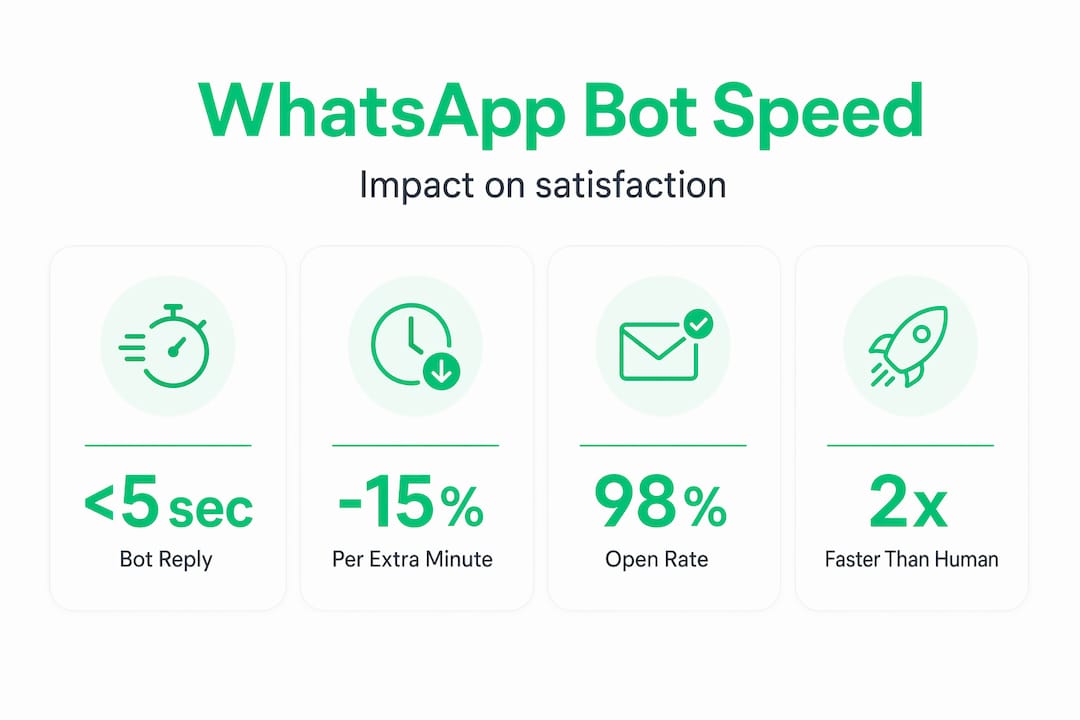
WhatsApp’s built-in engagement mechanics make this worse before bots enter the picture. Typing indicators and read receipts function as real-time feedback loops that accelerate reply expectations. About 50% of WhatsApp users actively check read receipts, which means the moment your business reads a message, the clock starts ticking in the customer’s mind.
The practical consequences for teams without automation are significant:
- Peak message volume can triple during campaigns or product launches, overwhelming human agents
- After-hours messages pile up overnight, greeted by cold silence until morning
- Repetitive FAQ-style questions consume agent time that should go toward complex issues
- No mechanism exists to triage urgency before a human opens each message
This is exactly the gap that well-designed WhatsApp bots fill.
How WhatsApp bots improve response time
The standard industry term for this automation layer is “conversational AI for messaging,” but in practice most teams use it through purpose-built WhatsApp bot platforms. The core response-time advantage comes from four distinct mechanisms, each solving a different problem.
-
Sub-5-second first replies. AI chatbots achieve sub-5-second response times as a baseline, compared to the 30-second benchmark considered “excellent” for human live chat agents. That gap compounds fast when volume increases.
-
Simultaneous conversation handling. A human agent manages one conversation at a time, occasionally two with difficulty. A bot handles hundreds of concurrent threads without any of them experiencing a queue delay. This is not an incremental improvement. It is a fundamental shift in how volume scales.
-
Automated FAQ and intake flows. Order status checks, pricing questions, appointment confirmations, and lead qualification can all run without a human. This frees your team for nuanced conversations that genuinely need them.
-
24/7 availability. Bots do not have shifts. A customer messaging at 11 p.m. on a Sunday gets an immediate, substantive reply rather than a timed auto-reply promising contact “the next business day.”
Pro Tip: Design your bot’s first response to actually resolve or route the inquiry, not just acknowledge it. A reply that says “I can help you track your order, please send your order number” creates momentum. A reply that says “Thanks for contacting us!” creates none.
The speed advantage is real, but the deeper benefit is that bots absorb query volume before it reaches humans. Reducing human queue workloads is where bots create sustained response-time improvements. Without queue reduction, even a fast bot becomes a bottleneck if it escalates everything to an overloaded team.

Technical factors that keep bots fast at scale
Speed at low volume is easy. Maintaining it under 10,000 messages per hour requires deliberate architecture decisions.
The most common performance killer is synchronous processing inside webhook handlers. When your WhatsApp integration receives an inbound message, Meta’s servers expect a 200 OK response quickly. If your system tries to process that message, query a database, generate an AI reply, and send a response all within the same synchronous call, delays cascade. Blocking synchronous webhook handlers creates backlogs that grow faster than they drain. The fix is durable message queues (Redis Streams, AWS SQS, or NATS) that accept the webhook instantly and hand processing to async workers.
Here is how synchronous and asynchronous architectures compare in practice:
| Architecture type | Response under low volume | Response under peak volume | Failure risk |
|---|---|---|---|
| Synchronous processing | Fast (under 3s) | Slow (30s+) | High during spikes |
| Async with durable queues | Fast (under 3s) | Consistently fast (under 5s) | Low, recoverable |
The second critical factor is conversation state storage. Bots that store session state in-process memory lose context during restarts or scaling events. Central state storage, whether Redis or a database, means every worker can pick up any conversation from exactly where it left off. This also powers the human handoff.
First responder plus handoff architecture means the bot handles initial contact, captures intent and key details, and passes the full conversation to a human agent when escalation is needed. The agent sees everything. The customer does not repeat themselves. That handoff is what separates a bot that improves experience from one that simply shifts frustration around.
Pro Tip: Store conversation context including the customer’s expressed intent, the last three message turns, and any data collected (order numbers, issue type) so agents can respond immediately without reading through the full thread from scratch.
Hybrid intent routing also matters. Quick-reply menus handle the most common intents instantly. Natural language understanding (NLU) handles longer, contextual queries. Combining both means your bot is fast for predictable questions and capable for everything else, without routing everything through a slower AI model when a button press would do.
Business benefits from faster bot responses
The improvements in response time translate directly into measurable business outcomes, not just better customer satisfaction scores.
Reduced churn is the most financially significant. Customers who get fast, useful replies on WhatsApp stay longer and buy again. The churn math is simple: if 89% of customers consider switching brands after a poor experience, a bot that prevents poor experiences at scale is protecting revenue, not just optimizing a metric.
Demand absorption without headcount growth is the operational benefit that often surprises business owners most. Intercom’s Fin bot resolved over 81% of support volume, handled 300% demand growth without staffing increases, and saved the company between $7.5M and $9M annually. Those numbers reflect what happens when bots handle scale that would otherwise require proportional hiring.
Additional practical benefits include:
- Higher conversion rates. Leads that get fast replies on WhatsApp are significantly more likely to complete a purchase or booking. Response latency is a conversion variable, not just a service metric.
- Improved agent performance. When bots handle volume, agents spend time on conversations that match their skills. Job satisfaction and quality of complex resolutions both improve.
- Better data capture. Bots collect structured information during interactions that unstructured human conversations often miss, improving CRM quality over time.
The engagement advantage of WhatsApp amplifies all of this. The platform’s open rates and reply rates outperform email by a significant margin. When you combine high inherent engagement with fast bot responses, every campaign and support interaction performs better.
Implementation best practices and common pitfalls
Deploying a WhatsApp bot and expecting speed improvements to follow automatically is where most teams go wrong. The implementation decisions matter as much as the technology.
Start with what you want the bot to resolve, not what you want it to say. Map your 10 most common inbound message types. Design specific flows for each one. A bot with clear resolution paths for real customer intents will outperform a bot with polished copy but vague routing.
Watch out for these common pitfalls:
- Auto-reply-only setups. Meaningful instant responses require context, not just acknowledgment. A bot that only confirms receipt and promises follow-up has not improved response time in any meaningful way.
- Broken handoffs. If escalation to a human agent drops conversation history, the customer experience degrades at exactly the moment it should improve. The handoff must carry full context automatically.
- Measuring only averages. Average response time can look good while a significant percentage of customers wait far too long. Track response time percentiles, specifically P90 and P99, to catch worst-case delays before they affect churn.
- Ignoring off-hours behavior. Your bot needs designed fallbacks for queries it cannot resolve after hours, including setting accurate expectations and capturing information for next-day follow-up.
Regular review of conversation logs reveals where bots are failing to resolve intents and sending too many escalations. That data is what drives the ongoing refinement that separates a bot that improves over time from one that plateaus.
My perspective on what really changes when you automate WhatsApp
I’ve seen businesses deploy WhatsApp bots expecting marginal improvements, then discover their first-response time dropped from 4 hours to under 10 seconds overnight. The surprise is always the same: they thought speed would be the win, but what actually changed was the nature of every subsequent conversation.
When a customer gets a real answer in under 10 seconds, the tone of the conversation shifts. Frustration doesn’t have time to build. The customer arrives at the human agent (when needed) in a cooperative mindset rather than an adversarial one. In my experience, that downstream effect on resolution quality is worth more than the speed improvement itself.
What I’ve learned is that the fear most business owners have about bots, that they feel cold or impersonal, almost always traces back to poorly designed handoffs, not bots in general. A bot that collects context and passes it seamlessly to a knowledgeable agent feels more attentive than a human who makes the customer repeat their problem three times.
Speed without context is just noise. But speed with context, built on architecture that doesn’t break under load, changes what customer communication is capable of entirely.
— Axel
How Whatsable helps you put this into practice
If this article has you rethinking what your WhatsApp communication should look like, Whatsable is built for exactly this problem. The platform combines AI-powered bot flows with the kind of async architecture and human handoff design this article describes, without requiring a development team to set it up.
Whatsable gives your team instant deployment of bot flows that resolve common queries, route complex conversations to agents with full context preserved, and run 24/7 across campaigns and support channels. Whatsable handles both customer-facing automation and internal team alerts, with integrations into Zapier, Make, n8n, and Pipedrive already in place. If you want to see what a 10-second first response at scale actually looks like for your business, that is where to start.
FAQ
Why do WhatsApp bots respond faster than human agents?
Bots process and reply to messages in under 5 seconds because they handle multiple conversations simultaneously without queuing, while human agents work through one conversation at a time. This speed advantage compounds during high-volume periods when human response times degrade significantly.
Does a fast bot reply actually improve customer satisfaction?
Yes, when the reply is meaningful. Every minute beyond 2 minutes reduces satisfaction by roughly 15%, so a bot that resolves or correctly routes an inquiry in under 10 seconds prevents a significant portion of negative experiences before they happen.
What is human handoff in a WhatsApp bot, and why does it matter?
Human handoff is the automated transfer of a conversation from bot to agent, including full conversation history and intent data. Without it, customers repeat themselves to agents, which eliminates the experience benefits that fast first responses create.
How do I measure whether my WhatsApp bot is actually improving response times?
Track percentile metrics rather than averages. P50 tells you the median experience, but P90 and P99 response times reveal what your slowest-served customers experience, which is what drives churn decisions.
Can WhatsApp bots handle demand spikes without slowing down?
Yes, when built on asynchronous architecture with durable message queues. Synchronous processing degrades under load, while async systems maintain consistent sub-5-second response times even during traffic spikes.

 Mira Okonkwo
 Elias Navarro