 Whatsable







TL;DR:
- WhatsApp dominates European customer communication with its high open rates and personalized, conversational style. Its extensive reach and GDPR-compliant infrastructure make it an essential channel for businesses seeking faster engagement and higher response rates. Effective use involves proper automation, personalized messaging, and strict compliance with data privacy rules.
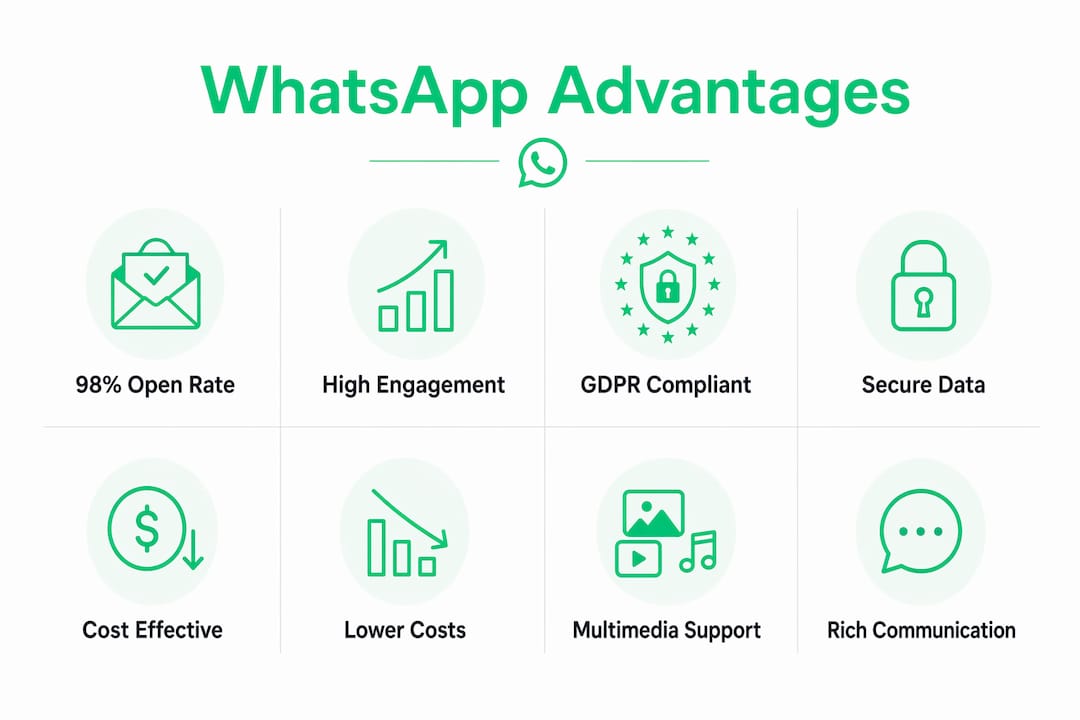
WhatsApp is the dominant customer communication channel in Europe because it combines a 98% message open rate, GDPR-compliant infrastructure, and a conversational style that mirrors how Europeans already communicate with friends and family. Germany alone has 60 million daily users on the platform. For business professionals analyzing why WhatsApp suits European customer communication, those two facts alone reframe the channel from “optional” to “essential.” Email averages a 20–25% open rate by comparison. No other customer communication tool for the European market closes that gap.
Why WhatsApp suits European customer communication better than any other channel
WhatsApp’s core advantage is reach. In the DACH region, WhatsApp penetration exceeds 94% of internet users aged 14 and above. That figure means a business in Germany, Austria, or Switzerland can realistically reach nearly every digitally active customer through a single channel. No email list, SMS database, or social media following comes close to that saturation level.

The platform also operates where customers already spend their time. WhatsApp is not a business tool customers download specifically for support. It is the same app they use to message their family. That context changes how customers perceive incoming messages. A WhatsApp notification from a brand feels personal, not transactional. That perception gap is exactly why the benefits of using WhatsApp in Europe translate directly into higher engagement and faster responses.
What makes WhatsApp’s communication style ideal for European customers?
WhatsApp functions as an intimacy channel. Companies that treat it this way gain higher customer engagement and measurably better sales outcomes. The key difference is tone. A WhatsApp message reads like a text from a trusted contact, not a marketing blast. That distinction matters enormously in markets like France, the Netherlands, and Spain, where customers are increasingly skeptical of impersonal brand communication.
Conversational commerce is the direct result of this dynamic. When a customer asks a product question via WhatsApp, the business can answer, upsell, share a photo, send a PDF, and close a sale, all within a single chat thread. The fusion of service, sales, and consultation in one conversation represents a genuinely new customer engagement model. Traditional email requires multiple back-and-forth exchanges across days. WhatsApp compresses that cycle into minutes.
The friction reduction is concrete and measurable. Customers do not need to find a contact form, wait for a ticket number, or navigate a phone tree. They open an app they already use and type a message. That simplicity drives higher contact rates and reduces abandonment before a question is even asked.
Pro Tip: Use a warm, first-name greeting in every WhatsApp message and match the customer’s own tone. Customers who receive conversational replies are significantly more likely to continue the exchange and convert than those who receive formal, template-style responses.
Key behaviors that define effective WhatsApp communication in Europe:
- Use short paragraphs and plain language, not corporate copy
- Send images, product videos, or documents directly in the chat thread
- Respond quickly. Customers expect replies within 60 seconds via WhatsApp
- Personalize follow-up messages based on prior conversation history
- Avoid mass-broadcast language. Write as if addressing one person
How does WhatsApp handle European data privacy requirements?
GDPR is the defining regulatory constraint for any customer communication tool operating in Europe. WhatsApp Business API addresses this directly. The API supports EU-based server hosting and full data privacy controls, including no automatic contact synchronization. That distinction separates the API from the standard WhatsApp Business App, which does sync contacts and carries greater compliance risk for businesses handling personal data at scale.
Data Processing Agreements, known as DPAs, are a non-negotiable requirement under GDPR when a third party processes customer data on a business’s behalf. Reputable WhatsApp Business Solution Providers offer signed DPAs as part of their service agreements. Without one, a business using WhatsApp for customer communication is technically operating outside GDPR requirements, regardless of how carefully it handles data internally.
Opt-in rules are equally strict. Explicit opt-in with double confirmation is mandatory for WhatsApp marketing messages in Europe. This mirrors the double opt-in standard familiar from email marketing under GDPR. A customer clicking “I agree” on a checkout page is not sufficient. The confirmation must be active, specific to WhatsApp messaging, and documented.
Critical compliance requirements for European WhatsApp deployments:
- Use WhatsApp Business API, not the standard Business App, for any data-sensitive operation
- Confirm your provider offers a signed Data Processing Agreement
- Collect explicit, documented opt-in consent before sending any marketing message
- Store consent records with timestamps and message content for audit purposes
- Choose providers that host data on EU-based servers
Pro Tip: When selecting a WhatsApp Business Solution Provider, ask directly whether they are an official Meta Business Partner and whether their DPA covers EU data residency. Those two questions filter out the majority of non-compliant vendors immediately.
How does WhatsApp compare to email, SMS, and phone for European businesses?
The performance gap between WhatsApp and traditional channels is not marginal. WhatsApp messages achieve a 98% open rate. Email sits at 20–25%. SMS performs better than email but still falls short of WhatsApp’s engagement depth because SMS cannot carry images, documents, or interactive buttons. Phone calls require both parties to be available simultaneously, which creates scheduling friction that chat eliminates entirely.
| Channel | Open rate | Response speed | Multimedia support | GDPR compliance path | International cost |
|---|---|---|---|---|---|
| 98% | Under 60 seconds | Full (images, video, docs) | API with DPA | Low | |
| 20–25% | Hours to days | Attachments only | Standard | Low | |
| SMS | ~45% | Minutes | Text only | Carrier-dependent | High |
| Phone | N/A | Real-time only | None | Call recording rules | High |
Cost is another clear advantage. Sending WhatsApp messages is more cost-effective than SMS, particularly for international communication. Recipients pay nothing to receive messages. For businesses with customers across multiple European countries, that cost structure is a significant operational benefit compared to per-message SMS pricing.
Demographic preference reinforces the channel’s position. 67% of Millennials and Gen Z customers prefer chat channels over phone calls. Those two generations now represent the majority of active consumers in most European markets. A business that routes customer service through phone and email is structurally misaligned with how its core customers want to communicate.
What are the practical steps for adopting WhatsApp in a European business?
The first decision is choosing between WhatsApp Business App and WhatsApp Business API. The App suits sole traders and very small businesses with low message volumes. The API is the correct choice for any business with multiple agents, automation requirements, or GDPR obligations at scale. The API supports unlimited users, AI integration, and ERP connections, along with a verified green checkmark that builds customer trust.
Implementation follows a clear sequence:
- Apply for WhatsApp Business API access through an official Meta Business Solution Provider
- Complete business verification and phone number registration
- Set up consent collection on your website, app, or checkout flow
- Build automated welcome messages and FAQ response flows using a tool like Zapier, Make, or n8n
- Connect your CRM, such as Pipedrive or HubSpot, to log every WhatsApp interaction automatically
- Define escalation rules so AI-handled queries transfer to a human agent when needed
- Track response time, customer satisfaction scores, and resolution rates from day one
AI chatbots handle the volume problem that stops many businesses from committing to WhatsApp. 89% of customers rank fast response times as the top priority, according to Gartner 2025 research. An AI chatbot on WhatsApp can answer product questions, confirm orders, and send tracking links instantly, at any hour, without adding headcount. Human agents then focus on complex queries that genuinely require judgment.
Pro Tip: Build a “handoff message” into your automation flow. When a chatbot transfers a customer to a human agent, send a message like “I’m connecting you with our team now. They have your full conversation history.” That single message eliminates the frustration of customers repeating themselves and measurably improves satisfaction scores.
Key Takeaways
WhatsApp is the highest-performing customer communication channel in Europe because its adoption rate, open rates, GDPR-compliant API, and conversational format align precisely with what European customers expect and regulators require.
| Point | Details |
|---|---|
| Unmatched open rates | WhatsApp achieves a 98% open rate, compared to 20–25% for email. |
| GDPR compliance requires the API | The WhatsApp Business API supports EU server hosting, DPAs, and no contact sync. |
| Opt-in is mandatory | European businesses must collect explicit double opt-in before sending marketing messages. |
| Conversational commerce drives revenue | Treating WhatsApp as an intimacy channel increases engagement and sales within a single thread. |
| AI handles volume, humans handle complexity | Automation covers instant responses while human agents resolve high-value or sensitive queries. |
WhatsApp as a customer channel: what most businesses still get wrong
Most businesses I see adopting WhatsApp make the same mistake. They treat it as a faster email inbox. They assign a ticket number, send a templated reply, and close the thread. The customer receives a response that could have come from any channel. The opportunity is completely wasted.
WhatsApp’s real value is that it collapses the distance between a brand and a customer. When a business uses it correctly, a customer asking about a return policy ends up buying an additional product in the same conversation. That outcome is not accidental. It happens because the channel’s format encourages dialogue rather than transaction processing.
The businesses I have seen succeed with WhatsApp in Europe are the ones that train their teams to write like humans, not like support agents. They also invest in automation early, not as a cost-cutting measure, but because speed is the currency of customer satisfaction on this channel. A reply that arrives in 90 seconds beats a perfectly worded reply that arrives in 4 hours, every single time.
The future of WhatsApp in European customer communication runs through AI. Not AI that replaces human judgment, but AI that handles the predictable 80% of queries so human agents can focus on the 20% that actually require empathy and expertise. Businesses that build that infrastructure now will have a structural advantage over competitors still routing customers through email queues.
— Axel
Whatsable: WhatsApp automation built for European businesses
European businesses that want to move from manual WhatsApp replies to a fully automated, GDPR-compliant communication system have a direct path through Whatsable.
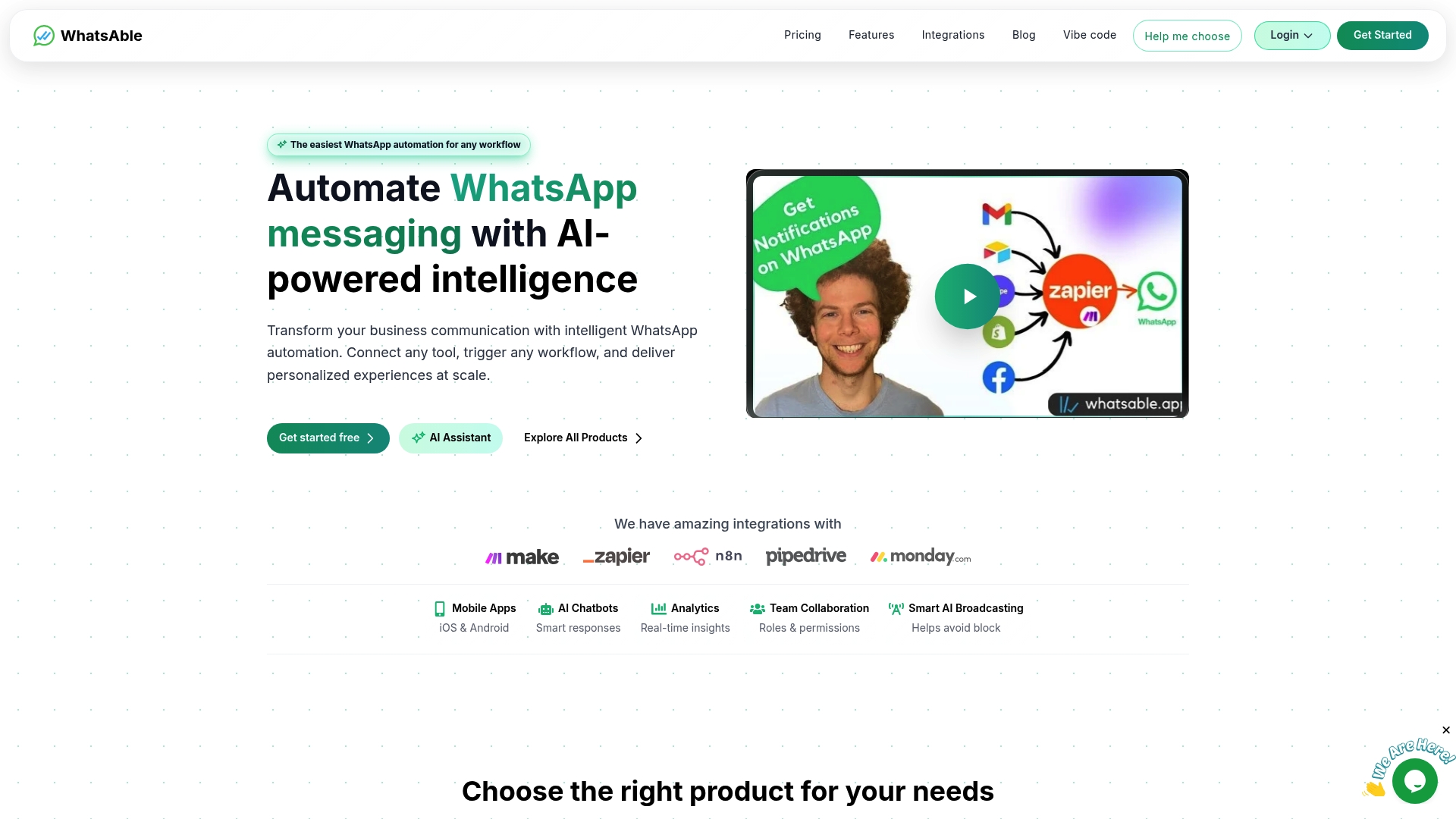
Whatsable lets businesses send unlimited branded WhatsApp messages, build automated follow-up sequences, and connect directly with tools like Zapier, Make, n8n, and Pipedrive. The platform supports AI-powered chatbots, bulk messaging with anti-block measures, and detailed analytics. Whatsable Bot handles internal team notifications and alerts with minimal setup time. Both products are built for the compliance requirements European businesses face, with onboarding support included from day one.
FAQ
What is WhatsApp’s open rate compared to email in Europe?
WhatsApp messages achieve a 98% open rate in Europe, compared to approximately 20–25% for email. That gap makes WhatsApp the highest-engagement written communication channel available to European businesses.
Does WhatsApp Business API comply with GDPR?
The WhatsApp Business API supports GDPR compliance through EU-based server hosting, Data Processing Agreements, and no automatic contact synchronization. Businesses must still collect explicit double opt-in consent before sending marketing messages.
What is the difference between WhatsApp Business App and WhatsApp Business API?
The WhatsApp Business App suits very small businesses with low message volumes but lacks GDPR-grade data controls. The API supports multiple agents, AI integration, ERP connections, and full data privacy controls required for compliant customer communication at scale.
How quickly do European customers expect a WhatsApp reply?
Customers expect a response within 60 seconds via WhatsApp. Businesses that cannot meet that threshold manually should implement AI chatbots to handle initial responses automatically.
Why do Millennials and Gen Z prefer WhatsApp for customer service?
67% of Millennials and Gen Z customers prefer chat channels over phone calls. WhatsApp meets that preference while also supporting multimedia, automation, and the conversational tone this demographic expects from brands.
 Mira Okonkwo
 Jonah Reed
 Elias Navarro