 Whatsable







TL;DR:
- WhatsApp improves buyer qualification by offering high open rates and conversational messaging that encourages honest responses. Using 2-3 structured questions with button or list picker answers enhances data quality and speeds up lead routing. AI and CRM integration automate scoring and ensure consistent, scalable qualification processes.
WhatsApp buyer qualification is defined as the process of using real-time conversational messaging to assess a prospect’s intent, budget, and timeline before routing them to a sales rep. The role of WhatsApp in buyer qualification has become a core sales function because message open rates exceed 95%, compared to roughly 20% for email. That gap means most email-based qualification flows fail before a prospect reads the first question. WhatsApp closes that gap by meeting buyers where they already spend time, enabling structured conversations that feed directly into CRM workflows and AI-driven lead scoring.
How does WhatsApp improve the buyer qualification process?
WhatsApp outperforms email and web forms in buyer qualification because it operates in a channel buyers already trust and check constantly. The 95% open rate is not a vanity metric. It means your qualification questions actually get read, which is the minimum requirement for any qualification process to work.

The conversational format also changes how buyers respond. A web form feels like a job application. A WhatsApp message feels like a text from a colleague. Buyers give more honest, complete answers in a low-pressure chat environment than they do in a formal form.
Structured inputs make the difference between useful data and noise:
- Button-based answers reduce drop-off because buyers tap one option rather than type a full sentence.
- List pickers let buyers select their industry, company size, or timeline from a predefined set, which produces clean CRM data automatically.
- Free-text fields create inconsistent data that requires manual cleanup before it can be scored or routed.
Structured button responses consistently outperform free-text in both completion rate and data quality. That finding has a direct operational implication: every qualification question you send on WhatsApp should offer a button or list picker, not an open text box.
Sales leaders who treat WhatsApp as a high-intent channel report that conversational flows outperform broadcast tools by 3–4x in conversion rate. Broadcast messaging treats every prospect the same. Conversational qualification treats each buyer as an individual with a specific problem, and that distinction drives results.
What are effective WhatsApp lead qualification frameworks?
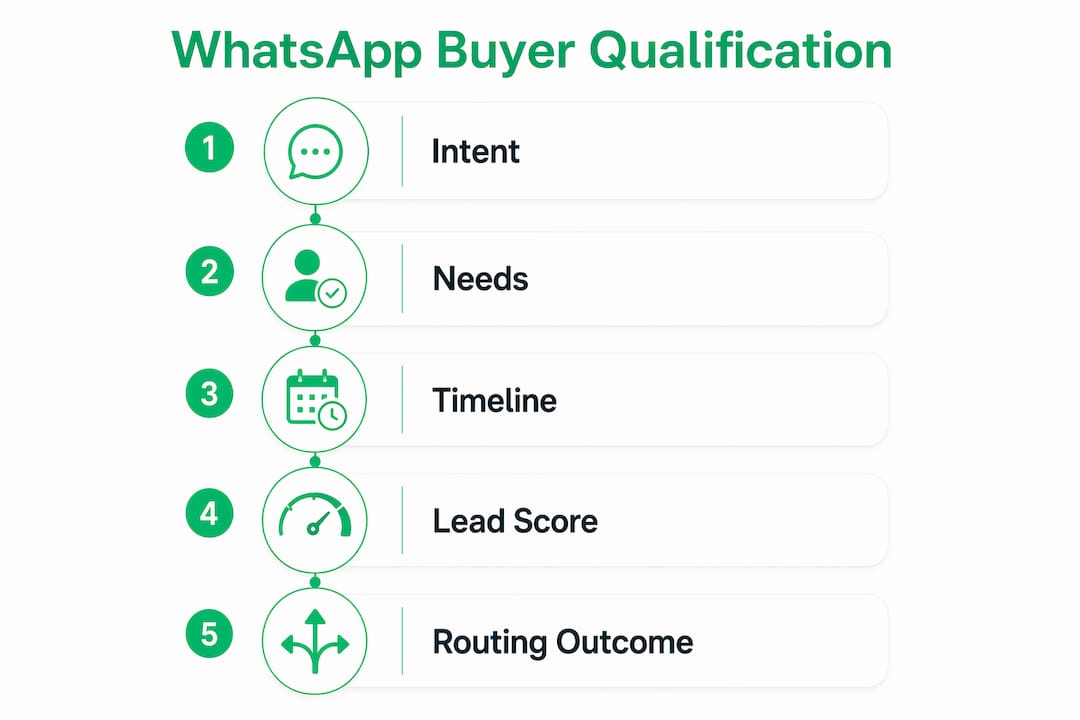
The most effective WhatsApp qualification framework uses three structured questions focused on intent, need, and timeline. Fewer than three questions under-qualifies the lead. More than five creates friction that drives drop-off. A middle ground of 2–3 structured questions produces better conversion economics than long scripts or free-text bots.
A practical three-question sequence looks like this:
- Intent: “What brought you here today?” with button options such as “Pricing info,” “Product demo,” or “Just browsing.”
- Need: “What’s your biggest challenge right now?” with a list picker covering your core use cases.
- Timeline: “When are you looking to make a decision?” with options like “This month,” “Next quarter,” or “Just exploring.”
Each answer feeds a lead score automatically. A buyer who selects “Pricing info,” names a specific pain point, and answers “This month” scores as a hot lead and routes to a sales rep within seconds. A buyer who selects “Just browsing” enters a nurture sequence without consuming any rep time.
Pro Tip: Map your button options directly to CRM field values before you build the flow. If your CRM uses “Q1,” “Q2,” and “Q3” as timeline values, your WhatsApp buttons should match exactly. Mismatched labels create data cleanup work that erases the efficiency gains.
The table below shows how different response combinations translate into routing decisions:
| Intent | Timeline | Routing outcome |
|---|---|---|
| Pricing info | This month | Immediate rep handoff |
| Product demo | Next quarter | Scheduled follow-up |
| Just browsing | Just exploring | Automated nurture sequence |
| Pricing info | Just exploring | Low-priority nurture |
| Product demo | This month | Priority rep handoff |
Routing automation removes the judgment call from reps and applies consistent criteria across every lead. That consistency is what makes WhatsApp qualification repeatable at scale.
How do AI and automation enhance WhatsApp buyer qualification?
AI-powered chatbots handle the qualification conversation at scale without sacrificing the conversational tone that makes WhatsApp effective. AI assigns lead scores and routes prospects based on criteria like budget, timeline, and decision authority, then triggers the appropriate next step automatically. The rep only enters the conversation when the lead meets a defined threshold.
The operational benefits of AI-driven qualification on WhatsApp include:
- Real-time scoring: Every response updates the lead score instantly, so routing decisions happen in seconds rather than hours.
- 24/7 coverage: AI handles qualification outside business hours, which captures leads that would otherwise go cold overnight.
- Consistent criteria: AI applies the same scoring logic to every lead, eliminating the variability that comes from rep-to-rep judgment differences.
- Automatic follow-up: Leads who don’t complete the qualification flow receive a follow-up message after a set interval, closing the gap that manual processes miss.
The handoff from AI to human is the most critical moment in the flow. A clumsy transition destroys the trust built during the conversational qualification. The AI should signal the handoff naturally, for example: “Great, I’m connecting you with a specialist now. They’ll be with you shortly.” That phrasing maintains the conversational register and sets a clear expectation.
Pro Tip: Use conversational AI frameworks to design your handoff language before you build the automation. The tone of the transition message matters as much as the timing.
CRM integration is what separates a WhatsApp chatbot from a governed qualification system. When every response syncs to a CRM record in real time, the sales rep who receives the handoff already has full context. They don’t ask the buyer to repeat information. That continuity is a significant differentiator in competitive sales environments.
What steps should sales teams follow to implement WhatsApp qualification?
Start with a pilot focused on one buyer segment rather than rolling out WhatsApp qualification across your entire pipeline. Pilot programs targeting specific segments show measurable improvements in lead response time and CRM data completeness before you scale. A focused pilot also limits the risk of a poorly designed flow reaching your highest-value prospects.
The implementation checklist for sales teams:
- Define your qualification criteria first. Know exactly what makes a lead “hot” before you write a single question. Budget threshold, decision authority, and timeline are the standard BANT criteria, but your business may weight them differently.
- Build CRM-backed workflows. Salesforce-backed governance keeps WhatsApp as the conversational surface while the CRM remains the system of record for compliance and audit purposes.
- Keep question sequences short. Three questions maximum for initial qualification. Additional questions belong in the follow-up conversation with a rep, not the automated flow.
- Test drop-off points. Monitor where prospects exit the flow and rewrite those questions. High drop-off at question two usually signals the question is too complex or the button options don’t match how buyers think about the problem.
- Balance automation with human response. Automation handles volume. Personalization closes deals. The WhatsApp customer journey requires both working together.
Pro Tip: Run your pilot for at least four weeks before drawing conclusions. WhatsApp qualification flows improve significantly as you refine button labels and routing thresholds based on real response data.
The most common mistake sales teams make is treating WhatsApp qualification as a one-time setup. The flow needs regular review as your product, pricing, and buyer segments evolve. A qualification flow built for last year’s ICP will misroute leads this year.
How does WhatsApp qualification fit into the broader sales workflow?
WhatsApp functions as the high-intent, real-time touchpoint in a multi-channel sales workflow, not a replacement for every other channel. WhatsApp engagement data informs retargeting and segmentation for buyers who showed interest but didn’t convert during the initial qualification. That data turns an incomplete conversation into a useful signal rather than a lost lead.
The channel comparison is straightforward. WhatsApp handles fast, conversational qualification. Email handles long-form content like case studies, proposals, and contract summaries. Treating WhatsApp as a broadcast email replacement is the single most common misuse of the channel, and it produces exactly the engagement rates you’d expect from email.
CRM integration is the connective tissue between WhatsApp and the rest of the sales workflow. When WhatsApp syncs to your CRM, every qualification response becomes a data point in the buyer’s record. Sales reps see the full conversation history, lead score, and routing reason before they make the first call. That context reduces the time reps spend re-qualifying and increases the time they spend closing.
Industry-specific applications show how flexible the channel is. Real estate teams qualify buyers by property type, budget range, and purchase timeline before scheduling a showing. SaaS companies qualify by company size, current tool stack, and contract start date before booking a demo. Financial services firms qualify by asset range and product interest before routing to a licensed advisor. The framework is the same across industries. The button labels change.
Key Takeaways
WhatsApp buyer qualification works because structured conversational flows, AI-driven lead scoring, and CRM integration combine to produce faster, cleaner, and more consistent qualification than email or web forms.
| Point | Details |
|---|---|
| Open rate advantage | WhatsApp’s 95% open rate vs. email’s 20% makes qualification questions far more likely to be read and answered. |
| Three-question framework | Limit initial qualification to three structured questions covering intent, need, and timeline for best conversion economics. |
| Buttons over free text | Button-based answers reduce drop-off and produce clean CRM data automatically, unlike free-text responses. |
| AI handles scale | AI chatbots score and route leads in real time, covering off-hours and eliminating rep-to-rep scoring inconsistency. |
| CRM as system of record | Keep the CRM as the governed data layer while WhatsApp serves as the conversational surface for compliance and audit. |
Why most sales teams are still using WhatsApp wrong
I’ve watched sales teams add WhatsApp to their stack and immediately start blasting promotional messages to their entire contact list. Within two weeks, opt-out rates spike and the channel is effectively dead for that business. WhatsApp is not a faster email. It’s a different medium with different rules, and the teams that treat it as a broadcast tool burn it before they ever use it for qualification.
The teams that get it right do one thing differently: they design the conversation before they build the automation. They know exactly what a qualified buyer looks like, they write button options that match how buyers actually describe their own problems, and they test the flow on real prospects before scaling. That discipline is rare, and it’s the actual competitive differentiator.
The AI component gets oversold in most discussions. AI is not magic. It’s a scoring engine that applies your criteria consistently. If your criteria are wrong, AI applies them wrong at scale. The value of AI in WhatsApp qualification is consistency and speed, not intelligence. Get your qualification logic right first, then automate it.
The businesses winning with WhatsApp qualification in 2026 are not the ones with the most sophisticated chatbots. They’re the ones with the clearest definition of a qualified buyer and the discipline to build a governed flow that captures that definition in three questions or fewer.
— Axel
How Whatsable powers governed WhatsApp qualification workflows
Whatsable gives sales teams the infrastructure to build, automate, and govern WhatsApp qualification flows without writing code. The platform connects WhatsApp conversations directly to CRM tools like Pipedrive, with native integrations for Zapier, Make, and n8n covering the rest of the stack. AI-powered chatbots handle the initial qualification conversation, score leads based on your criteria, and route hot prospects to reps instantly. Every response syncs to your CRM in real time, so your data governance stays intact while the buyer experience stays conversational. Review Whatsable’s pricing plans to find the tier that fits your team’s qualification volume and integration requirements.
FAQ
What is WhatsApp buyer qualification?
WhatsApp buyer qualification is the process of using structured conversational messages on WhatsApp to assess a prospect’s intent, budget, and timeline before routing them to a sales rep. It replaces web forms and email sequences with a faster, higher-engagement channel.
Why does WhatsApp outperform email for lead qualification?
WhatsApp message open rates exceed 95%, compared to roughly 20% for email, which means qualification questions are far more likely to be read and answered. The conversational format also reduces the friction that causes prospects to abandon web forms.
How many questions should a WhatsApp qualification flow include?
Three structured questions covering intent, need, and timeline produce the best balance between data quality and completion rate. More than five questions increases drop-off without meaningfully improving lead scoring accuracy.
How does AI improve WhatsApp lead qualification?
AI chatbots score leads based on criteria like budget, timeline, and decision authority, then route hot leads to sales reps instantly and place lower-scoring leads into nurture sequences automatically. The system operates 24/7 without rep involvement until a lead meets the qualification threshold.
How does WhatsApp qualification connect to CRM systems?
WhatsApp serves as the conversational surface while the CRM functions as the system of record, with every response syncing in real time to create a complete buyer profile. Platforms like Whatsable connect WhatsApp flows to CRM tools through integrations with Zapier, Make, n8n, and Pipedrive.
 Elias Navarro