 Whatsable







WhatsApp has become one of the most consequential tools in political communication, not because governments chose it deliberately, but because citizens already lived on it. The platform’s role in policy announcement distribution is now well-documented: officials use it to push updates, cascade directives through hierarchical group networks, and reach constituents who rarely check government websites or watch press briefings. With over two billion people worldwide using WhatsApp, the platform’s reach is simply too large for political communicators to ignore.
What makes WhatsApp distinct from broadcast email or official press releases is the combination of immediacy, familiarity, and network density. A policy update sent through a tiered group structure can reach thousands of people within minutes, forwarded person-to-person in ways that feel personal rather than institutional. Research shows that 98% of government officials use WhatsApp for organizational updates, including newly formulated policies and leadership changes. That figure alone tells you this is no longer an informal workaround. It is the de facto infrastructure of administrative communication in many governments.
The platform’s advantages come with real costs. Encrypted, closed-group messaging limits public oversight. Messages disappear. Record-keeping suffers. And the scale of distribution networks can distort political competition in ways that have nothing to do with the quality of a policy argument. Understanding both sides of this equation is what separates a communicator who uses WhatsApp well from one who uses it recklessly.
Key dynamics at a glance:
- WhatsApp groups and broadcast lists enable rapid, targeted policy dissemination at scale
- End-to-end encryption protects message content but shields political messaging from public scrutiny
- Hierarchical group structures allow cascading announcements from national to local levels
- Forwarding limits introduced after 2018 reduce viral spread but are easily circumvented by copy-paste
- Transparency and record-keeping obligations are routinely undermined when officials conduct policy discussions on the platform
- Demographic reach spans urban professionals and rural communities, making WhatsApp an unusually broad channel for official communication
Why WhatsApp works so well for political and policy communication
WhatsApp’s appeal to political communicators is not accidental. The platform combines low cost, multimedia support, and an interface that requires almost no learning curve, making it accessible across age groups, income levels, and digital literacy levels. For government officials managing dense workloads, that simplicity is decisive: 98% use WhatsApp for organizational updates, 97% share documents, 93% use audio calls, and 88% share URLs for administrative coordination.
The core features that matter most for policy distribution are groups (up to 1,024 members per group), broadcast lists (messages sent to multiple contacts who each receive them privately), Communities (groups of groups that function as announcement channels), Status updates, and document sharing. Research confirms that document sharing is used by 97% of government officials on the platform, alongside chat (98%), audio calls (93%), and URL sharing (88%). These are not marginal features. They form the backbone of how policy circulars, orders, and operational guidance actually move through bureaucracies.

Compared to public social media platforms like X (formerly Twitter) or Facebook, WhatsApp offers a fundamentally different communication dynamic. Posts on X are public by default and subject to algorithmic filtering. WhatsApp messages land directly in a group or inbox, unfiltered, with a notification. That directness is why political actors prefer it for time-sensitive announcements. The tradeoff is that the same closed architecture that makes delivery reliable also makes the channel invisible to journalists, regulators, and the public.
One technical constraint worth understanding is WhatsApp’s forwarding limit, introduced in 2018 after viral misinformation in India led to mob violence. WhatsApp capped forwarding to reduce the speed at which false content spreads. In practice, politically motivated actors often bypass this by copying and pasting message text rather than using the forward function, which means the limit slows organic sharing more than it slows coordinated campaigns.
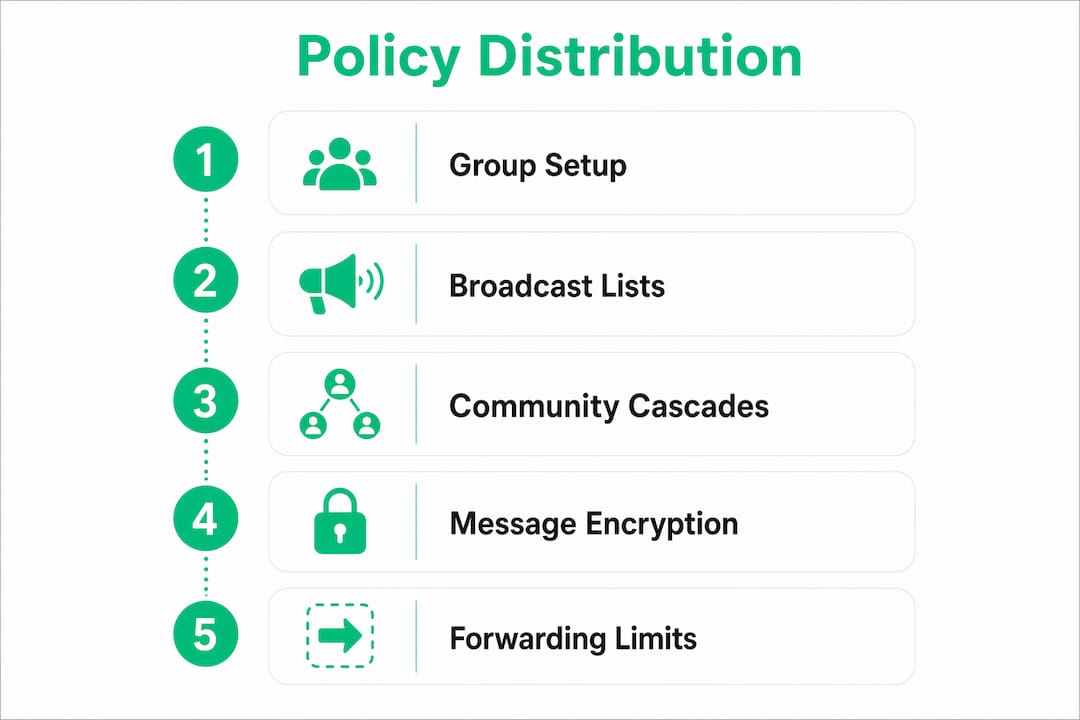
For political communicators considering WhatsApp list messages and broadcast tools, the platform’s architecture rewards those who understand its group hierarchy and content format preferences. Text and PDF remain the dominant formats: 100% of officials surveyed preferred text-based communication, and 94% relied on PDFs for structured knowledge sharing.
How governments and political actors deploy WhatsApp for announcements
The most sophisticated WhatsApp-based political operations do not rely on a single group or broadcast list. They build layered architectures where messages flow from a central source downward through regional, district, and local nodes, each managed by a designated administrator.
India’s Bharatiya Janata Party (BJP) offers the most thoroughly documented example of this model at scale. According to reporting by Rest of World, the BJP operates over 5 million WhatsApp groups across India, with an infrastructure capable of disseminating information from New Delhi to any location in the country within 12 minutes. In a single small town, Mandi, with a population of 26,000, party volunteers managed more than 400 WhatsApp groups. That density of local coverage is what makes the system effective.
The operational mechanics break down into several layers:
- Central coordination: Party offices in New Delhi send daily messaging directives to regional administrators, who adapt and forward them to local group managers.
- Volunteer networks: A single BJP worker in Mandi oversaw a volunteer team of 500 members managing roughly 400 WhatsApp groups, with plans to expand to 600 before elections.
- Segmentation by identity: Groups are organized by location, profession, age, religion, gender, caste, and tribe, allowing messages to be tailored to specific communities rather than broadcast generically.
- Communities feature: The BJP used WhatsApp Communities, which function as groups of groups, allowing a single admin to push messages to more than 142 subgroups simultaneously.
- Multimedia content: Images, audio clips, and video are used alongside text to increase engagement and make messages more shareable.
- AI-powered bots: Automated messaging tools handle routine updates and follow-up sequences, reducing the manual burden on volunteer administrators.
This model is replicable at smaller scales. U.S. political campaigns and government agencies can adopt the same tiered structure, using contact list segmentation to target messages by district, demographic, or issue area. The key variable is not the technology but the organizational discipline behind it.
One underappreciated aspect of this approach is how it blurs the line between official communication and organic conversation. When BJP workers share party messaging in groups that mix political and personal contacts, recipients often cannot tell whether a message originated from the party or from a neighbor. That ambiguity is not accidental. It is a feature of the distribution strategy.
Geographical reach and demographic penetration: what the data shows
WhatsApp’s global footprint is uneven in ways that matter for political communicators. India is the platform’s largest market, with 400 million active users, which explains why it has become the primary battleground for political messaging in that country. Latin America, the Middle East, and sub-Saharan Africa show similarly high penetration rates, with WhatsApp often functioning as the default internet communication layer for populations who access the web primarily through smartphones.

In the United Kingdom, WhatsApp has penetrated government communication at the ministerial level, as documented in multiple public inquiries. In Latin America, it is the dominant messaging platform across urban and rural populations alike, with news publishers describing it as “the most important messaging app in Mexico and Latin America” with a captive audience already in place.
The demographic picture across these markets:
| Demographic Group | WhatsApp Usage Pattern | Relevance for Policy Communication |
|---|---|---|
| Urban professionals | High frequency, document sharing, group coordination | Primary channel for policy circulars and administrative updates |
| Rural communities | Voice messages, image sharing, lower text literacy | Effective for audio-based policy outreach and visual announcements |
| Government officials | 98% use for organizational updates; 97% use document sharing; 93% use audio calls; 88% share URLs | De facto administrative communication infrastructure |
| Young adults | High engagement, frequent forwarding | Key amplifiers of political messaging within peer networks |
| Older adults | Lower adoption but growing | Reachable through family group networks rather than direct channels |
For U.S. political communicators, the most relevant demographic insight is WhatsApp’s penetration among Hispanic communities, where the platform functions as a primary communication channel connecting families across borders. News publishers targeting immigration and health content in the U.S. have specifically cited WhatsApp as the platform where their audience “utilizes WhatsApp to stay in touch with their families and friends, but also to consume and share news.”
The urban-rural divide matters less on WhatsApp than on platforms that require high-bandwidth connections or complex interfaces. Voice messages and image sharing work on low-speed connections, which extends WhatsApp’s reach into communities that other digital channels miss. For policy communicators trying to reach constituents outside major metropolitan areas, that accessibility is a genuine advantage.
Pro Tip: When building a WhatsApp outreach program for policy announcements, segment your contact lists by geography and preferred content format before you send a single message. Rural contacts often engage more with voice notes and images; urban professional contacts respond better to concise text with a linked document. Sending the same format to everyone wastes the platform’s targeting capacity.
Privacy, data concerns, and transparency challenges
WhatsApp’s end-to-end encryption is its most-cited privacy feature and its most significant governance problem. Messages are visible only to the sender and recipients, which means no third party, including Meta, can read them in transit. For citizens communicating privately, that is a protection. For government officials conducting policy discussions, it is a transparency gap.
The practical consequences are serious. When policy decisions are made or shaped in WhatsApp groups, those conversations leave no official record. They cannot be retrieved through Freedom of Information requests in the way that emails or formal meeting minutes can. Research on government use of instant messaging describes this as a form of “deep secrecy” where officials use the platform’s closed architecture to conduct state business outside the reach of public accountability mechanisms.
The United Kingdom provides the clearest documented case. During multiple public inquiries, it emerged that officials had systematically deleted political WhatsApp messages to avoid disclosure under Freedom of Information law. The messages sometimes resurfaced during formal inquiries when devices were examined, but the routine deletion practice had already compromised the evidentiary record. This is not a hypothetical risk. It happened at the highest levels of government.
Key transparency and privacy concerns for political communicators:
- No public record: WhatsApp conversations are not automatically archived and are not subject to standard government records management requirements in most jurisdictions.
- Deletion risk: Messages can be deleted by senders or administrators, creating gaps in the documentary record of policy decisions.
- Opaque group membership: Only group admins and members can see who is in a group and what is being discussed, making coordinated campaigns invisible to outside observers.
- Misinformation amplification: The closed nature of groups makes it difficult to identify and correct false information before it spreads through forwarding chains.
- Data privacy obligations: In the U.S. context, using WhatsApp for official government communication raises questions under federal records management statutes, including the Federal Records Act, which requires preservation of official communications.
The WhatsApp message window policy adds another layer of complexity for organizations trying to use the platform for structured outreach. Understanding what constitutes a compliant message, and what triggers platform-level restrictions, is a prerequisite for any official communication program.
The misinformation problem is not hypothetical either. In 2018, viral false content about child kidnappings spread through Indian WhatsApp groups, leading to mob violence. WhatsApp’s response, capping the number of times a message can be forwarded, reduced some viral spread but did not address coordinated copy-paste campaigns. The Mozilla Foundation specifically called out WhatsApp’s Communities feature as a potential threat to election integrity because of the scale at which a single admin can push content to thousands of recipients simultaneously.
How WhatsApp has reshaped political messaging and voter outreach
WhatsApp has not just added a new channel to political communication. It has changed the underlying logic of how political influence works. On traditional media, reach was constrained by broadcast infrastructure. On public social media, reach was constrained by algorithms. On WhatsApp, reach is constrained almost entirely by the size and organization of your distribution network.
That shift has concrete consequences. A political party or government agency with a well-organized WhatsApp network can push a message to millions of people within minutes, bypassing editorial gatekeepers, platform algorithms, and the news cycle entirely. The BJP’s ability to disseminate content from Delhi to any location in India within 12 minutes is not a curiosity. It represents a structural advantage that smaller parties or less-organized government agencies simply cannot match.
The social media role in political outreach has evolved significantly as WhatsApp has grown. Where Facebook and X reward content that generates public engagement, WhatsApp rewards content that travels through private networks. That distinction changes what kind of content works. Emotional, identity-affirming messages travel faster through personal networks than dry policy summaries. Political actors who understand this produce content designed for peer-to-peer forwarding, not for public debate.
The impact on political transparency is direct. When a government announces a policy change through a press conference, journalists can ask questions, critics can respond publicly, and the record is clear. When the same announcement travels through WhatsApp groups, it reaches a large audience but generates no public record, no opportunity for real-time correction, and no accountability for how the message was framed. Officials can test different framings in different groups without any public visibility into that process.
Key impacts on political communication dynamics:
- Narrative control: Hierarchical group structures allow political actors to set the daily messaging agenda and monitor what gets discussed at local levels.
- Mobilization speed: Volunteers and supporters can be activated for events, canvassing, or counter-messaging within hours of a central directive.
- Audience segmentation: Tailored messages for different demographic groups allow political actors to present different faces of the same policy to different communities.
- Accountability erosion: The absence of a public record makes it harder for journalists, researchers, and oversight bodies to track how political messaging evolves.
- Distribution dominance: As former BJP consultant Shivam Shankar Singh put it, better distribution beats better narrative. A party with a larger WhatsApp network wins the information environment regardless of policy quality.
For U.S. government communicators, the lesson is not to replicate the BJP’s scale but to recognize that WhatsApp’s architecture rewards organizational discipline over content quality. A well-structured WhatsApp notification system with clear protocols for what gets sent, to whom, and when, will consistently outperform an ad hoc approach.
WhatsApp’s effect on policy discussions and decision-making
Beyond public-facing announcements, WhatsApp has become a space where policy is actually made, or at least where the conversations that shape policy decisions happen. That is a different and more troubling phenomenon than using the platform as a distribution channel.
Research on government use of WhatsApp describes an “informality gap” where pervasive professional use of the platform coexists with a complete absence of formal institutional recognition. Officials share policy circulars, debate options, and coordinate responses through WhatsApp groups that have no official status, no designated record-keeper, and no formal archive. The knowledge generated in those conversations stays outside the organization’s official memory.
The paradox is that WhatsApp makes government more efficient and less accountable at the same time. Officials can coordinate faster, share documents instantly, and get real-time feedback from colleagues across different locations. But those efficiency gains come at the cost of the procedural legitimacy that formal communication channels provide. When a decision is made in a WhatsApp group, there is no audit trail, no formal record of who said what, and no mechanism for public review.
Institutional theory suggests that for any informal practice to gain long-term legitimacy, it must be embedded in formal organizational structures and rules. WhatsApp has not made that transition in most governments. The platform is used intensively but recognized officially almost nowhere, which means the knowledge and decisions generated through it remain outside the formal institutional record.
The quality of knowledge management in government depends on active usage norms and organizational habits, not just the availability of technology features. WhatsApp adoption in policy contexts has been driven by convenience and peer pressure rather than deliberate institutional design. That organic adoption pattern produces high usage rates but weak governance frameworks, leaving organizations exposed to the record-keeping and accountability risks described above.
For researchers studying political communication, this dynamic represents a genuine gap in the literature. Most studies of political messaging on WhatsApp focus on public-facing campaign content. The internal policy coordination function, where officials use the platform to shape decisions before they become announcements, is far less documented and potentially more consequential.
Key Takeaways
WhatsApp’s role in policy announcement distribution is defined by the tension between its unmatched reach and the accountability gaps its closed architecture creates.
| Point | Details |
|---|---|
| Scale of government adoption | 98% of officials use WhatsApp for organizational updates, 97% use document sharing, 93% use audio calls, and 88% use URL sharing, making it the de facto administrative communication channel. |
| Distribution network advantage | The BJP’s 5 million WhatsApp groups can push content from Delhi to any location in India within 12 minutes. |
| Transparency risk | UK officials systematically deleted political WhatsApp messages to avoid Freedom of Information disclosure. |
| Forwarding limits have limits | WhatsApp capped message forwarding after 2018 mob violence, but coordinated actors bypass it by copying and pasting text. |
| Institutional gap | WhatsApp is used intensively for policy coordination but formally recognized almost nowhere, leaving decisions outside the official record. |
FAQ
How does WhatsApp distribute policy announcements at scale?
WhatsApp uses hierarchical group structures, broadcast lists, and Communities to cascade announcements from central administrators to local recipients. The BJP’s network demonstrates this at its most extreme, pushing content to millions of people within minutes through a tiered volunteer system.
What are the main transparency risks of using WhatsApp for official communication?
Messages in WhatsApp groups leave no automatic official record and can be deleted by senders or admins. In the UK, officials deleted political WhatsApp messages to avoid Freedom of Information disclosure, a pattern that has since been documented in multiple public inquiries.
How does WhatsApp compare to public social media for policy distribution?
WhatsApp bypasses algorithmic filtering and delivers messages directly to recipients, making it faster and more reliable for targeted outreach. Public platforms like X or Facebook offer broader visibility but subject content to editorial and algorithmic gatekeeping that WhatsApp avoids entirely.
Why do government officials prefer WhatsApp over formal communication channels?
Research shows that 98% of officials use WhatsApp for organizational updates, 97% for document sharing, 93% for audio calls, and 88% for URL sharing because it combines low cost, multimedia support, and real-time delivery in a familiar interface. The platform’s ease of use and speed consistently outcompete formal channels for day-to-day administrative coordination.
What regulatory challenges affect WhatsApp use in U.S. government communication?
In the United States, the Federal Records Act requires preservation of official communications, which creates compliance questions when policy discussions occur on WhatsApp. The platform’s encryption and deletion features make it difficult to meet standard records management obligations without additional archiving protocols.
 Elias Navarro