 Whatsable






WhatsApp is the highest-converting post-purchase upsell channel available to e-commerce and sales teams right now. Messages open at rates significantly higher than email, and D2C brands using WhatsApp upselling report notable increases in Average Order Value (AOV). The role of WhatsApp in upsell sequences goes beyond simple notifications. It covers the full post-purchase arc:
- Order confirmations that set expectations and open the door to add-ons
- Pre-delivery upsell offers timed to the customer’s purchase excitement
- Shipping updates that keep the conversation alive
- Post-delivery cross-sell suggestions tied to what the customer just received
- Loyalty incentives that reward repeat buyers and increase lifetime value
Rich media support lets you drop product images, carousels, and video clips directly into the chat. Platforms like Whatsable automate these flows at scale, so a five-message upsell sequence runs without a single manual send.
Table of Contents
- Why WhatsApp outperforms other channels for post-purchase upsells
- How to structure a WhatsApp post-purchase upsell sequence
- Segmentation and personalization that actually move conversion rates
- Integration and automation best practices for WhatsApp upsell flows
- Measuring and optimizing your WhatsApp upsell sequences
- What successful WhatsApp upsell campaigns look like in practice
- How to handle customer responses and sell conversationally on WhatsApp
- Whatsable makes WhatsApp upsell automation straightforward
- Key Takeaways
- FAQ
Why WhatsApp outperforms other channels for post-purchase upsells
The core advantage is conversational commerce. WhatsApp mirrors the experience of a knowledgeable salesperson on a shop floor: it responds, it listens, and it adapts. Broadcast channels like email push messages out. WhatsApp pulls customers into a dialogue.
That dialogue drives speed. Brands that reply to a prospect within 1 minute via WhatsApp see conversion rates climb by up to 391%. Even without a live agent, a well-timed automated reply keeps momentum going in a way that a 48-hour email turnaround never will.
Stat to know: WhatsApp messages open at rates between 80% and 95%, compared to email’s typical 20–30%, giving every upsell offer a near-certain chance of being seen.
Customers also perceive WhatsApp messages as personal rather than promotional. The one-to-one format reduces the “ad fatigue” that tanks email click rates. When a message arrives in the same app someone uses to text their family, it carries a different weight. That perception translates directly into lower opt-out rates and higher engagement on upsell offers.
Shifting from CRM-heavy email workflows to WhatsApp conversational selling significantly accelerates deal closure. For post-purchase sequences specifically, that speed means capturing the customer while their buying intent is still warm.
How to structure a WhatsApp post-purchase upsell sequence
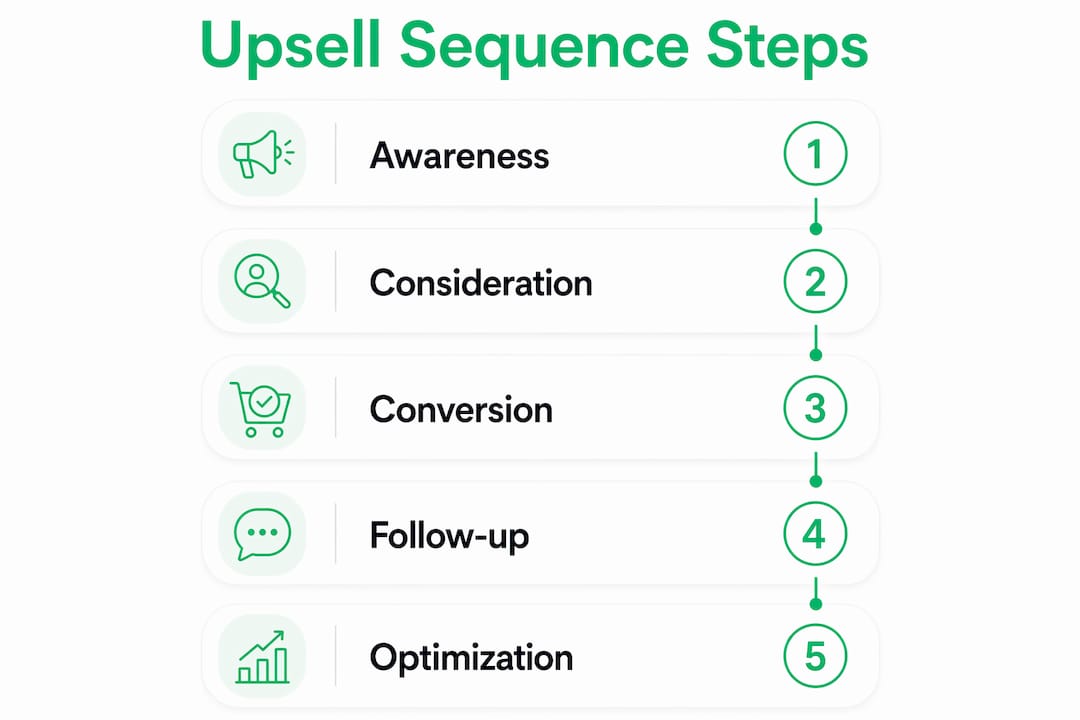
Timing and order matter as much as message content. A well-built sequence follows the customer’s emotional journey from purchase excitement through delivery satisfaction and into repeat buying.
-
Immediate order confirmation soon after purchase. Confirm the order, thank the customer by name, and include a single relevant add-on. Keep it brief. The customer is still in buying mode, so a well-placed upgrade offer here converts better than at any other point.
-
Pre-delivery upsell shortly after purchase. While the customer waits for shipping confirmation, send a short message presenting a complementary product or a premium upgrade. Frame it as “make the most of your order” rather than a separate sale.
-
Shipping update with cross-sell (at dispatch). Notify the customer their order is on the way, then attach a cross-sell suggestion tied to what they bought. A customer who ordered a coffee maker is a natural target for a bag of specialty beans.
-
Delivery confirmation with feedback request (at delivery). Confirm arrival and ask a simple question about their experience. This opens a two-way conversation and creates a natural entry point for a follow-up offer.
-
Post-delivery upsell some time after delivery. Once the customer has had time to use the product, send a targeted upsell based on their purchase. Replenishment reminders, accessories, and premium service packages all perform well here.
-
Loyalty offer after some days post-purchase. Reward customers who engaged with earlier messages with an exclusive discount or early access to a new product. This step builds retention, not just revenue.
-
Replenishment reminder (product-cycle dependent). For consumables, schedule a reminder when the customer is likely running low. Pair it with a bundle offer or a larger size to increase order value.
Delivering proposals in small, structured messages rather than long blocks improves clarity and keeps customers reading. One idea per message, one call to action per message.
Pro Tip: Cap promotional messages at 2–3 per week per customer. Watch your opt-out rate closely. If it rises after a specific message in the sequence, that is your signal to adjust timing or content, not to send more.
Segmentation and personalization that actually move conversion rates
Generic upsell messages underperform. Personalized WhatsApp messages referencing a customer’s name and purchase history are significantly more likely to be opened and engaged with. That gap is too large to ignore.
Effective segmentation starts with four data layers:
- Purchase history: what the customer bought, how often, and at what price point
- Browsing behavior: products viewed but not purchased, categories explored
- Demographics: location, age bracket, and device type where available
- Engagement level: whether the customer replies, clicks, or only reads
AI-driven dynamic content takes this further. Instead of manually building segments, you feed behavioral triggers into your automation platform and let it select the right message template for each customer. A customer who bought a standard plan and viewed the premium plan page gets a different upsell than one who bought the premium plan and browsed accessories.
Pro Tip: Start with two or three segments before building out a complex matrix. Over-segmentation creates maintenance overhead and often produces marginal gains. Nail the high-purchase-frequency segment first, then expand.
The two-way nature of WhatsApp creates a retail-like, consultative experience that broadcast channels cannot replicate. When a customer replies to an upsell message with a question, that is a live sales conversation. Train your team or configure your chatbot to handle the three most common objections: price, relevance, and timing.
Integration and automation best practices for WhatsApp upsell flows
Automation without CRM integration loses customer context and breaks sales continuity. When WhatsApp conversations happen outside your CRM, the data disappears. The next agent starts from scratch, the customer repeats themselves, and conversion rates drop. Logging every WhatsApp interaction as a CRM event solves this directly.
Whatsable handles the automation layer. It sends unlimited branded messages, manages follow-up sequences, and connects to Zapier, Make, n8n, and Pipedrive without custom code. You can connect WhatsApp to Pipedrive in minutes and trigger upsell messages automatically when a deal moves to a specific stage. Whatsable Bot handles internal notifications and team alerts, keeping your sales team informed when a customer responds to an upsell offer.
Key integration steps for a working upsell automation:
- Set behavioral triggers in your CRM: purchase completed, cart abandoned, delivery confirmed, support ticket closed
- Map each trigger to a message template in your WhatsApp automation platform
- Log all replies back to the CRM contact record so any agent can pick up the conversation with full context
- Connect your e-commerce platform (Shopify, WooCommerce, or similar) to sync order data and fire the right sequence at the right time
- Build opt-out handling into every workflow so customers who reply “STOP” are immediately removed from future sequences
Compliance is non-negotiable. Explicit customer opt-in is required for WhatsApp marketing under GDPR, and providing a clear opt-out path protects your Quality Rating with Meta. A high block rate can suspend your number. Collect opt-ins at checkout, in post-purchase emails, or via Click-to-WhatsApp ads, and document your consent records.
For teams already running multi-channel funnels, WhatsApp slots in as the high-engagement layer that email cannot fill. Use email for long-form nurture and quarterly newsletters. Use WhatsApp to trigger action at the moments that matter.
Measuring and optimizing your WhatsApp upsell sequences
Tracking the right metrics tells you exactly where a sequence is winning and where it leaks. Regular A/B testing of message content and timing produces continuous performance improvement, but only if you know which numbers to watch.
| KPI | What it tells you | Optimization lever |
|---|---|---|
| Message open rate | Whether your send time and sender name are working | Test different send windows (morning vs. evening) |
| Click-through rate | Whether your offer and CTA are compelling | A/B test message copy and product images |
| Conversion rate | Whether the full sequence drives purchases | Review the step where drop-off occurs |
| Average Order Value (AOV) | Whether upsells are increasing basket size | Adjust offer price point or bundle composition |
| Opt-out rate | Whether frequency or relevance is off | Reduce message volume or tighten segmentation |
A/B testing on WhatsApp works best when you change one variable at a time: the opening line, the product image, the offer amount, or the send timing. Running two variables simultaneously makes it impossible to know which change drove the result.
Customer replies are data too. When someone responds to an upsell message with a question or objection, log it. Patterns in those replies reveal gaps in your messaging, pricing objections you have not addressed, and product pairings that customers find confusing. Feed those insights back into your templates.
Strong calls to action inside your messages directly affect click-through rates. Effective CTAs are specific (“Get 20% off your next order”), not generic (“Click here”). One CTA per message, placed at the end after the value proposition is clear.
What successful WhatsApp upsell campaigns look like in practice
The most effective WhatsApp upsell campaigns share a few structural traits: they trigger off real customer behavior, they offer something genuinely relevant, and they keep the message short.
A beauty brand running a replenishment sequence sends a single message 28 days after a customer purchases a moisturizer. The message references the specific product by name, notes that most customers reorder around this time, and offers a bundle with a complementary serum at a slight discount. No long copy. No multiple offers. The conversion rate on that single message outperforms a full email campaign because the timing is right and the offer matches exactly what the customer needs next.
An electronics retailer uses a post-delivery cross-sell sequence triggered when the carrier marks an order as delivered. The first message confirms delivery and asks a one-question satisfaction check. If the customer replies positively, the next automated message suggests a compatible accessory with a product image and a direct purchase link. The two-step approach, confirmation then offer, feels consultative rather than pushy.
Abandoned cart sequences work the same way. Rather than a plain reminder, the message acknowledges the specific item left in the cart and adds a cross-sell suggestion that pairs naturally with it. The WhatsApp Business platform supports product catalogs and rich media directly in the chat, so the customer can browse and buy without leaving the conversation.
How to handle customer responses and sell conversationally on WhatsApp
The moment a customer replies to an automated upsell message, the sequence becomes a live conversation. How you handle that reply determines whether the sale closes or the customer disengages.
Speed is the first rule. Configure your platform to alert a sales agent the instant a deal-stage contact responds. A reply left sitting for hours loses the momentum the automated sequence built. If you are running a fully automated flow, your chatbot needs to handle the three most common response types: a question about the product, a price objection, and a request to opt out.
For product questions, the chatbot should deliver a concise answer and then re-present the offer. Break the response into short messages rather than one long block. Ask one clarifying question at a time. The structured messaging approach used in B2B sales translates directly here: problem summary, solution, next step, each as a separate message.
Price objections are best handled with value framing rather than discounts. Remind the customer what they already paid for, explain what the upsell adds, and let the math speak. If a discount is warranted, offer it once and make it time-limited.
When a customer asks to stop receiving messages, honor it immediately and confirm the opt-out in the same conversation. That confirmation builds trust and leaves the door open for future opt-ins. Customers who feel respected are more likely to re-engage than those who feel ignored.
Whatsable makes WhatsApp upsell automation straightforward
Running a post-purchase upsell sequence manually across hundreds of customers is not realistic. Whatsable gives sales and marketing teams the infrastructure to automate every step of the process without losing the personal feel that makes WhatsApp effective.
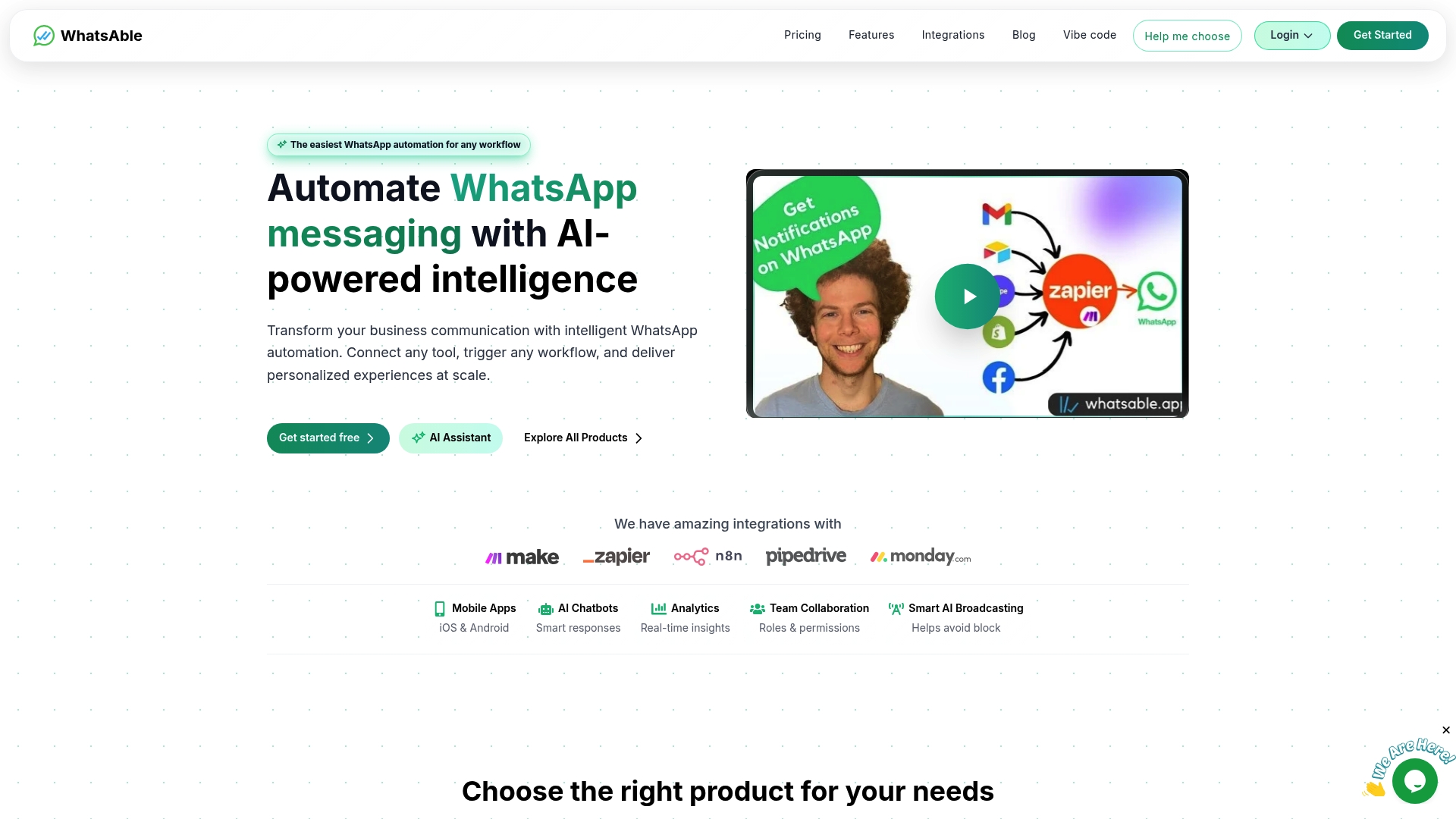
Whatsable handles unlimited branded message sends, automated follow-up sequences, and deep integrations with Zapier, Make, n8n, and Pipedrive. You build the sequence once, set your behavioral triggers, and the platform handles timing, delivery, and reply logging. Whatsable Bot keeps your internal team in sync, alerting agents when a customer responds so no conversation goes cold. Both products are built for teams that need volume and reliability without a complex technical setup.
Whatsable suits marketing agencies, e-commerce brands, and sales teams that want to move beyond broadcast email and into the kind of conversational selling that actually drives repeat revenue. Check the pricing plans to find the tier that fits your send volume and team size, and get your first automated upsell sequence running today.
Key Takeaways
WhatsApp drives post-purchase upsell revenue because its open rates, conversational format, and automation capabilities combine in a way no other channel currently matches.
| Point | Details |
|---|---|
| Open rate advantage | WhatsApp messages open at 80–95%, versus email’s 20–30%, giving upsell offers near-certain visibility. |
| AOV impact | D2C brands using WhatsApp upselling report notable increases in Average Order Value (AOV). |
| Personalization multiplier | Messages referencing customer names and purchase history are 2.5x more likely to be opened and engaged with. |
| Compliance requirement | Explicit opt-in is mandatory under GDPR; easy opt-out protects your Meta Quality Rating and sender reputation. |
| Whatsable for automation | Whatsable automates full upsell sequences with Zapier, Make, Pipedrive, and n8n integrations. |
FAQ
What is the 24-hour rule on WhatsApp for business messaging?
Businesses using the WhatsApp Business API can only send free-form messages within a limited window after the customer’s last message; outside that window, pre-approved message templates must be used.
What are the four stages of upselling on WhatsApp?
A standard WhatsApp upsell flow moves through awareness (the initial offer), consideration (answering questions or objections), decision (the purchase prompt), and retention (the follow-up loyalty offer). Each stage maps to a specific message type in the sequence.
What makes WhatsApp marketing effective for upsells?
WhatsApp combines high open rates, two-way conversation, and rich media support in a single channel. Customers who opt in are already engaged, and the personal format reduces the resistance that broadcast advertising creates.
How does Whatsable help automate WhatsApp upsell sequences?
Whatsable sends unlimited branded messages, automates follow-up sequences triggered by customer behavior, and integrates with tools like Zapier, Pipedrive, and Make to keep your CRM in sync with every conversation.
How often should you send upsell messages on WhatsApp?
Limit promotional messages to 2–3 per customer per week unless a strong behavioral trigger justifies more. Monitor opt-out rates after each message in the sequence; a spike signals that frequency or relevance needs adjustment.
 Elias Navarro