 Whatsable







TL;DR:
- WhatsApp has an average open rate of about 98%, vastly outperforming email’s typical 20%. Its personal, habit-driven environment and rich media support lead to higher engagement and faster responses, especially in WhatsApp-dominant markets. Using automation and proper opt-in management through platforms like Whatsable helps sustain these high open rates over time.
WhatsApp vs email open rates: the numbers that change your strategy
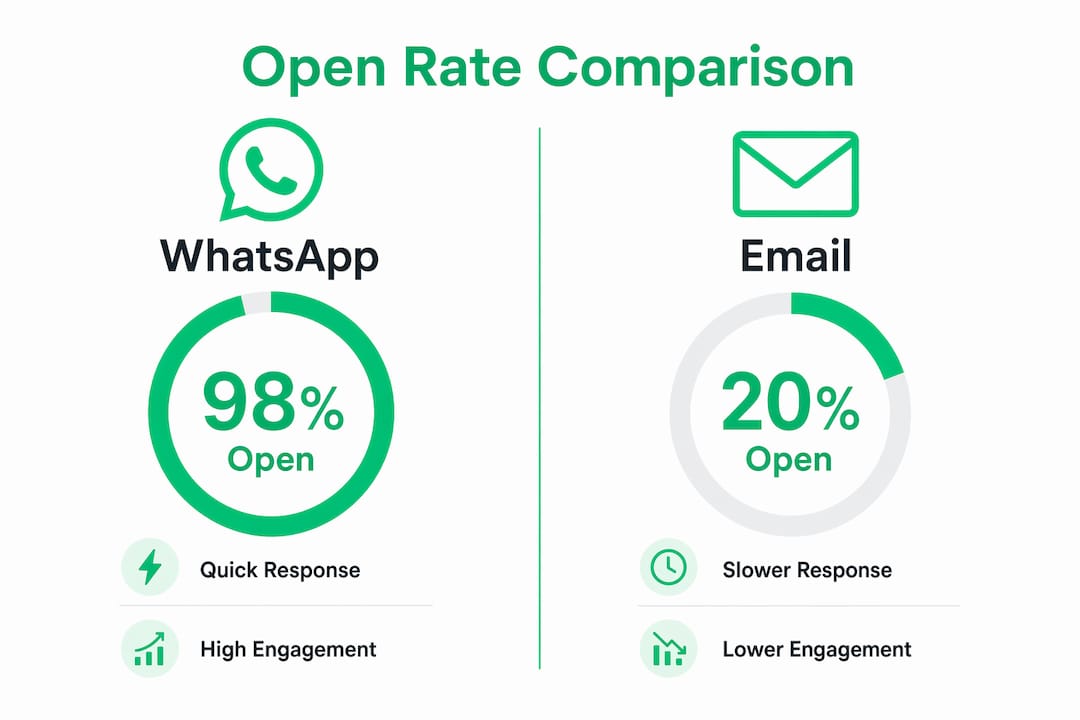
WhatsApp averages an open rate of about 98%, while email typically sits near 20%. That gap is not a rounding error. It means that for every 100 marketing messages you send, WhatsApp delivers roughly 98 reads versus 20 for email. If you are still treating email as your primary engagement channel, you are leaving the majority of your audience unreached.
WhatsApp’s average open rate of about 98% is significantly higher than email’s typical 20%, making it one of the most direct lines to your customers in digital marketing today.
The click-through rate gap is similarly large. WhatsApp marketing messages achieve click-through rates between 45% and 60%, which far exceed email CTRs of 2–3%. Response times follow the same pattern: WhatsApp messages are usually read within minutes, while email responses can take hours or days.
The core problem with email is structural. Inbox algorithms increasingly filter promotional emails into spam or promotions tabs, cutting visibility before a human even decides whether to open the message. Add to that the sheer volume of email traffic globally, and your carefully crafted campaign is competing with hundreds of other messages for a few seconds of attention.
Key differences at a glance:
- WhatsApp open rate much higher than email open rate
- WhatsApp CTR much higher than email CTR
- WhatsApp response time: typically minutes vs email: hours to days
- Email promotional filtering reduces visibility before any human decision is made
- WhatsApp messages arrive in a personal, conversation-style inbox with no algorithmic gating
Table of Contents
- Why users open WhatsApp messages but ignore email
- How WhatsApp compares to SMS, email, and push notifications
- What actually drives WhatsApp open rates up or down
- Common mistakes that kill WhatsApp open rates
- How to improve WhatsApp open rates and keep them high
- How Whatsable helps you capitalize on WhatsApp’s open rate advantage
- Whatsable puts WhatsApp’s open rate advantage to work for your business
- Key Takeaways
- FAQ
Why users open WhatsApp messages but ignore email
The behavioral gap between WhatsApp and email runs deeper than notification settings. Users check WhatsApp multiple times per hour as part of their daily personal communication routine. Email, by contrast, is checked on a schedule, often reactively, and frequently skimmed rather than read.
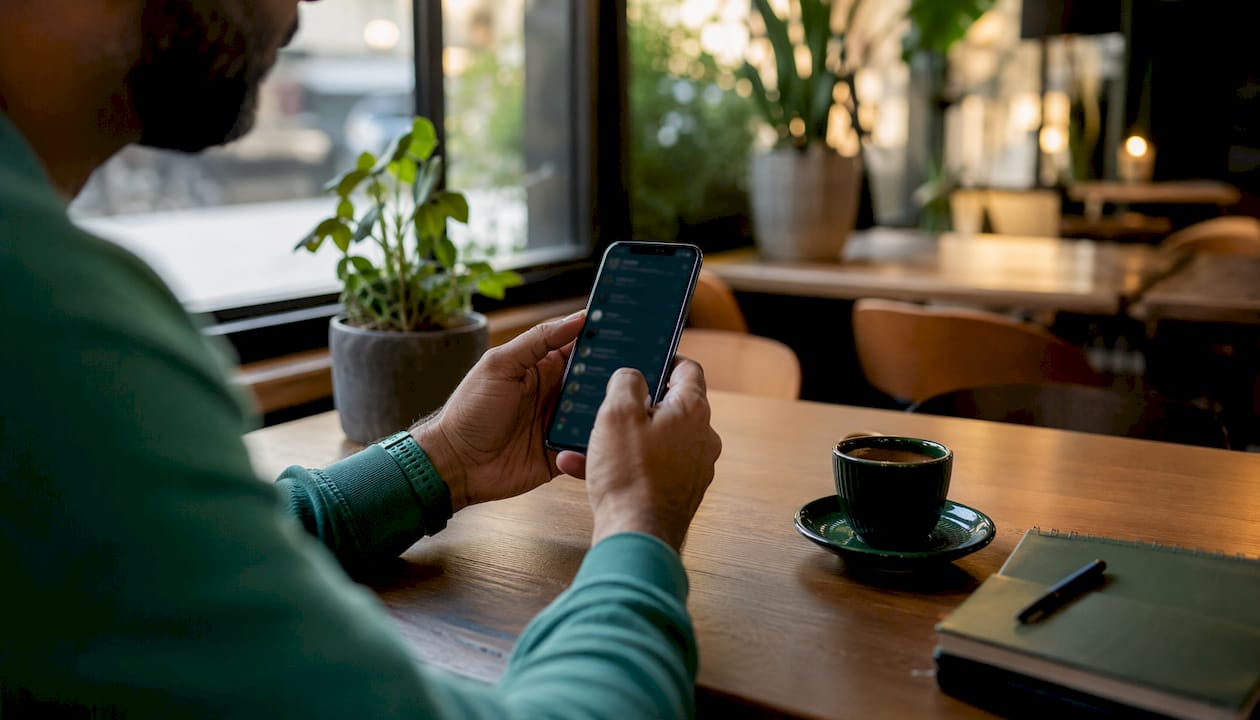
WhatsApp lives in the same mental space as texting a friend. When a message arrives, the psychological default is to open it. Email occupies a different mental category entirely: work, obligations, newsletters, and promotions all compete in the same inbox, which trains users to be selective and skeptical.
Several behavioral and psychological factors explain why WhatsApp is more effective:
- Habit-driven engagement: WhatsApp is an active channel. People open it constantly throughout the day, not just when they sit down to “check messages.”
- Personal context: Messages arrive in a conversational thread, not a broadcast inbox. That framing creates a sense of direct communication rather than mass marketing.
- Trust and familiarity: Users associate WhatsApp with people they know. A brand message that lands there carries more implicit trust than one buried in a promotions tab.
- Notification immediacy: WhatsApp push notifications are treated with the same urgency as personal texts. Email notifications, when they exist at all, are routinely snoozed or ignored.
- Low noise environment: WhatsApp inboxes are not cluttered with newsletters, automated receipts, and cold outreach the way email inboxes are. Your message stands out.
- Privacy perception: End-to-end encryption gives users a sense that WhatsApp is a protected, personal space. That perception increases tolerance for brand messages when users have opted in.
The opt-in effect matters here. A user who gives a brand their WhatsApp number has made a more deliberate choice than someone who handed over an email address at checkout. That intentionality translates directly into higher engagement.
The email follow-up model that worked in 2016 relied on inboxes that were less crowded and algorithms that were less aggressive. Neither condition holds today.
How WhatsApp compares to SMS, email, and push notifications
WhatsApp does not just beat email. It leads across nearly every major engagement metric when compared to the full range of digital marketing channels.

| Channel | Average open rate | Typical CTR | Response time | Rich media support |
|---|---|---|---|---|
| ~98% | 45–60% | Minutes | Yes (images, video, PDFs, buttons) | |
| SMS | ~90% | 6–8% | Minutes | Limited |
| ~20% | 2–3% | Hours to days | Yes (HTML) | |
| Push notifications | Varies widely | 2–4% | Seconds to minutes | Limited |
Both SMS and WhatsApp carry high open rates, but the click-through and conversion story diverges sharply. SMS is text-only in most cases, which limits how much you can communicate in a single message. WhatsApp supports images, videos, PDFs, location sharing, interactive list messages, and call-to-action buttons, giving marketers far more room to drive action within a single conversation.
Push notifications have the fastest delivery but the lowest sustained engagement. Users frequently disable them or develop banner blindness after repeated exposure. The open rate varies so widely by app, industry, and device that a single benchmark is nearly meaningless.
A few regional factors are worth noting:
- WhatsApp dominates in Latin America, India, and Southeast Asia, where it functions as the primary communication method for most of the population.
- In North America, SMS still holds an edge for transactional and high-reliability notifications, though WhatsApp adoption is growing.
- For B2C communication in markets where WhatsApp is the default messaging app, no other channel comes close for engagement depth.
The practical conclusion: if your audience is in a WhatsApp-dominant market, SMS is a backup channel, not a primary one. If you are in North America, a combined strategy that uses SMS for critical transactional messages and WhatsApp for richer engagement conversations tends to outperform either channel alone.
What actually drives WhatsApp open rates up or down
A 98% average open rate is the ceiling, not the floor. Marketers who treat WhatsApp as a set-and-forget broadcast channel will see that number erode quickly. Personalization, segmentation, and timing are the primary levers that determine whether your campaigns stay near the top of that range or slide toward the bottom.
Message personalization and segmentation
Generic broadcast messages feel out of place in a personal messaging app. Users who receive a message that clearly was not written for them specifically are more likely to mute the sender than engage. Segmenting by purchase history, location, or behavior stage and adjusting the message accordingly keeps open rates high and block rates low.
Timing and frequency
Sending at the right moment matters more on WhatsApp than on email, precisely because WhatsApp messages feel immediate. A message sent at 11 PM local time will be read, but it may also irritate the recipient. Mid-morning and early evening tend to perform best for most consumer segments, though testing against your specific audience is the only way to confirm.
Frequency is equally critical. WhatsApp’s personal context means users have a lower tolerance for over-messaging than they do with email. Two to four messages per week is a reasonable ceiling for most marketing use cases, though the right number depends entirely on the value you are delivering.
Trust and privacy concerns
Users who feel their WhatsApp number was obtained without clear consent will block or report the sender. That is not just a lost contact. Enough reports can get a business account flagged or suspended by WhatsApp. Maintaining explicit opt-in records is not optional.
Demographics and user segmentation
Younger demographics (18–34) tend to engage with WhatsApp marketing at higher rates, partly because WhatsApp is their primary communication channel. Older demographics engage too, but often prefer less frequent, more transactional messages. WhatsApp’s advantages in emerging market sales are particularly pronounced among mobile-first audiences who rarely use desktop email at all.
Pro Tip: Treat WhatsApp like a conversation, not a campaign. If a message would feel intrusive coming from a friend, it will feel intrusive coming from a brand. Write in a tone that matches the platform’s casual, direct register, and always give users an easy way to opt out.
Common mistakes that kill WhatsApp open rates
Most WhatsApp marketing failures come down to a handful of repeatable errors. Knowing them in advance is cheaper than learning them through a declining open rate.
- Over-messaging: Sending too frequently is the fastest way to earn a mute or a block. Unlike email, where users can simply ignore a message, WhatsApp users actively manage their notification load. Exceeding their tolerance threshold has immediate consequences.
- Skipping opt-in requirements: WhatsApp’s Business Policy requires explicit user consent before sending marketing messages. Buying contact lists and blasting them on WhatsApp is not just ineffective. It violates platform rules and risks account suspension. Ignoring opt-in rules is one of the most common reasons campaigns underperform or get shut down entirely.
- Generic, impersonal messaging: “Dear Customer, check out our latest offers” reads as spam in any channel. On WhatsApp, it reads as a violation of the personal space users associate with the platform. Personalization is not a nice extra here. It is the baseline expectation.
- Ignoring timing and targeting: Sending a promotional message at 2 AM or to a segment that has already converted on the offer wastes the contact and erodes trust. Poor targeting is often invisible in aggregate open rate data until it has already done damage.
- Violating WhatsApp platform guidelines: WhatsApp has specific rules about message templates, approved content categories, and the 24-hour conversation window. Sending template messages outside approved categories or attempting to re-engage users outside the conversation window without a pre-approved template will result in message failures and potential account restrictions.
- No clear call to action: A WhatsApp message that informs but does not direct the user toward a next step misses the channel’s conversion potential. Every marketing message should have one clear action: reply, click, confirm, or redeem.
How to improve WhatsApp open rates and keep them high
Improving WhatsApp open rates is less about tactics and more about building a system that respects the channel’s conversational nature while delivering consistent value. Automation, scarcity tactics, and timely follow-ups are the three levers that consistently move the needle.
-
Build automated follow-up workflows. Set up triggered messages based on user behavior: abandoned cart reminders, post-purchase check-ins, and re-engagement sequences. Automation keeps your timing precise without requiring manual effort at scale. Tools like Zapier, Make, or n8n can connect your CRM or e-commerce platform to your WhatsApp messaging system.
-
Use scarcity and exclusivity to drive urgency. “This offer expires in 24 hours” or “You have been selected for early access” outperform generic promotional messages because they give the user a reason to act now rather than later. VIP access framing works particularly well on WhatsApp because the channel already feels personal.
-
Personalize beyond the first name. Reference the user’s last purchase, their location, or a specific action they took. A message that says “You left these items in your cart” with the actual product names converts at a significantly higher rate than a generic cart abandonment reminder.
-
Time messages around user activity. Sending a follow-up within 30–60 minutes of an abandoned cart or a completed purchase captures users while the context is still fresh. The WhatsApp 24-hour rule means you can send unlimited messages within a 24-hour conversation window after a user interaction, which is a significant advantage for timely follow-up sequences.
-
Segment before you send. Divide your audience by purchase stage, engagement history, and demographic profile. A first-time visitor needs a different message than a repeat buyer. Sending the same message to both wastes the contact and trains users to ignore you.
-
Test message formats. WhatsApp supports text, images, videos, PDFs, and interactive buttons. A product image with a single CTA button often outperforms a text-only message for e-commerce. Test formats systematically rather than defaulting to text.
-
Monitor and act on read receipts. WhatsApp’s read receipts tell you exactly who opened your message and when. Use that data to identify segments with declining engagement and adjust frequency or content before open rates drop.
Pro Tip: The fastest way to destroy a high open rate is to keep sending after a user stops engaging. Build an automatic suppression rule: if a contact has not opened three consecutive messages, reduce frequency or move them to a re-engagement sequence before continuing regular sends.
How Whatsable helps you capitalize on WhatsApp’s open rate advantage
Understanding why WhatsApp outperforms email is one thing. Building the infrastructure to act on it at scale is another. Whatsable is built specifically for that second part.
The platform’s Whatsable gives businesses the ability to send unlimited branded WhatsApp messages, automate follow-up sequences, and connect with tools like Zapier, Make, n8n, and Pipedrive. That means your CRM triggers, e-commerce events, and internal workflows can all feed directly into WhatsApp campaigns without manual intervention.
Key capabilities that directly support higher open rates:
- AI-powered chatbots that handle inbound responses and keep conversations active within the 24-hour window, maximizing the engagement value of every user interaction.
- Bulk messaging with anti-block measures, so high-volume campaigns do not trigger WhatsApp’s spam detection and get your account restricted.
- Detailed analytics that surface open rates, click-throughs, and response patterns at the campaign and segment level, giving you the data to optimize timing and content.
- Team management tools that let multiple agents handle inbound conversations without losing context or duplicating responses.
- Onboarding support and human customer service, which matters when you are setting up automation sequences for the first time and need guidance on WhatsApp’s platform rules.
Pro Tip: Whatsable Bot is particularly useful for internal use cases: HR announcements, policy updates, and team alerts that currently go out by email and get ignored. Shifting those to WhatsApp through an automated bot can dramatically improve read rates for internal communications as well.
For WhatsApp automation in 2026, the combination of bulk messaging, AI chatbots, and deep integrations is what separates a scalable WhatsApp marketing operation from a manual one.
Whatsable puts WhatsApp’s open rate advantage to work for your business
Most marketers already know email open rates are declining. The harder part is building a WhatsApp operation that captures the 98% open rate potential without burning through your contact list or violating platform rules.
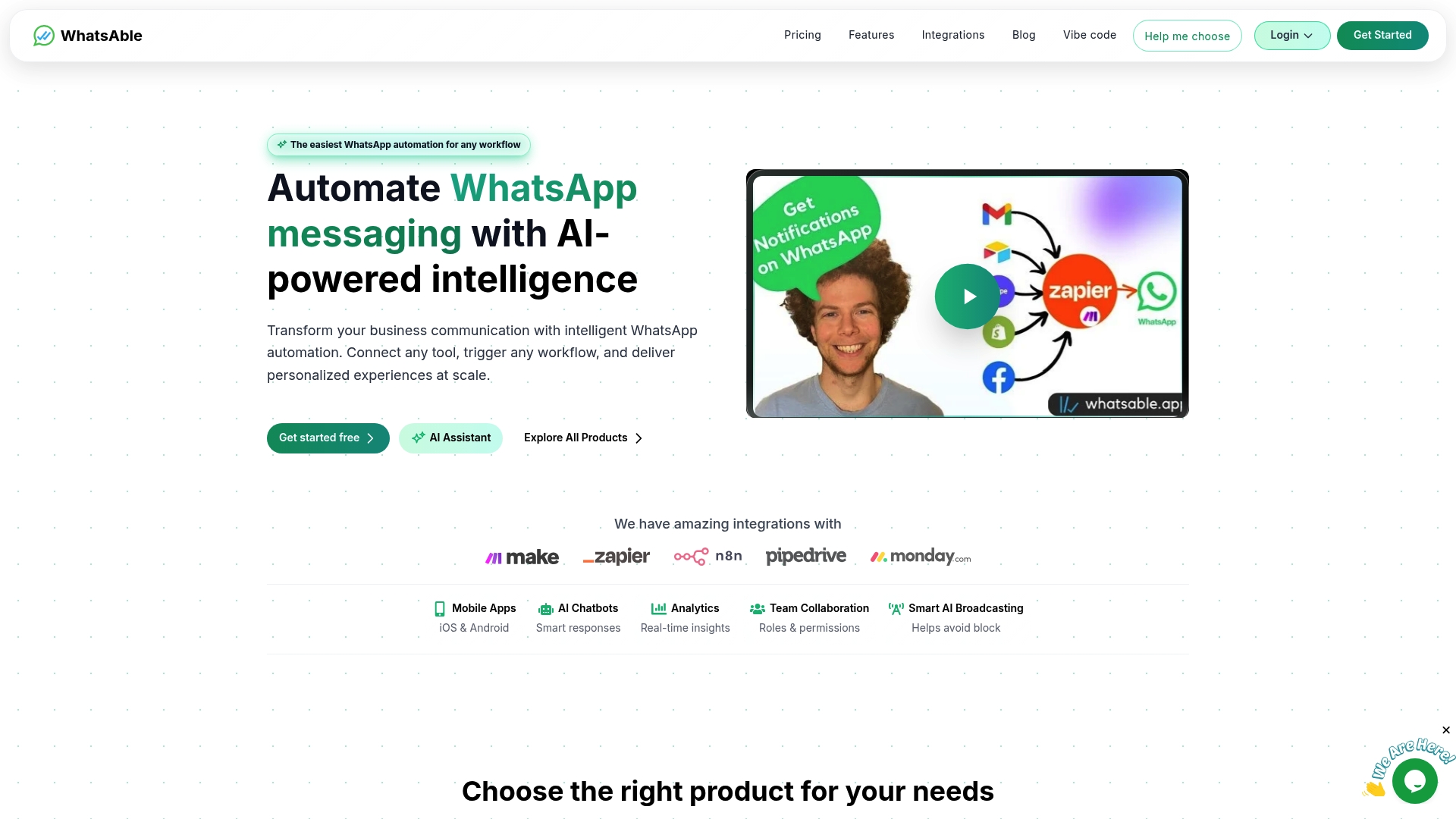
Whatsable gives you the infrastructure to do exactly that. Whatsable handles unlimited branded messaging, automated sequences, and integrations with the tools your team already uses. You are not starting from scratch; you are connecting WhatsApp to the workflows you have already built. For teams that need internal notification automation, Whatsable Bot sets up in minutes and routes alerts directly to the right people without the email noise.
The difference between a WhatsApp campaign that holds a 98% open rate over time and one that degrades to 40% within a month usually comes down to one thing: whether the system respects the channel’s conversational rules. Whatsable is built around those rules, with anti-block measures, opt-in management, and analytics that flag engagement drops before they become account-level problems.
See what your campaigns could look like with the right infrastructure. Check Whatsable’s pricing and find the plan that fits your send volume and team size.
Key Takeaways
WhatsApp outperforms email because it is an active, personal channel users engage with constantly, while email faces algorithmic filtering and passive checking habits that suppress visibility and response rates.
| Point | Details |
|---|---|
| Open rate gap | WhatsApp averages an open rate of about 98%, compared to email’s typical 20%. |
| CTR advantage | WhatsApp CTRs are 45–60%, far higher than email’s 2–3%. |
| Behavioral driver | Users check WhatsApp habitually throughout the day; email is checked reactively and selectively. |
| Top optimization levers | Personalization, precise timing, and automated follow-ups are the primary factors sustaining high WhatsApp open rates. |
| Whatsable’s role | Whatsable automates WhatsApp campaigns with anti-block measures and deep CRM integrations. |
FAQ
What is the open rate of WhatsApp vs email?
WhatsApp averages an open rate of about 98%, while email typically achieves around 20%. That gap reflects the difference between an active, personal messaging channel and a filtered, high-volume inbox.
Why does WhatsApp outperform email for marketing?
WhatsApp messages arrive in a personal, conversational inbox that users check multiple times per hour, while promotional emails are routinely filtered into spam or promotions tabs before a human ever sees them. The combination of habit-driven usage, trust, and no algorithmic gating gives WhatsApp a structural engagement advantage.
Is 35% a good email open rate?
Yes, an email open rate above 20% is above average for email marketing, indicating strong list quality and relevant subject lines. That said, even an email open rate around 20% still trails WhatsApp’s 98% by a wide margin.
What is the 24-hour rule on WhatsApp?
The WhatsApp 24-hour rule defines a conversation window: once a user sends a message or interacts with your business, you can send unlimited messages within the following 24 hours. After that window closes, you must use a pre-approved message template to re-initiate contact.
How can Whatsable help improve WhatsApp open rates?
Whatsable automates follow-up sequences, manages opt-ins, and integrates with CRM tools like Pipedrive and Zapier, helping businesses maintain high open rates by sending the right message to the right segment at the right time.
 Priya Deshmukh
 Elias Navarro